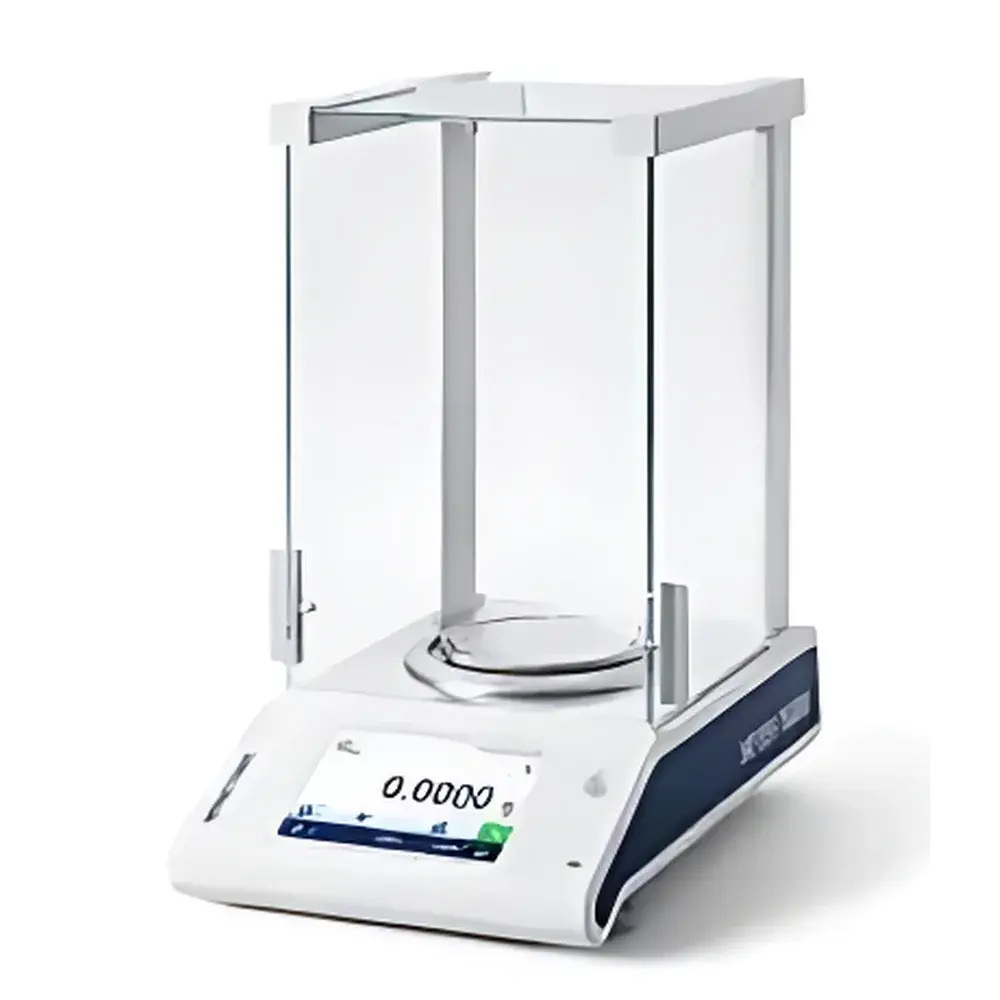
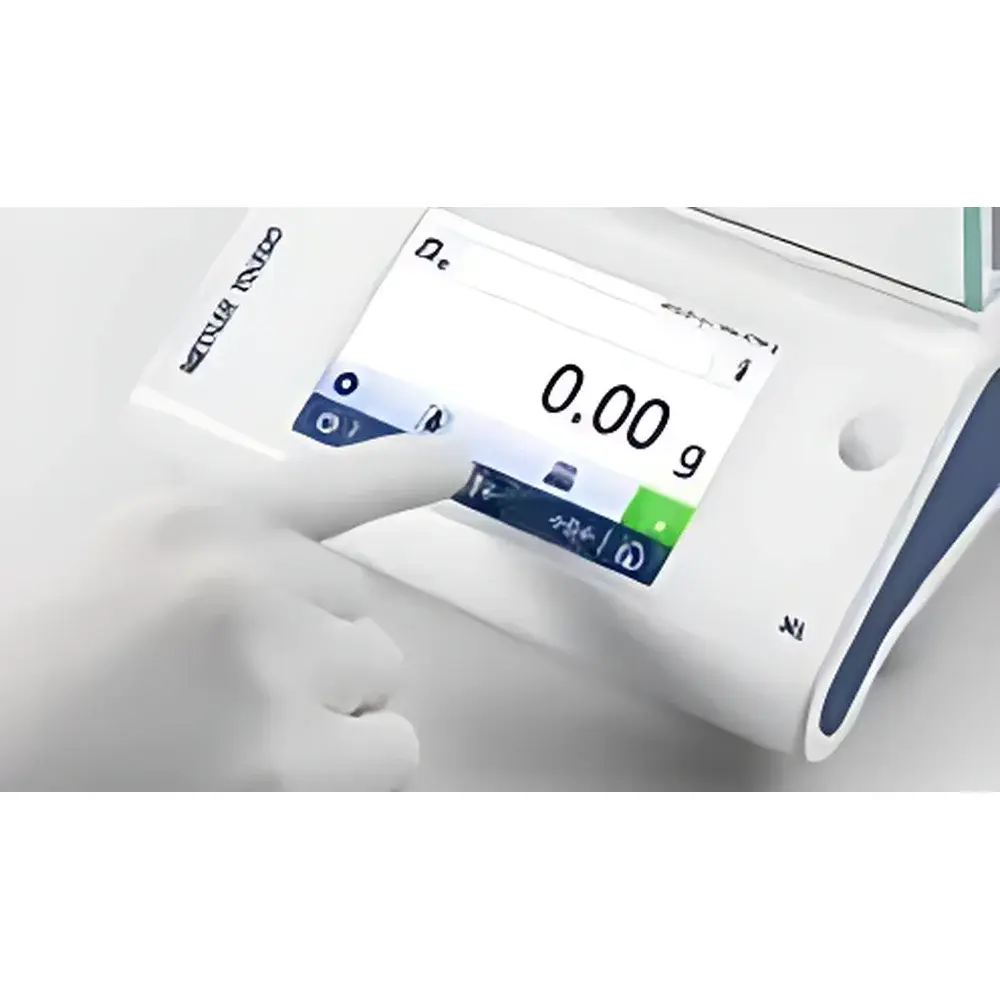
METTLER TOLEDO ML304T/02 Analytical Balance
| Brand | METTLER TOLEDO |
|---|---|
| Origin | Austria |
| Model | ML304T/02 |
| Maximum Capacity | 320 g |
| Readability | 0.1 mg |
| Repeatability | 0.1 mg |
| Minimum Weight (USP) | 160 mg |
| Stabilization Time | 2 s |
| Pan Diameter | 90 mm |
| Calibration | Internal / FACT |
| Construction | Die-cast aluminum housing with ABS components |
| Interfaces | USB Host, USB Device, RS232, Optional Bluetooth |
| Weighing Unit | MonoBloc® High-Resolution Electromagnetic Force Compensation Sensor |
Overview
The METTLER TOLEDO ML304T/02 Analytical Balance is a high-precision laboratory instrument engineered for routine analytical weighing tasks requiring reproducible results at the 0.1 mg readability level. Built upon METTLER TOLEDO’s proprietary MonoBloc® weighing cell—a monolithic electromagnetic force compensation sensor—this balance delivers exceptional long-term stability and resistance to environmental disturbances such as temperature fluctuations and mechanical vibration. Its core operating principle relies on electromagnetic force restoration, where the displacement of the load pan is counterbalanced by a precisely regulated current through a coil within a permanent magnetic field; the resulting current is linearly proportional to mass and digitally converted into a stable weight reading. Designed for GLP- and GMP-compliant environments, the ML304T/02 integrates traceable calibration, audit-ready logging, and user-access control to support regulatory adherence in pharmaceutical, chemical, and academic laboratories.
Key Features
- MonoBloc® weighing sensor ensures high reproducibility and minimal drift over time, eliminating the need for frequent recalibration under stable ambient conditions.
- FACT (Fully Automatic Calibration Technology) enables temperature-triggered internal adjustment—no manual intervention required—maintaining accuracy across typical lab temperature ranges (10–30 °C).
- LevelControl™ provides real-time visual guidance on the 4.5-inch full-color touchscreen to assist rapid and precise leveling—critical for measurement integrity at sub-milligram resolution.
- QuickLock™ draft shield system allows tool-free disassembly of all transparent acrylic components in under 10 seconds, facilitating rapid cleaning and minimizing downtime between weighings.
- MinWeigh™ function enforces USP minimum weight compliance: net sample mass below the user-defined threshold (default 160 mg) triggers persistent red display, preventing out-of-specification measurements.
- Dual USB ports (Host and Device), RS232 serial interface, and optional Bluetooth module enable seamless integration with LIMS, ELN, or standalone PCs without third-party drivers—PC Direct mode supports direct ASCII data streaming.
- Die-cast aluminum chassis with reinforced ABS top housing delivers mechanical robustness while maintaining compact footprint (210 × 330 × 335 mm D×W×H) and low center of gravity for vibration resistance.
Sample Compatibility & Compliance
The ML304T/02 accommodates standard weighing vessels—including glass beakers, aluminum pans, and stainless-steel crucibles—within its 90 mm diameter stainless-steel pan. Its draft shield design complies with ISO 9001 and ISO/IEC 17025 requirements for environmental isolation during microgram-level operations. All calibration and adjustment events—including FACT activation, leveling verification, and MinWeigh threshold updates—are automatically recorded in the built-in ISO-compliant audit trail (ISO Logging), retaining timestamps, operator IDs (when password-protected user accounts are configured), and pre-/post-adjustment values. This functionality satisfies FDA 21 CFR Part 11 expectations for electronic record integrity when paired with appropriate access controls and backup protocols.
Software & Data Management
No external software is required for basic data export: PC Direct transmits weight readings as plain ASCII text via USB or RS232, compatible with Excel, LabArchives, and most LIMS platforms. For advanced workflow automation, the balance supports METTLER TOLEDO’s LabX® Lite (free download), enabling customizable SOP-driven weighing sequences, digital signature capture, and automatic report generation with embedded metadata (e.g., balance ID, calibration status, environmental logs). All stored logs adhere to ALCOA+ principles—Attributable, Legible, Contemporaneous, Original, Accurate, Complete, Consistent, Enduring, and Available—for inspection readiness.
Applications
This balance is routinely deployed in quality control labs for active pharmaceutical ingredient (API) assay, reference standard preparation, and dissolution testing per USP . It supports gravimetric analysis in environmental chemistry (e.g., filter weighing for PM2.5 quantification), catalyst loading in R&D synthesis, and formulation development where batch-to-batch consistency hinges on sub-milligram accuracy. Educational institutions utilize its intuitive interface and integrated tutorials (e.g., “How to Level,” “Calibration Checklist”) to train students in metrological best practices aligned with EURAMET cg-18 and NIST SP 1020 guidelines.
FAQ
What does FACT calibration entail, and how often is it triggered?
FACT initiates an internal recalibration whenever the balance detects a temperature change ≥1.5 °C from the last calibration point—ensuring continuous accuracy without user action.
Can the ML304T/02 meet USP repeatability requirements?
Yes: its 0.1 mg repeatability (tested with 100 g Class M1 calibration weight) satisfies USP thresholds for balances with readability ≤0.1 mg when used above the validated minimum weight (160 mg).
Is the ISO log exportable for external review?
Yes—logs are exportable via USB stick in CSV format, including event type, timestamp, operator ID (if enabled), and parameter values before/after adjustment.
Does the balance support multi-user authentication?
Yes—password-protected administrator and operator profiles restrict access to calibration, MinWeigh setup, and log deletion functions.
What environmental conditions are recommended for optimal performance?
Operate within 15–25 °C, <60% RH, on a vibration-isolated surface away from air currents, direct sunlight, and electromagnetic sources (e.g., centrifuges, RF transmitters).