
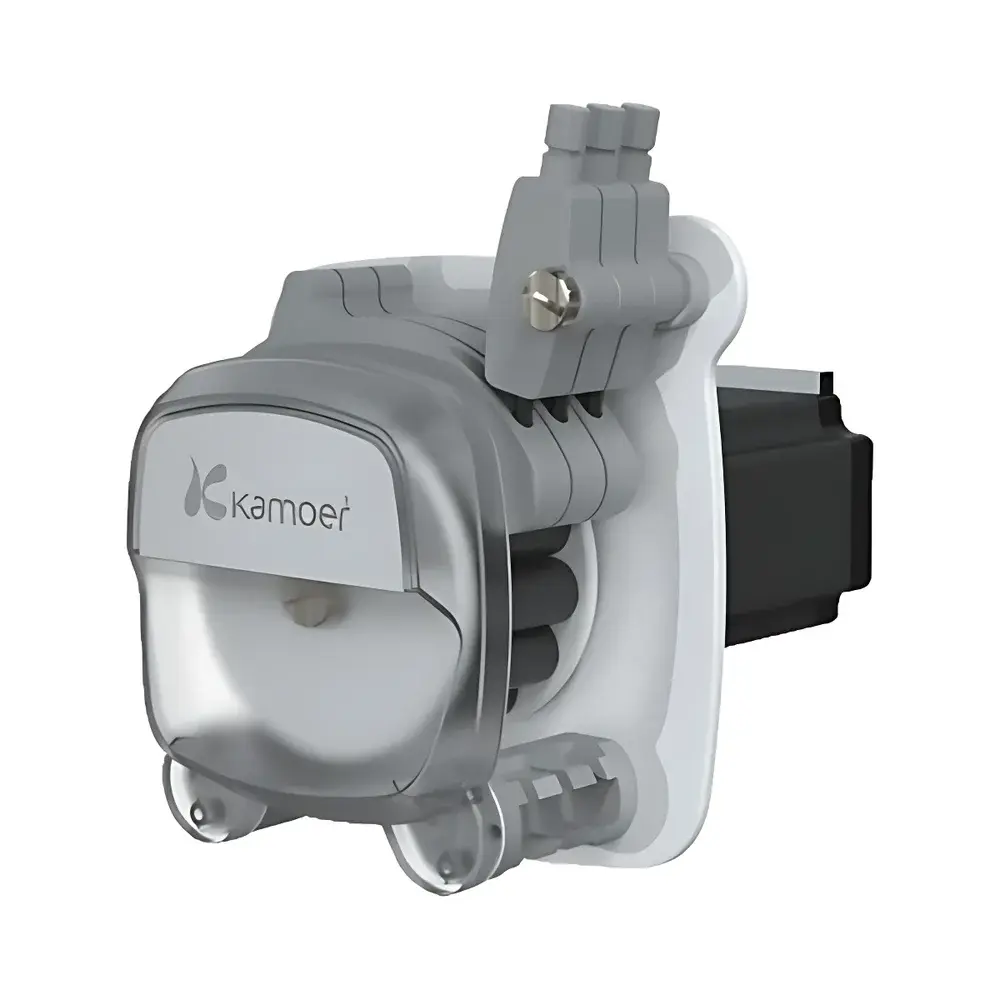
Kamoer KMC57 Multi-Channel Peristaltic Pump
| Brand | Kamoer |
|---|---|
| Origin | Shanghai, China |
| Manufacturer Type | Direct Manufacturer |
| Product Category | Domestic (China-Made) |
| Model | KMC57 |
| Instrument Type | Peristaltic Pump |
| Flow Rate Range | 0.01–29 mL/min per channel |
| Motor Type | 57-step Hybrid Stepper Motor |
| Channel Configuration | Configurable for 3- or 4-channel pump heads |
| Rotor Design | 12-roller low-pulsation rotor |
| Mounting | Front-panel flush-mount compatible |
| Tubing Compatibility | PVC, PU, and other chemically resistant elastomeric tubing (including microbore capillary tubing) |
| Application Domain | ICP-OES/ICP-MS sample introduction, analytical instrument fluid handling, microfluidic dispensing, clinical analyzer reagent delivery |
Overview
The Kamoer KMC57 is a precision-engineered multi-channel peristaltic pump designed for demanding laboratory and analytical instrumentation applications requiring accurate, pulse-minimized, and chemically inert fluid delivery. Based on the proven principle of peristaltic displacement—where rollers compress flexible tubing to generate positive displacement—the KMC57 utilizes a 57-step hybrid stepper motor coupled with a 12-roller rotor architecture to deliver high-resolution speed control and exceptionally low flow pulsation (<±1.5% peak-to-peak under calibrated conditions). Its modular design supports interchangeable 3-channel or 4-channel pump heads, enabling scalable fluid handling across parallel sample streams without cross-contamination. The pump is specifically optimized for integration into automated analytical platforms—including inductively coupled plasma optical emission spectrometry (ICP-OES) and mass spectrometry (ICP-MS) systems—where consistent nebulizer uptake, precise reagent metering, and long-term operational stability are critical to data reproducibility and method compliance.
Key Features
- High-resolution motion control via 57-step hybrid stepper motor ensures fine-grained speed adjustment (0.1 rpm increments) and repeatable flow output across the full range.
- 12-roller low-pulsation rotor geometry reduces flow ripple and minimizes pressure transients—critical for sensitive detection systems and stable plasma generation in ICP instruments.
- Modular pump head configuration: supports both 3-channel and 4-channel layouts with standardized mounting interfaces, facilitating rapid reconfiguration for varying throughput requirements.
- Dedicated front-panel flush-mount compatibility enables seamless OEM integration into analytical instrument chassis; integrated M4 threaded standoffs simplify mechanical anchoring and vibration isolation.
- Wide tubing compatibility: validated for standard ID/OD ranges from 0.5 mm to 3.2 mm, including microbore capillary tubing (e.g., 0.25 mm ID PTFE-lined PU), PVC, and silicone alternatives—ensuring chemical resistance across acidic, basic, and organic solvent environments.
- Motor and driver electronics are thermally managed to sustain continuous operation at rated torque, supporting unattended 24/7 duty cycles typical in QC/QA laboratories and regulated manufacturing environments.
Sample Compatibility & Compliance
The KMC57 is engineered for use with single-use, non-metallic fluid paths—eliminating risk of metal leaching or catalytic surface interactions that compromise trace-element analysis in ICP workflows. Tubing selection follows ISO 8536-4 (infusion sets) and ASTM D2240 (durometer) guidelines for elastomer consistency. While the pump itself does not carry CE, UL, or FDA device certification, its mechanical and electrical architecture conforms to IEC 61000-6-2 (EMC immunity) and IEC 61000-6-4 (EMC emissions) standards. When deployed within validated analytical systems—such as those operating under GLP or GMP frameworks—the KMC57 supports audit-ready documentation through external control logging (see Software & Data Management). It is routinely deployed in laboratories complying with ISO/IEC 17025 and USP <1058> Analytical Instrument Qualification protocols.
Software & Data Management
The KMC57 operates via TTL-level digital input (start/stop, direction, step pulse) and analog 0–5 V or 0–10 V speed reference signals—enabling direct integration with PLCs, DAQ systems, or custom LabVIEW/Python-based controllers. Optional RS-485 Modbus RTU interface (firmware v2.1+) provides bidirectional communication for real-time status reporting (motor temperature, error flags, actual RPM) and remote parameter setting. All operational parameters—including channel enable state, speed setpoint, and run time—are accessible for external logging. When embedded in regulated environments, the pump’s deterministic behavior and absence of internal non-volatile storage ensure full compatibility with 21 CFR Part 11-compliant data acquisition architectures, provided the host system implements electronic signatures, audit trails, and user access controls.
Applications
- ICP-OES and ICP-MS sample introduction: stable, pulse-free delivery to concentric nebulizers and microflow PFA nebulizers.
- Clinical chemistry analyzers: precise reagent and calibrator dispensing in discrete-chemistry and random-access platforms.
- Microfluidic assay systems: low-volume buffer exchange, gradient generation, and cell culture media perfusion (down to µL/min regimes).
- Environmental testing labs: automated leachate extraction, sequential extraction protocols, and continuous-flow dialysis setups.
- Pharmaceutical QC: dissolution apparatus sampling loops, HPLC mobile phase delivery pre-mixing modules, and automated titration manifolds.
FAQ
What tubing materials are recommended for ICP applications requiring ultra-trace metal analysis?
For sub-ppt metal analysis, we recommend fluoropolymer-lined polyurethane (PU/PTFE) or pure PTFE microbore tubing (0.25–0.5 mm ID), validated for minimal Ni, Cr, and Fe extractables per ASTM D5127.
Can the KMC57 be operated in closed-loop mode with flow feedback?
No—the KMC57 is an open-loop peristaltic pump. For closed-loop control, integrate with an external flow sensor (e.g., Coriolis or thermal mass flowmeter) and PID controller.
Is firmware upgrade supported in-field?
Yes—via RS-485 using Kamoer’s proprietary configuration utility; version history and release notes are available under NDA for OEM partners.
What is the maximum continuous operating temperature for the pump head assembly?
Ambient: 5–40 °C; pump head surface temperature rise remains ≤12 K above ambient at full load, per IEC 60068-2-2 thermal testing.
Does the KMC57 meet RoHS or REACH substance restrictions?
Yes—certified compliant with Directive 2011/65/EU (RoHS 2) and Regulation (EC) No 1907/2006 (REACH), with full SVHC declaration available upon request.



