
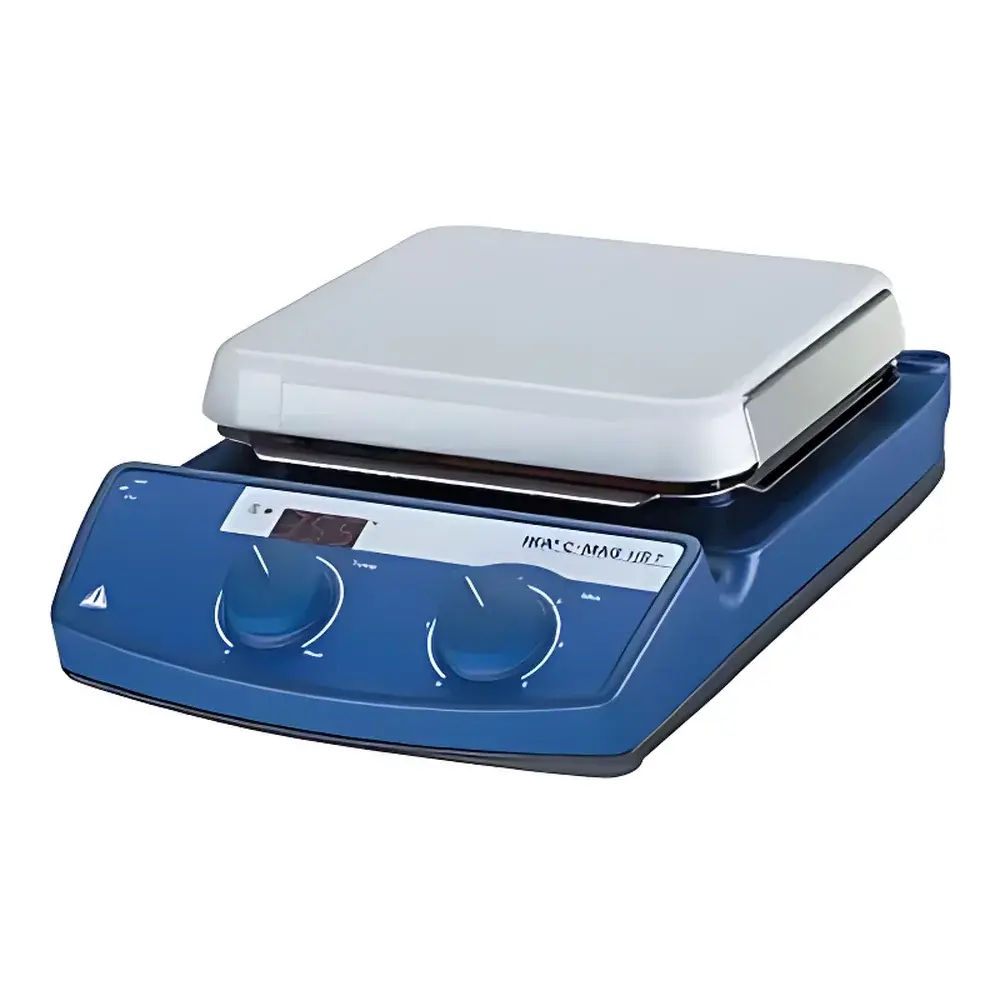
IKA C-MAG HS 7 Magnetic Hotplate Stirrer
| Brand | IKA |
|---|---|
| Origin | Germany |
| Model | C-MAG HS 7 |
| Stirring Points | 1 |
| Max. Stirring Volume (H₂O) | 10 L |
| Speed Range | 100–1500 rpm |
| Heating Temperature Range | 50–500 °C |
| Heating Power | 1000 W |
| Plate Material | Ceramic |
| Plate Dimensions | 200 × 200 mm |
| Overall Dimensions | 220 × 105 × 330 mm |
| Weight | 5 kg |
| IP Rating | IP21 |
| Input Voltage | 230 V, 50/60 Hz |
| Motor Output Power | 1.5 W |
| External Temperature Sensor Interface | ETS-D4 |
| Safety Cut-off Temperature | 550 °C |
| Temp. Stability (with sensor) | ±3 K |
| Temp. Control Accuracy (plate) | ±1 K |
| Max. Stir Bar Length | 80 mm |
| Heating Rate | 5 K/min (for 1 L H₂O) |
Overview
The IKA C-MAG HS 7 is a precision-engineered magnetic hotplate stirrer designed for demanding laboratory applications requiring simultaneous heating and homogeneous mixing of aqueous and moderately viscous solutions. Utilizing a robust permanent magnet drive system coupled with a high-power ceramic heating plate, the device operates on the principle of magnetic coupling—where rotation of an internal drive magnet induces synchronous motion in a magnetic stir bar immersed in the sample vessel. This contactless torque transmission eliminates mechanical wear, ensures leak-free operation, and supports sterile or sealed-vessel protocols. The HS 7 is optimized for single-vessel workflows in chemistry, pharmaceutical development, materials synthesis, and quality control labs where reproducible thermal and hydrodynamic conditions are critical to reaction kinetics, dissolution testing, or buffer preparation.
Key Features
- Ceramic heating plate (200 × 200 mm) with seamless, chemically inert surface resistant to strong acids, bases, and organic solvents—ensuring long-term durability and ease of decontamination.
- Microprocessor-controlled dual-loop regulation: independent feedback circuits maintain set speed (100–1500 rpm) and plate temperature (50–500 °C) with high reproducibility across repeated runs.
- Integrated safety architecture including automatic thermal cut-off at 550 °C, blinking LED heat warning indicator, and IP21-rated enclosure compliant with DIN EN 60529 for protection against vertically falling solids.
- Elevated control panel design minimizes risk of liquid ingress during vigorous stirring or accidental spills, while improving ergonomics for parameter readout and adjustment.
- Dedicated interface for optional IKA ETS-D4 external contact temperature sensor—enabling closed-loop solution temperature control with ±3 K accuracy and enhanced thermal stability over time.
- High-torque motor (1.5 W output) paired with optimized magnetic field geometry prevents stir bar “jumping” even under high-viscosity conditions or with extended stir bars up to 80 mm.
Sample Compatibility & Compliance
The C-MAG HS 7 accommodates standard laboratory glassware including beakers (up to 10 L capacity), Erlenmeyer flasks, and jacketed reactors. Its ceramic surface withstands exposure to common reagents such as concentrated HCl, NaOH, acetone, and ethanol without degradation. The unit complies with IEC/EN 61010-1 for electrical safety in laboratory environments and meets EMC requirements per EN 61326-1. While not intrinsically rated for hazardous area use, its design supports GLP-compliant documentation when integrated with validated temperature sensors and electronic logbooks. No built-in data export or audit trail functionality; however, manual recording of setpoints and operational duration satisfies basic ISO/IEC 17025 documentation expectations for routine QC procedures.
Software & Data Management
The C-MAG HS 7 operates via analog-digital hybrid controls—rotary dials for speed (0–6 scale) and temperature (LED digital display)—with no onboard software, firmware updates, or USB/Ethernet connectivity. All parameters are manually configured and retained only during active operation. For traceable temperature monitoring, integration with the IKA ETS-D4 sensor enables real-time analog output (0–10 V) compatible with third-party data acquisition systems (e.g., LabVIEW, DIAdem) or chart recorders. Users seeking 21 CFR Part 11 compliance must implement external electronic lab notebook (ELN) systems to capture timestamps, operator IDs, and parameter logs—no native user authentication or electronic signature capability is embedded.
Applications
- Controlled heating and homogenization during titration, standardization, and calibration solution preparation.
- Accelerated dissolution testing of solid dosage forms under pharmacopoeial conditions (USP , EP 2.9.3).
- Synthesis of metal-organic frameworks (MOFs), polymer precursors, and nanoparticle dispersions requiring precise thermal ramping and shear history control.
- pH adjustment and buffer equilibration in bioprocessing upstream workflows.
- Preparation of culture media and enzymatic assay mixtures where localized overheating or vortex instability must be avoided.
- Long-duration stability studies (e.g., 72-hr hydrolysis assays) leveraging thermal consistency and low-maintenance magnetic drive reliability.
FAQ
What is the maximum recommended viscosity for reliable stirring with the C-MAG HS 7?
The unit is rated for aqueous solutions up to ~10,000 mPa·s (e.g., 1% carboxymethyl cellulose). For higher viscosities, use shorter stir bars (<50 mm) and reduce speed incrementally to avoid decoupling.
Can the C-MAG HS 7 be used with non-magnetic vessels such as aluminum or stainless steel containers?
No. Magnetic coupling requires diamagnetic or paramagnetic vessel materials (e.g., borosilicate glass, PTFE, polypropylene). Ferromagnetic or conductive metal vessels will shield the magnetic field and prevent stir bar rotation.
Is the 50–500 °C heating range applicable to the sample temperature or the plate surface?
The specified range refers to the ceramic plate surface temperature. Actual solution temperature depends on vessel geometry, volume, thermal conductivity, and ambient conditions—and is best monitored externally using the ETS-D4 sensor.
Does the unit support programmable temperature ramps or multi-step protocols?
No. The C-MAG HS 7 provides only static setpoint control. Programmable thermal profiles require external controllers interfaced via the ETS-D4 analog output.
What maintenance is required to ensure long-term performance?
Routine cleaning with mild detergent and soft cloth; periodic inspection of stir bar integrity and ceramic plate for micro-cracks or residue buildup. Avoid thermal shock by allowing the plate to cool naturally before cleaning.
Related Products



