
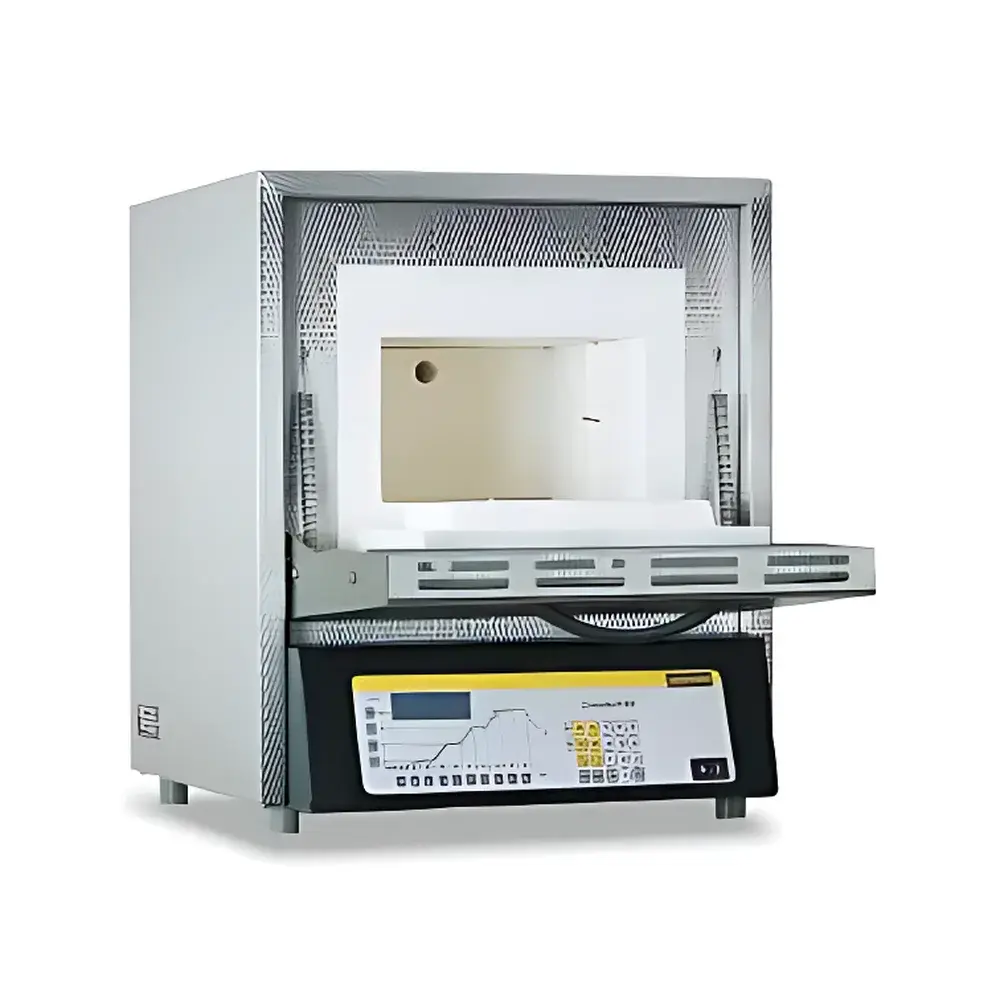
Nabertherm LT5/11/P330 Lift-Door Laboratory Muffle Furnace
| Brand | Nabertherm |
|---|---|
| Origin | Germany |
| Model | LT5/11/P330 |
| Max Temperature | 1100 °C |
| Internal Dimensions (W×D×H) | 200 × 170 × 130 mm |
| Chamber Volume | 5 L |
| External Dimensions (W×D×H) | 440 × 470 × 520 + 220 mm |
| Power Supply | 2.4 kW, Single-phase |
| Weight | 35 kg |
| Heating Time to Max Temp | ~60 min |
| Controller | P330 Programmable Touchscreen Controller (9 programs, 40 segments, graphical color display, 1 °C/1 min resolution, skip function, manual MV control, self-optimizing PID, clock, runtime counter, kWh meter, programmable socket, gas inlet interface, optional exhaust chimney with fan/catalyst) |
Overview
The Nabertherm LT5/11/P330 is a precision-engineered lift-door laboratory muffle furnace designed for reproducible high-temperature thermal processing in research, quality control, and small-batch production environments. Operating on resistive heating principles via embedded resistance wires within ceramic heating plates, the furnace delivers uniform temperature distribution across its 5 L chamber—critical for applications requiring strict thermal homogeneity, such as ashing, calcination, sintering, heat treatment of ceramics or metals, and gravimetric analysis. Its dual-sided (or optional triple-sided) heating architecture minimizes thermal gradients, while vacuum-insulated fiber modules ensure low external surface temperatures and high energy efficiency. The lift-door configuration eliminates direct contact between operators and hot surfaces during loading/unloading, enhancing safety and ergonomics—particularly relevant in GLP-compliant laboratories where procedural consistency and operator protection are mandated.
Key Features
- Robust double-walled stainless steel housing with brushed finish, engineered for long-term structural stability and reduced outer casing temperature (<60 °C at ambient conditions)
- Ceramic heating plates with fully embedded NiCr resistance wire—chemically inert, resistant to volatile condensates and splashes, and maintenance-free over extended service life
- Lift-type furnace door with adjustable air inlet and rear-mounted exhaust port—enabling controlled atmosphere operation and efficient off-gas removal
- Vacuum-reinforced high-purity alumina-silica fiber insulation, rated for continuous operation up to 1100 °C with minimal thermal mass and rapid cool-down characteristics
- Electronically silent solid-state relay switching, eliminating mechanical wear and electromagnetic interference in sensitive lab environments
- Integrated overtemperature protection per EN 60519-2 Class 2—mechanically independent thermal cut-off limiting maximum chamber temperature to prevent equipment or sample damage
- Optional accessories include catalytic exhaust chimneys, forced-air ventilation units, protective gas inlets (N₂, Ar, forming gas), and automated gas dosing systems
Sample Compatibility & Compliance
The LT5/11/P330 accommodates standard crucibles (alumina, quartz, platinum), ceramic setters, and small metal components up to 200 mm wide × 170 mm deep × 130 mm tall. Its sealed muffle design isolates samples from combustion by-products, ensuring contamination-free processing essential for ASTM E1867 (ash content determination), ISO 562 (volatile matter in coal), and USP heavy metals testing. The furnace meets CE marking requirements under the EU Machinery Directive 2006/42/EC and Low Voltage Directive 2014/35/EU. Optional configurations support compliance with GMP Annex 15 (qualification protocols), FDA 21 CFR Part 11 (when paired with validated data logging software), and ISO/IEC 17025 traceability standards through calibrated temperature mapping and audit-ready controller event logs.
Software & Data Management
The P330 controller features a 4.3-inch graphical color touchscreen with intuitive icon-based navigation and multilingual UI (English, German, French, Spanish). It supports up to 9 independent programs, each comprising 40 definable temperature/time segments with 1 °C and 1 min resolution. Key software capabilities include: real-time status display (current temp, segment number, remaining time, power output %), programmable start delay (for off-peak energy utilization), runtime and kWh consumption counters, self-tuning PID algorithms with adaptive parameter optimization, and manual override of heating power (MV control) during critical ramp phases. The controller includes an RS485 interface (Modbus RTU protocol) for integration into centralized lab automation systems or SCADA platforms. Optional Nabertherm LabControl software enables remote monitoring, electronic signature-enabled program validation, and PDF report generation compliant with ALCOA+ data integrity principles.
Applications
- Thermal decomposition and ash residue quantification in pharmaceutical excipients, foodstuffs, and environmental samples
- Pre-sintering and binder burnout of technical ceramics and additive-manufactured green parts
- Calibration and verification of thermocouples and reference materials per ISO/IEC 17025
- Heat treatment of calibration standards, reference electrodes, and sensor substrates
- Controlled oxidation/reduction studies under inert or reactive atmospheres (with optional gas manifold)
- Residue analysis in regulatory testing workflows aligned with EPA Method 2540E, ASTM D3174, and IEC 60695-2-11
FAQ
What is the typical temperature uniformity across the working zone?
At 1000 °C, radial and axial uniformity is ±5 °C within the central 80% of the chamber volume, verified per DIN 17052-1 using a 9-point mapping procedure.
Can the P330 controller be validated for GxP environments?
Yes—the controller supports IQ/OQ documentation packages; audit trail functionality (including user login, program edits, and alarm events) is enabled when connected to Nabertherm’s validated LabControl software.
Is the furnace suitable for use with flammable solvents or organic residues?
Only with appropriate exhaust management: the rear exhaust port must be ducted to a fume hood or catalytic oxidizer, and the optional overpressure relief valve should be installed for volatile-laden processes.
Does the lift-door mechanism require periodic lubrication or maintenance?
No—the counterbalanced lifting system uses sealed stainless steel linear guides and requires no scheduled maintenance beyond visual inspection of the door gasket integrity every 6 months.
What calibration certificates are available at time of delivery?
Factory calibration includes a UKAS-accredited temperature uniformity report and a traceable thermocouple verification certificate (NIST-traceable reference standard), both supplied with serial-numbered documentation.



