
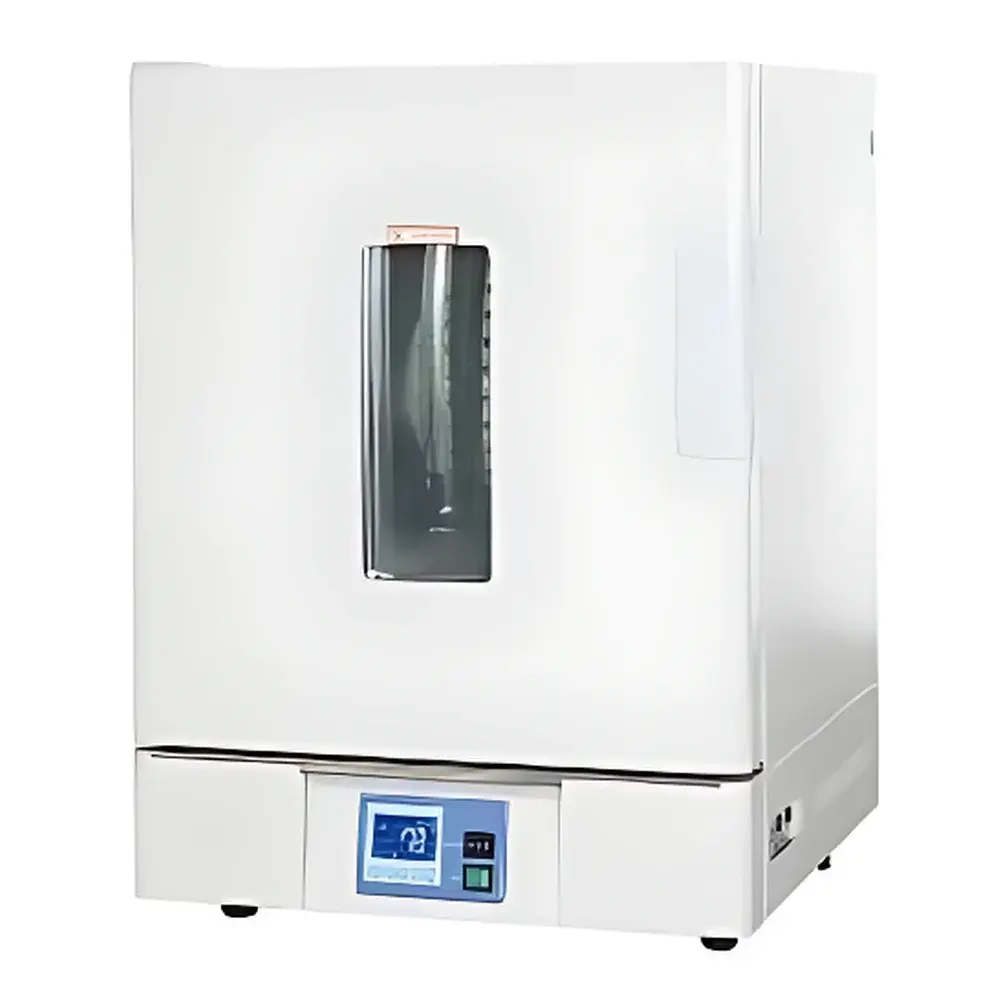
Shanghai Yiheng BPG Series Precision Forced-Air Drying Oven
| Brand | Shanghai Yiheng |
|---|---|
| Origin | Shanghai, China |
| Model Series | BPG (Precision Drying Oven) |
| Temperature Range | RT+10°C to 200°C (optional up to 250°C) |
| Temperature Uniformity | ±2.5% (BPG-A series) / ±1.5% (BPG-B series) at 100°C |
| Temperature Fluctuation | ±1°C |
| Temperature Resolution | 0.1°C |
| Heating Method | Forced-air convection |
| Interior Material | Mirror-finish stainless steel |
| Programmable Stages | 7 programs × 9 steps (63 total steps), 0–5999 min per step |
| Safety Features | Independent over-temperature protection with audible/visual alarm |
| Power Input | 750–2000 W (model-dependent) |
| Interior Volume | 50–220 L |
| External Interface Options | RS-485, USB (U-disk data export), optional thermal printer |
Overview
The Shanghai Yiheng BPG Series Precision Forced-Air Drying Oven is an engineered solution for controlled thermal processing in research laboratories, quality control environments, and industrial R&D settings. Designed around a robust forced-convection architecture, the oven maintains precise temperature uniformity and stability across its working chamber through a high-efficiency axial fan system and optimized airflow ducting. Unlike natural convection ovens, the BPG series ensures rapid heat transfer and minimal thermal stratification—critical for applications requiring reproducible drying, curing, sterilization, or moisture loss analysis. Its operational range extends from ambient +10°C to 200°C standard (with extended capability to 250°C on select configurations), supporting protocols aligned with ASTM E145, ISO 17025 thermal validation requirements, and internal GLP-compliant documentation workflows.
Key Features
- High-Resolution Digital Control: A large backlit LCD display presents real-time chamber temperature, setpoint, elapsed time, and program status simultaneously—enabling immediate visual verification without menu navigation.
- Multi-Stage Programmable Logic: Supports up to seven independent programs, each containing nine sequential steps. Users may define ramp rates, dwell times, target temperatures, and fan speed profiles—facilitating complex thermal profiles such as gradual preheating, staged drying, or post-process cooldown sequences.
- Enhanced Thermal Integrity: Mirror-polished 304 stainless steel interior with seamless rounded corners minimizes contamination traps and simplifies cleaning. Dual-layer door insulation and advanced silicone gasketing reduce surface temperature rise and lower steady-state power consumption by >25% versus legacy designs.
- Integrated Diagnostic System: Self-monitoring firmware continuously checks sensor integrity, heater function, and fan operation. Fault codes appear directly on-screen with descriptive text (e.g., “E03 – PT100 Open Circuit”), accelerating troubleshooting and reducing downtime.
- Dual-Safety Architecture: Primary PID controller operates in parallel with a hardware-independent over-temperature cutoff circuit. Audible buzzer and red LED flash when deviation exceeds user-defined thresholds—meeting IEC 61010-1 Class II safety compliance for laboratory equipment.
Sample Compatibility & Compliance
The BPG series accommodates a wide variety of sample formats—including Petri dishes, crucibles, glassware, polymer films, and metal coupons—within its standardized interior dimensions (50 L to 220 L). All models comply with GB/T 5170.2–2017 (Chinese national standard for temperature uniformity testing of drying ovens) and support IQ/OQ documentation per ISO/IEC 17025 Annex A.2. The ±1.5% temperature uniformity (BPG-B variant) satisfies stringent requirements for gravimetric moisture analysis (e.g., USP Loss on Drying) and pharmaceutical stability testing per ICH Q1A(R2). Optional calibration certificates traceable to NIM (National Institute of Metrology, China) are available upon request.
Software & Data Management
While the BPG oven operates autonomously via its embedded controller, optional digital interfaces enable full traceability and audit readiness. The RS-485 port supports Modbus RTU protocol for integration into centralized lab management systems (LIMS) or SCADA networks. USB host functionality permits direct data logging to FAT32-formatted USB drives—capturing timestamped temperature/time records at user-selectable intervals (1–60 sec). When paired with optional thermal printers, hard-copy output meets FDA 21 CFR Part 11 requirements for electronic records, including operator ID, event timestamps, and signature-equivalent print headers. All exported files are CSV-compatible for statistical process control (SPC) analysis in JMP, Minitab, or Python-based validation scripts.
Applications
- Moisture content determination per AOAC 950.46 and ASTM D2231
- Pre- and post-weighing desiccation of filter papers, soil samples, and catalysts
- Curing of epoxy resins, powder coatings, and adhesive bonds
- Accelerated aging studies under controlled thermal stress
- Residue ashing preparation prior to elemental analysis (ICP-OES, AAS)
- Standardization of reference materials in metrology labs
- Storage conditioning for hygroscopic reagents and standards
FAQ
What is the difference between BPG-A and BPG-B models?
The BPG-B series achieves ±1.5% temperature uniformity at 100°C due to enhanced airflow calibration and tighter sensor tolerance; BPG-A models meet ±2.5% uniformity and are optimized for general-purpose drying tasks.
Can the oven be validated for GMP environments?
Yes—when equipped with optional NIST-traceable PT100 probes and used with documented IQ/OQ protocols, the BPG series supports qualification under EU Annex 15 and FDA guidance for equipment validation.
Is remote monitoring supported out of the box?
No built-in Ethernet or Wi-Fi module is included, but RS-485 connectivity allows integration with third-party IoT gateways for cloud-based telemetry and alarm notification.
What maintenance is required for long-term accuracy?
Annual verification of temperature uniformity and fluctuation using calibrated reference thermometers is recommended. Fan filter cleaning every six months prevents airflow degradation and maintains specified uniformity performance.
Does the controller support password protection?
Yes—the programming interface includes configurable operator-level access control (three-tier permission structure) to prevent unauthorized modification of critical parameters during unattended operation.



