
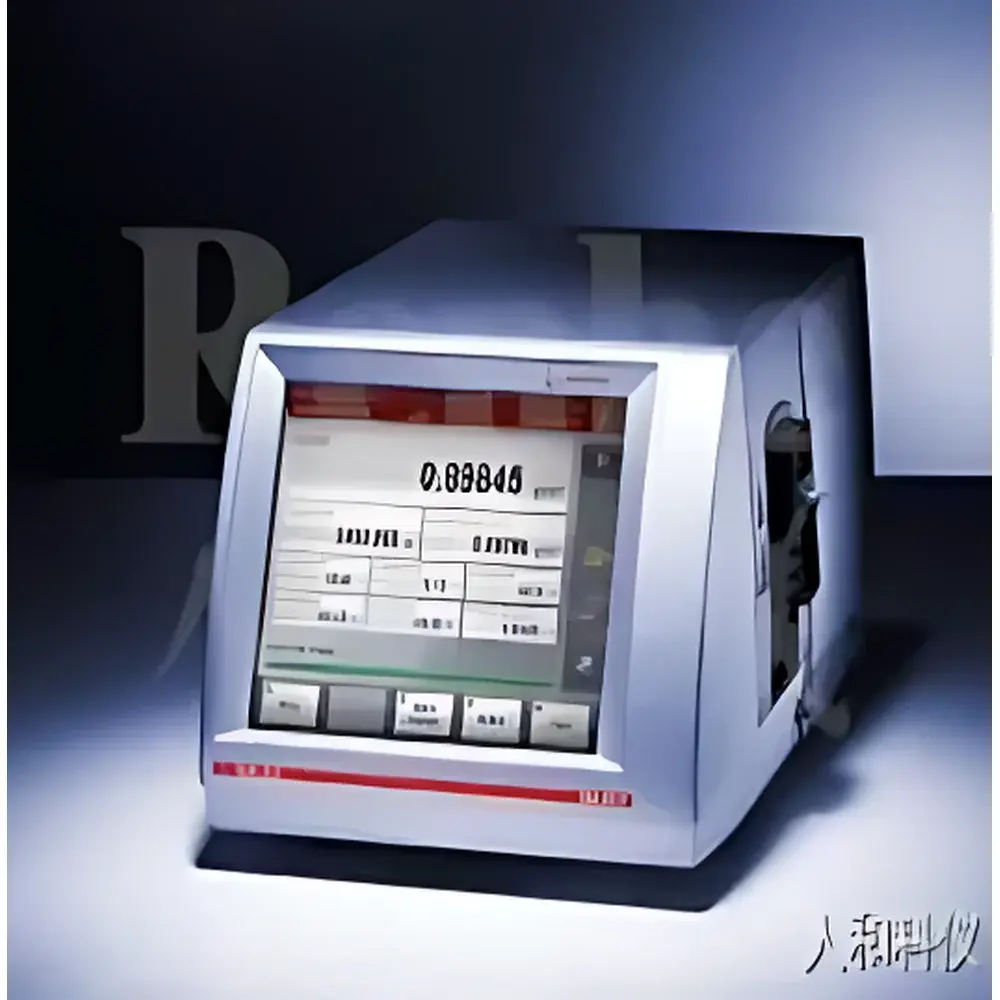
Anton Paar DMA 4200 M Oscillating U-Tube Density Meter for Petroleum Industry
| Brand | Anton Paar |
|---|---|
| Origin | Austria |
| Model | DMA 4200 M |
| Instrument Type | Laboratory Benchtop Oscillating Tube Densitometer |
| Sample Type | Liquid (including high-viscosity, solid-at-room-temperature, and pressurized samples) |
| Density Range | 0–3 g/cm³ |
| Density Accuracy | ±0.0001 g/cm³ |
| Density Repeatability | ≤0.00005 g/cm³ (standard deviation) |
| Temperature Range | −10 °C to +200 °C (14 °F to 392 °F) |
| Temperature Accuracy | ±0.03 °C |
| Pressure Range | 0–500 bar (0–7,250 psi) |
| Minimum Sample Volume | 2 mL |
| Measuring Cell Material | Hastelloy C-276 |
| Cell Volume | ~2 mL |
| Dimensions | 510 × 330 × 230 mm (20 × 13 × 8.7 in) |
| Weight | 27.1 kg (59.7 lb) |
| Power Supply | AC 100–240 V, 50–60 Hz, 250 VA |
| Interfaces | 4 × USB 2.0, 2 × S-Bus, 1 × Ethernet (100 Mbit), 1 × CAN Bus, 1 × RS-232, 1 × VGA |
Overview
The Anton Paar DMA 4200 M is a high-precision, laboratory benchtop oscillating U-tube densimeter engineered specifically for demanding density characterization in petroleum refining, upstream production, and downstream quality control. It operates on the fundamental physical principle of measuring the natural resonant frequency of a precisely machined, temperature-controlled U-shaped tube filled with sample — a method governed by the relationship between oscillation period, tube geometry, and fluid density. This technique delivers traceable, SI-based density values (kg/m³ or g/cm³) with exceptional long-term stability and minimal operator dependence. Designed for full compliance with ASTM D4052, ISO 12185, IP 160, and API MPMS Chapter 11.2, the DMA 4200 M supports regulatory reporting requirements across global oil & gas operations — including custody transfer, blending optimization, and specification conformance testing.
Key Features
- U-tube sensor constructed from Hastelloy C-276 alloy, providing superior corrosion resistance against HCl, H₂S, sour crude, and acidic hydrocarbon streams compared to standard stainless steel — essential for extended service life in aggressive refinery environments.
- Full temperature control from −10 °C to +200 °C, enabling direct density measurement of waxy crudes, bitumen, asphalt, and LPG without phase change or manual pre-conditioning.
- Integrated API gravity calculation engine compliant with API MPMS Chapter 11.1 and Chapter 11.2; automatically converts measured density to API gravity at standardized reference temperatures (e.g., 60 °F or 15.6 °C) without manual interpolation or external lookup tables.
- Low-volume operation: requires only ~2 mL sample per measurement, reducing waste, handling risk, and consumable costs — particularly advantageous for expensive or hazardous samples.
- Modular accessory support: includes dedicated LPG filling kits, hot-bitumen adapters, and high-pressure cells rated up to 500 bar for reservoir fluid PVT analysis under simulated downhole conditions.
- Self-cleaning capability: automated rinse cycles using minimal solvent volume (<1 mL) ensure rapid carryover mitigation between samples and reduce maintenance downtime.
Sample Compatibility & Compliance
The DMA 4200 M accommodates a broad spectrum of petroleum-related materials — from volatile light ends (LPG, naphtha) and mid-distillates (diesel, kerosene) to heavy fractions (vacuum residue, bitumen emulsions) and thermally labile components. Its Hastelloy cell and sealed thermal enclosure allow safe handling of samples containing sulfur compounds, organic acids, and dissolved CO₂/H₂S. The instrument meets GLP and GMP documentation requirements through audit-trail-enabled software (SOP execution logging, user authentication, electronic signatures). Data integrity complies with FDA 21 CFR Part 11 when configured with validated PC software and networked storage protocols.
Software & Data Management
Controlled via Anton Paar’s proprietary mPDS (multi Parameter Data System) software, the DMA 4200 M provides real-time visualization of oscillation decay curves, temperature stabilization status, and density convergence metrics. Measurement data are stored with full metadata (operator ID, timestamp, calibration history, environmental conditions) in encrypted SQLite databases. Export formats include CSV, PDF reports (ASTM-compliant templates), and XML for LIMS integration. Remote monitoring and configuration are supported via Ethernet interface; USB ports enable secure firmware updates and offline report generation.
Applications
- Routine QC of incoming crude slates and blended feedstocks per ASTM D1298 and D4052
- Density-to-API conversion for pipeline specification compliance and fiscal metering
- Bitumen viscosity surrogate determination via density/temperature profiling (ASTM D7042)
- LPG composition estimation using density and vapor pressure correlations
- PVT studies of reservoir fluids under elevated pressure and temperature
- Research-grade characterization of biofuels, synthetic lubricants, and hydrogenated hydrocarbons
FAQ
What standards does the DMA 4200 M comply with for petroleum density measurement?
It conforms to ASTM D4052, ISO 12185, IP 160, and API MPMS Chapters 11.1 and 11.2 for density, relative density, and API gravity determination.
Can the instrument measure samples that are solid at ambient temperature?
Yes — its extended temperature range (−10 °C to +200 °C) allows controlled melting and direct density measurement of waxes, asphaltenes, and polymer-modified bitumens without external heating baths.
Is the measuring cell replaceable, and what is its expected service life?
The Hastelloy C-276 U-tube is a permanent, non-consumable component with no specified replacement interval; Anton Paar specifies >10-year operational lifetime under routine refinery QC conditions.
How is traceability ensured for calibration?
Calibration uses certified reference materials (CRMs) traceable to NIST or PTB; factory calibration certificates include uncertainty budgets per ISO/IEC 17025 requirements.
Does the system support automated sample introduction?
While the base configuration is manual-fill, optional autosamplers (e.g., Xsample 530) integrate seamlessly via S-Bus and enable unattended batch processing of up to 48 samples.



