
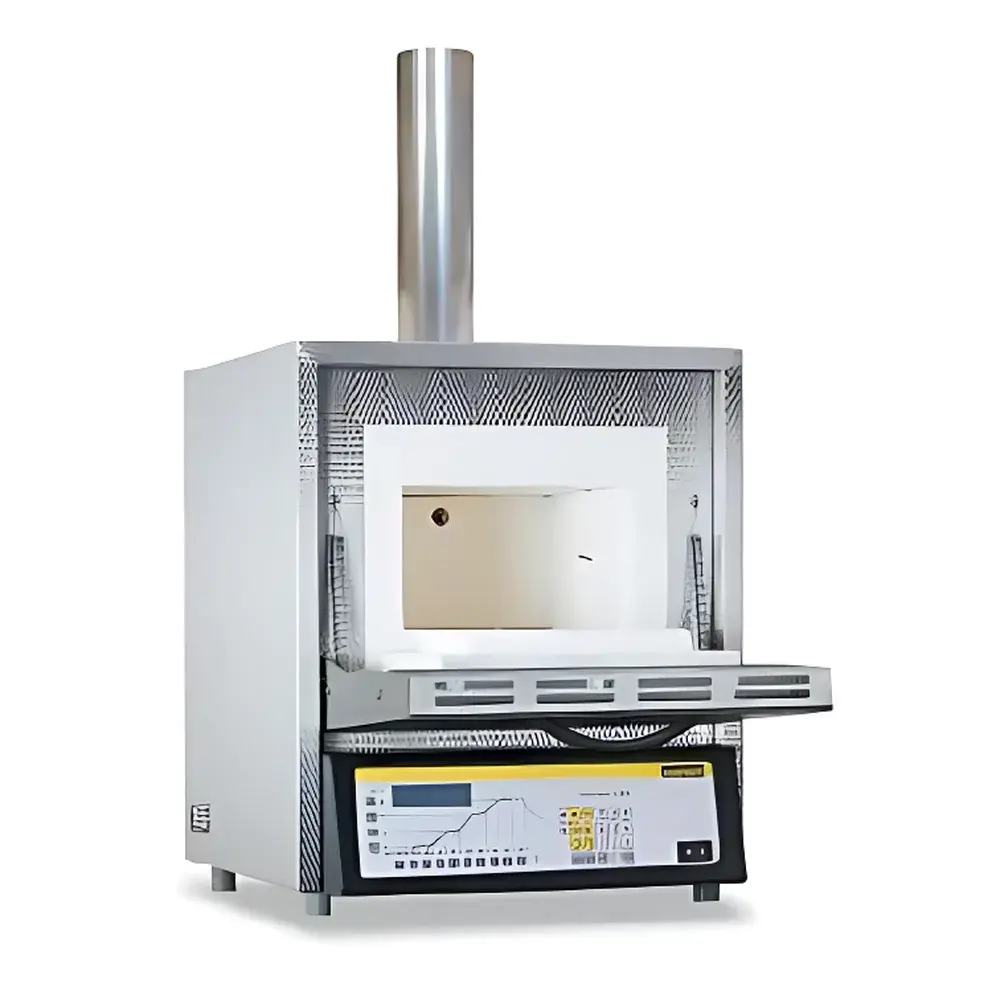
Nabertherm LVT5/11/P330 Ashing Furnace with Lift-Type Door
| Brand | Nabertherm |
|---|---|
| Origin | Germany |
| Model | LVT5/11/P330 |
| Max Temperature | 1100 °C |
| Internal Dimensions (W×D×H) | 200 × 170 × 130 mm |
| Chamber Volume | 5 L |
| External Dimensions (W×D×H) | 440 × 470 × 850 mm |
| Rated Power | 2.4 kW |
| Electrical Supply | Single-phase |
| Weight | 35 kg |
| Time to Max Temperature | ~120 min |
| Air Exchange Rate | >6 air changes per minute |
| Controller | P330 Programmable Touchscreen Controller (9 programs, 40 segments, graphical color display, self-optimizing PID, programmable outlets, kWh meter, clock, start delay, runtime counter, skip function, manual MV control, software interface) |
Overview
The Nabertherm LVT5/11/P330 is a precision-engineered laboratory ashing furnace designed specifically for quantitative residue analysis, organic matrix removal, and controlled thermal decomposition of samples in compliance with standardized analytical protocols (e.g., ASTM D3174, ISO 1171, USP , EN 15407). Operating on resistive heating via embedded ceramic heating elements, the furnace employs a dual-sided heating architecture—top and bottom ceramic plates—to ensure uniform thermal distribution across the 5 L chamber. Its core design principle centers on reproducible, contamination-free ashing: the furnace achieves >6 complete air exchanges per minute through a dedicated preheated inlet/exhaust system, minimizing volatile condensation, preventing cross-contamination between runs, and stabilizing oxygen partial pressure during combustion. The lift-type door mechanism eliminates direct contact between the operator and hot surfaces during loading/unloading, enhancing both safety and thermal integrity during transient operation.
Key Features
- Dual-ceramic heating plates with embedded resistance wires—fully encapsulated to resist chemical attack from halogenated or acidic volatiles and prevent sample contamination.
- High-performance vacuum-fiber insulation module offering low thermal mass, rapid heat-up, and minimal external surface temperature rise (≤55 °C at ambient conditions), enabled by a rigid double-wall stainless steel housing (brushed AISI 304).
- P330 programmable controller with 4.3″ color TFT touchscreen, alphanumeric keypad, and real-time graphical process visualization—engineered in-house by Nabertherm for deterministic thermal profiling.
- Comprehensive safety architecture: independent overtemperature protection (EN 60519-2, Class 2 thermal cut-off), silent solid-state relays, and fail-safe door interlock circuitry.
- Preheated forced-air ventilation system ensuring homogeneous temperature distribution (±3 °C at 1100 °C per DIN 17007) and consistent oxidative atmosphere throughout the ashing cycle.
- Integrated energy monitoring: kWh consumption meter, runtime counter, and programmable start delay—supporting off-peak operation and energy accountability in GLP/GMP environments.
Sample Compatibility & Compliance
The LVT5/11/P330 accommodates crucibles up to Ø100 mm × 80 mm height (e.g., porcelain, alumina, platinum) and supports routine ashing of biological tissues, foodstuffs, polymers, lubricants, coal, and pharmaceutical excipients. Its airflow dynamics and thermal stability meet requirements for gravimetric ash determination under ISO 2171 (cereals), AOAC 942.05 (dairy), and EPA Method 2540E. The furnace’s construction complies with CE marking directives (2014/35/EU Low Voltage, 2014/30/EU EMC), and its controller architecture supports audit-trail-capable operation when integrated with validated LIMS or electronic lab notebook (ELN) systems per FDA 21 CFR Part 11 guidelines.
Software & Data Management
The P330 controller includes a native RS485 interface (Modbus RTU protocol) for bidirectional communication with host PCs or PLCs. Optional Nabertherm LabControl software enables remote parameter upload/download, real-time temperature logging (1 Hz resolution), event-triggered data export (CSV), and automated report generation—including timestamps, setpoint deviations, and power consumption summaries. All program modifications are timestamped and user-logged; the controller retains full operational history even after power loss. Firmware updates are performed via USB stick with cryptographic signature verification to ensure configuration integrity.
Applications
- Quantitative ash content determination in feed, fertilizer, and soil testing laboratories.
- Residue analysis following Soxhlet extraction or solvent evaporation in environmental and petrochemical QA/QC workflows.
- Preparation of inorganic standards for ICP-OES/MS by complete organic matrix removal.
- Thermal conditioning of ceramic substrates and catalyst supports prior to BET surface area analysis.
- Calibration verification of thermocouples and reference materials using certified ash point standards (e.g., NIST SRM 1978).
- Routine cleaning of quartz and ceramic labware in semiconductor and microelectronics cleanrooms.
FAQ
What is the maximum recommended continuous operating temperature?
The LVT5/11/P330 is rated for continuous operation at 1100 °C. Sustained use above this limit voids warranty and risks insulation degradation.
Can the P330 controller store custom ramp-soak profiles for method validation?
Yes—up to 9 independent programs, each supporting 40 programmable segments with adjustable ramp rates (°C/min), soak durations (min), and output-controlled auxiliary devices (e.g., gas valves, cooling fans).
Is the furnace compatible with inert or reducing atmospheres?
No—the LVT series is optimized for air-based ashing. For controlled-atmosphere applications, Nabertherm recommends the N-series tube furnaces with gas-tight flanges and mass flow controllers.
How is temperature uniformity verified and documented?
Nabertherm provides factory calibration certificates traceable to DKD/DAkkS standards. Users may perform periodic verification using a calibrated multi-point thermocouple probe per DIN EN 62056-6-2.
Does the lift-type door affect chamber sealing or gas exchange efficiency?
No—the door features a high-temperature ceramic fiber gasket and pneumatically assisted positive closure, maintaining consistent airflow dynamics and preventing uncontrolled ambient ingress during operation.



