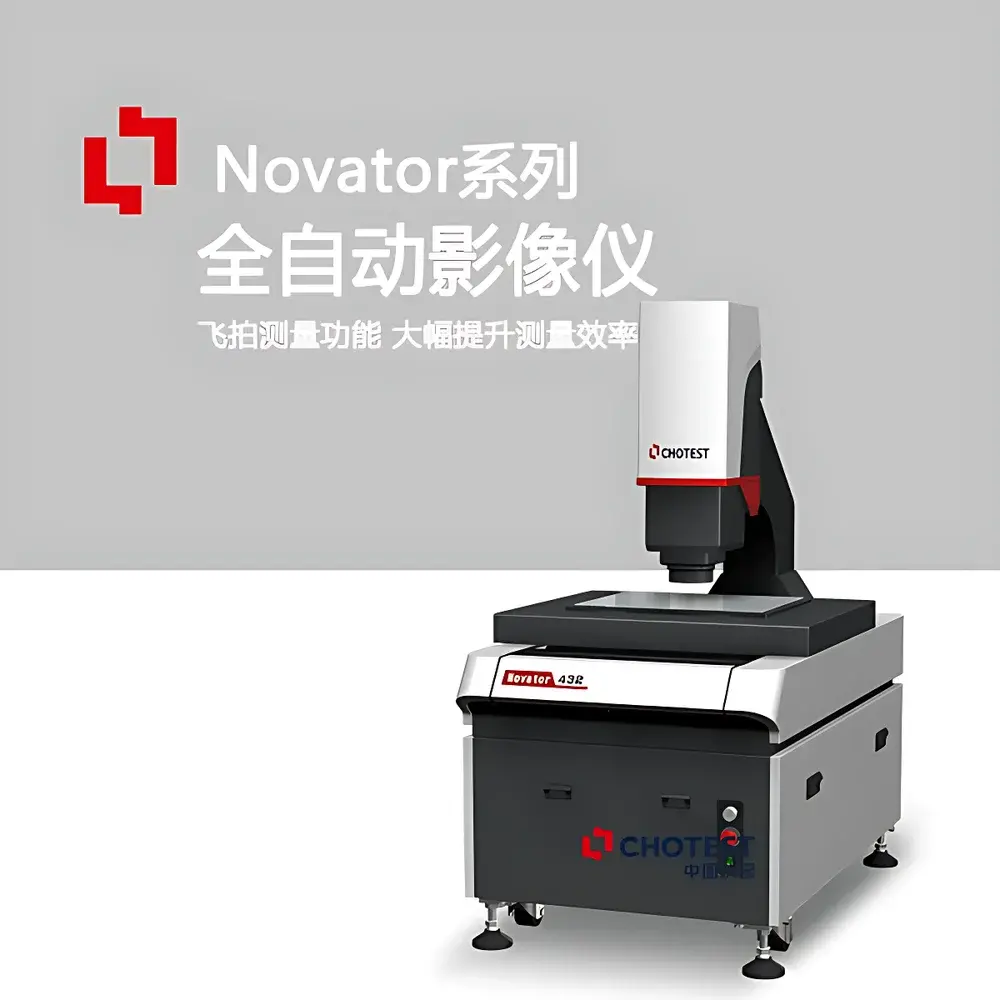
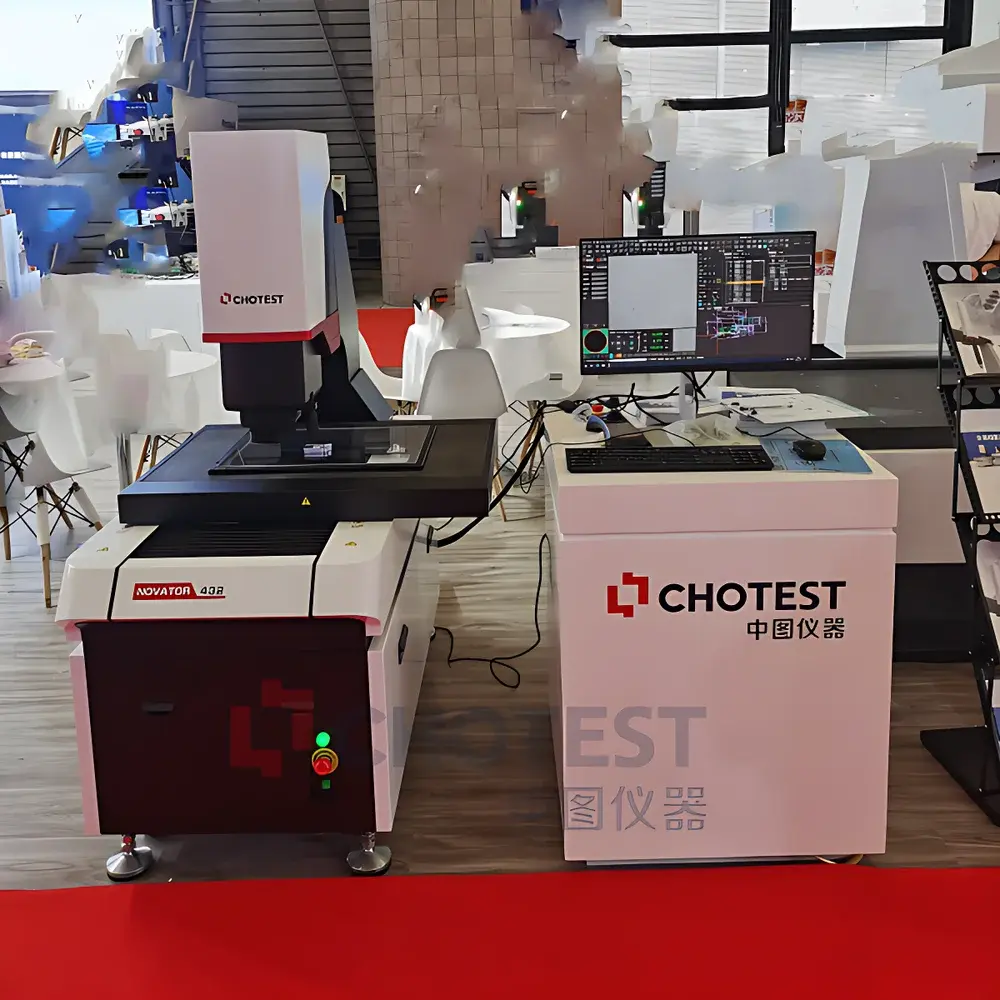
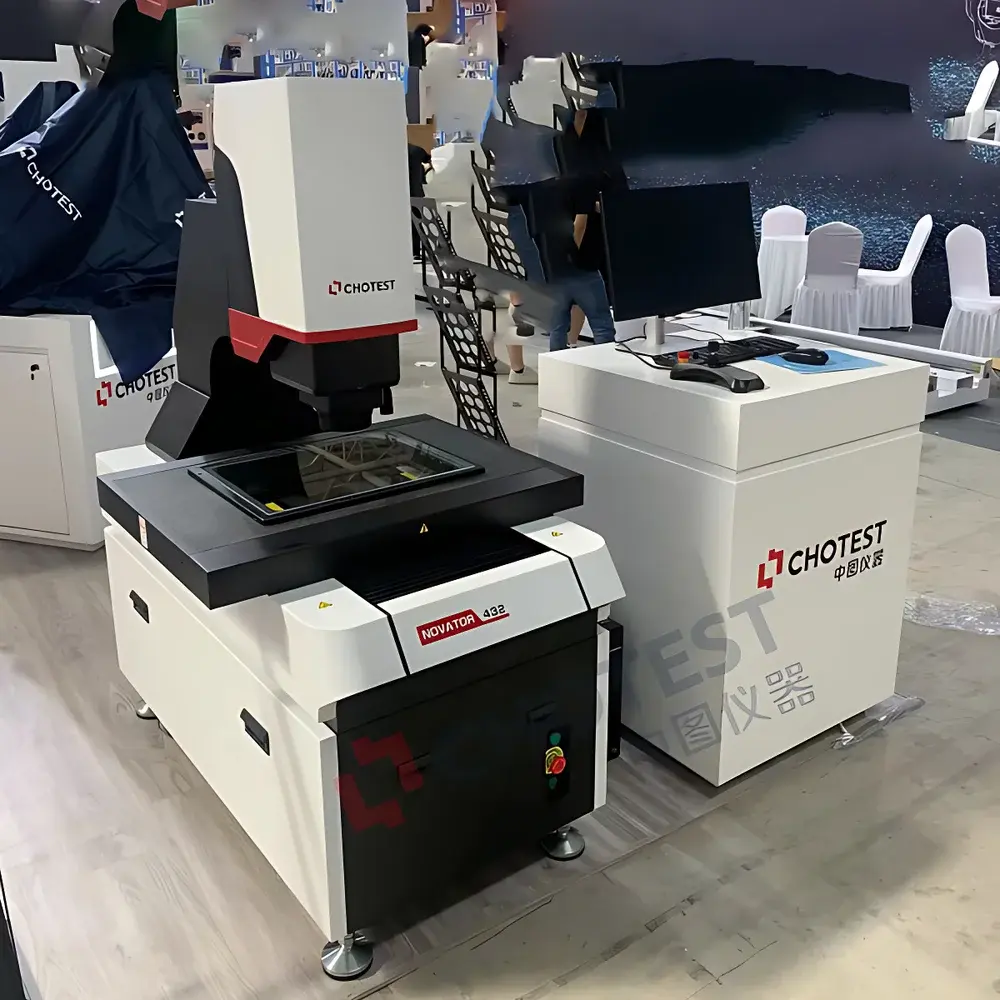
Chotest Novator Series AI-Powered Automatic Edge-Detection Vision Measuring System
| Brand | Chotest |
|---|---|
| Origin | Guangdong, China |
| Manufacturer Type | Authorized Distributor |
| Country of Origin | China |
| Model | Novator 78 |
| Operation Mode | Fully Automatic |
| Measurement Volume | ≥400 × 300 × 200 mm |
| Software Platform | VisionX with PTB-Certified AI Edge Detection Engine |
| Compliance | PTB-validated sub-pixel image analysis algorithms |
| Integration | Native CAD/Gerber import with auto-coordinate alignment |
| Application Scope | Precision geometric metrology for mold, electronics, medical devices, and PCB/FPC manufacturing |
Overview
The Chotest Novator Series AI-Powered Automatic Edge-Detection Vision Measuring System is an advanced coordinate measuring platform engineered for high-accuracy, high-repeatability geometric metrology in regulated industrial environments. Built upon a rigid granite base and precision linear motion architecture, the system employs a high-resolution digital camera coupled with multi-axis motorized zoom optics and programmable multi-directional LED illumination to capture calibrated images across its full measurement volume (≥400 × 300 × 200 mm). Its defining capability lies in the integration of a deep learning–based edge detection engine embedded within the VisionX measurement software — an algorithmic framework validated by the Physikalisch-Technische Bundesanstalt (PTB), Germany’s national metrology institute. This PTB-certified AI engine operates at ≤1% sub-pixel resolution, enabling robust boundary extraction under conditions where conventional thresholding or gradient-based methods fail: low-contrast surfaces (e.g., etched copper on FR4 substrates), superimposed edges (e.g., stacked connector terminals), surface artifacts (tool marks, burrs, chamfers), and reflective or textured finishes common in stainless steel medical components. Unlike rule-based image processing, the AI model dynamically discriminates geometrically meaningful contours from spurious intensity variations, delivering traceable edge localization without manual intervention.
Key Features
- Fully automated edge detection powered by a PTB-validated deep learning inference engine operating at sub-pixel accuracy (≤1% pixel)
- VisionX software with integrated training workflow: users can collect measurement images, annotate ground-truth edges, and retrain the model locally — enabling continuous adaptation to new materials, surface finishes, and part geometries
- Seamless CAD/Gerber import with automatic coordinate system registration and feature-based alignment — eliminating manual datum setup
- High-speed “fly-shooting” acquisition mode synchronized with stage motion, reducing per-feature dwell time and enabling rapid batch inspection
- Multi-spectral programmable LED illumination system with coaxial, ring, back, and oblique lighting channels — configurable per measurement step to maximize edge contrast
- Comprehensive GD&T evaluation suite supporting ISO 1101-compliant form, orientation, location, and runout assessments (flatness, perpendicularity, position, concentricity, etc.)
Sample Compatibility & Compliance
The Novator 78 accommodates a broad spectrum of industrial components, including injection-molded plastic cavities, stamped metal connectors, machined stainless-steel surgical instruments, and flexible printed circuits (FPCs). Its AI edge detection engine has been empirically verified across surfaces with reflectivity gradients, micro-textured finishes, and optical contrast ratios as low as 8:1 — conditions typical in PCB copper trace metrology. From a regulatory standpoint, VisionX supports audit-ready data management: all measurement sessions log operator ID, timestamp, software version, calibration status, and raw image metadata. The system is compatible with GLP and GMP workflows, and its measurement uncertainty reporting aligns with ISO/IEC 17025 requirements for accredited calibration laboratories. While not FDA 21 CFR Part 11–certified out-of-the-box, the software architecture supports electronic signature implementation and full audit trail configuration upon customer-specific validation.
Software & Data Management
VisionX serves as both the control interface and metrological computation engine. It features a modular design with role-based access control, encrypted project storage, and export capabilities compliant with ISO 9001 documentation standards (PDF reports with embedded images, CSV/Excel datasets, XML-based DMIS output). All AI inference operations are logged with hash-verified input frames and bounding box coordinates, ensuring full traceability. Training datasets are stored separately with versioned model checkpoints, enabling regression testing and model lineage tracking. Raw images and processed edge maps are archived with EXIF-compliant metadata, including lens distortion parameters, magnification factor, and illumination configuration — critical for uncertainty budgeting per GUM (Guide to the Expression of Uncertainty in Measurement).
Applications
- Mold & Die Manufacturing: Accurate contour assessment of narrow stepped cavities; reduction in false rejects due to tool-mark-induced edge ambiguity
- Electronics Assembly: Reliable measurement of pitch, coplanarity, and terminal width on multi-pin connectors with overlapping silhouettes
- Medical Device QA: Stable edge capture on passivated stainless-steel orthopedic components, supporting ISO 13485-compliant verification of flatness and positional tolerances
- PCB/FPC Inspection: Reproducible line width and spacing measurements on low-contrast Cu/PI interfaces, meeting IPC-6012 and IPC-A-600 acceptance criteria
- Automotive Precision Parts: Automated evaluation of gear tooth profiles, bearing seat geometry, and bracket hole patterns under variable lighting conditions
FAQ
Does the AI model require cloud connectivity for inference or training?
No. All AI inference and on-device model retraining occur locally on the measurement workstation. No data leaves the customer network unless explicitly exported.
Can VisionX integrate with existing MES or QMS platforms?
Yes. The software provides RESTful API endpoints and supports OPC UA server configuration for bidirectional data exchange with enterprise quality systems.
Is PTB certification applicable to all measurement tasks or only edge detection?
The PTB validation specifically covers the sub-pixel edge localization algorithm — the core computational module used across all 2D geometric measurements. Calibration certificate documentation is provided with each system shipment.
What maintenance is required for long-term AI performance stability?
Periodic retraining using newly acquired production parts is recommended every 3–6 months, depending on material/process variability. VisionX includes automated drift-detection alerts based on edge confidence scoring.
How is measurement uncertainty quantified when using AI-based edge detection?
Uncertainty budgets follow ISO/IEC 17025 Annex A guidelines and include contributions from optical magnification error, stage positioning repeatability, thermal expansion, and AI edge localization standard deviation — the latter derived from PTB’s published validation report.