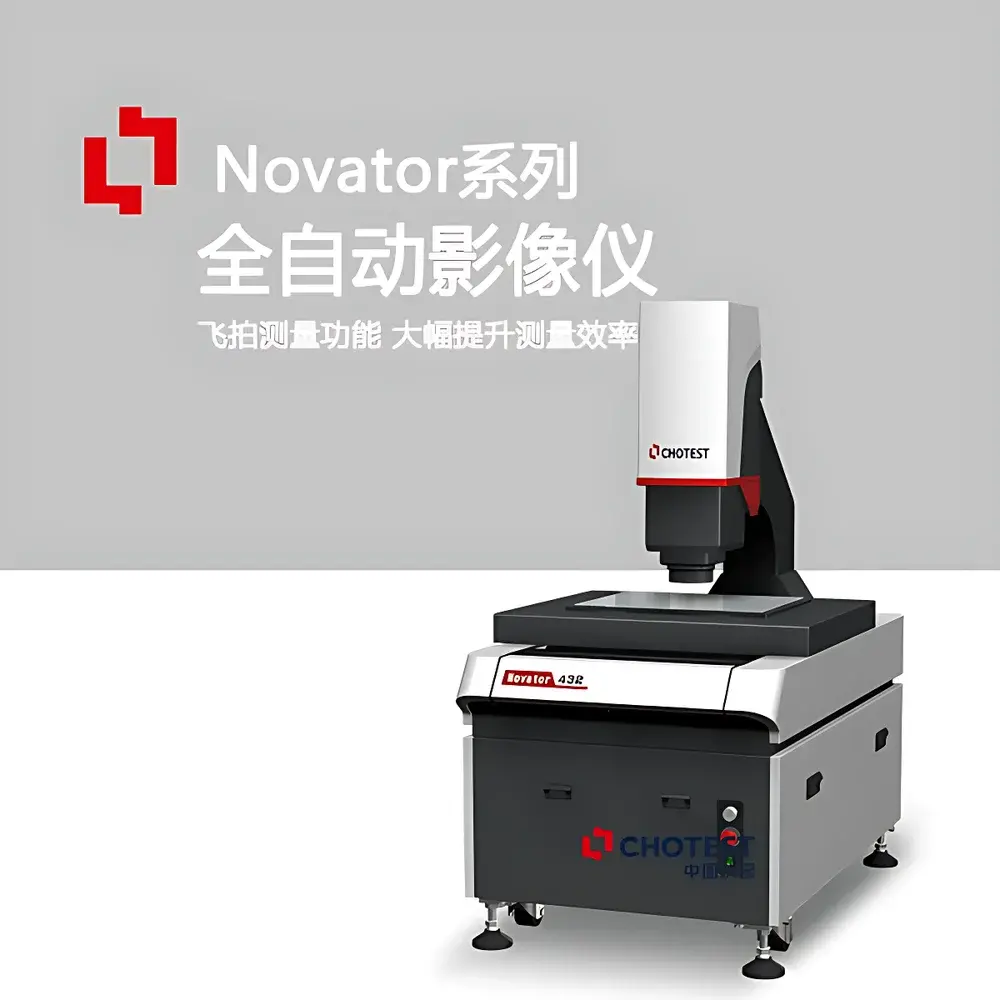
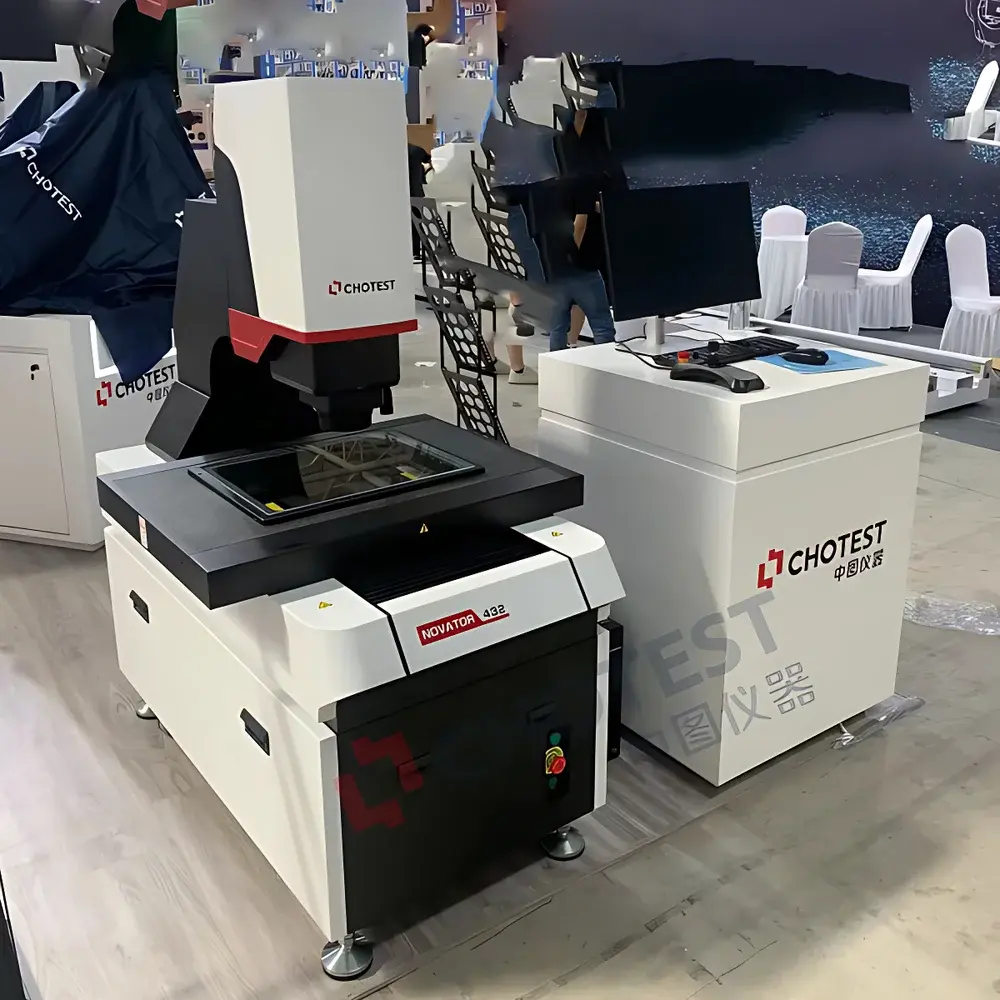
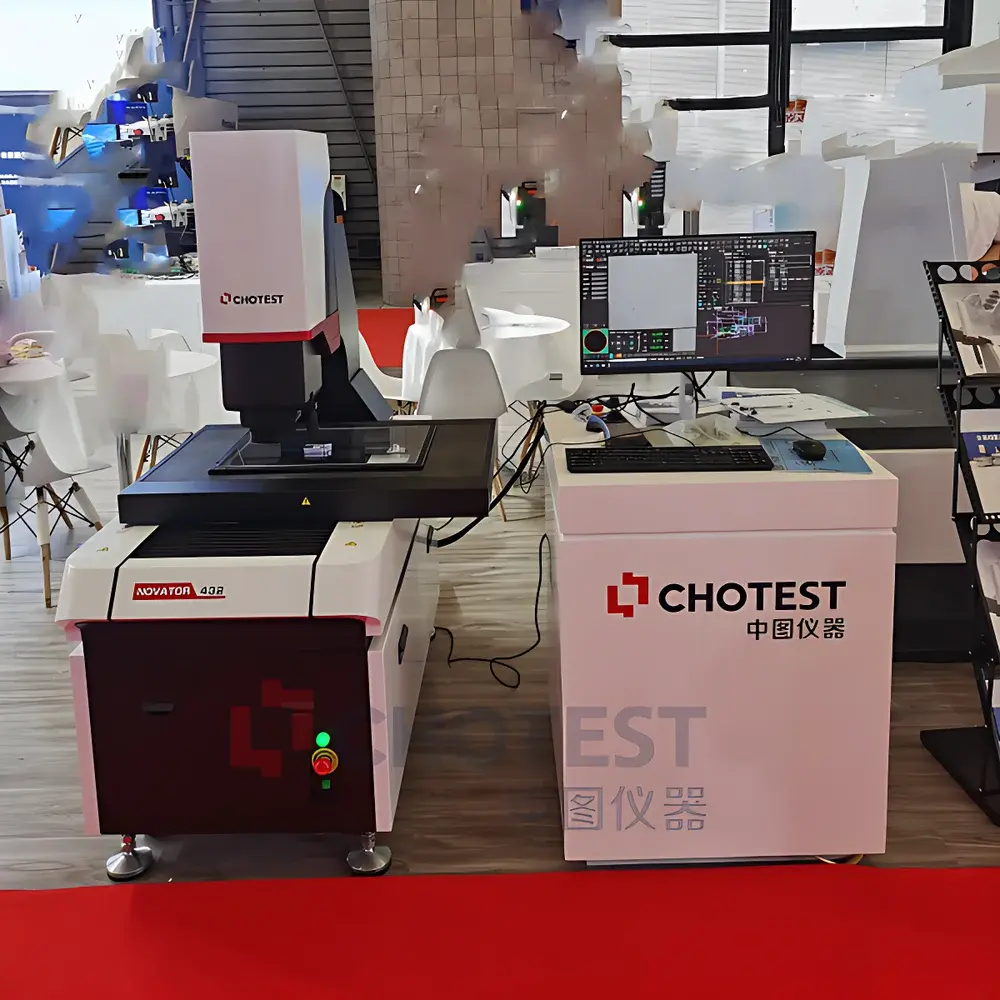
Chotest Novator 367 Fully Automated Surface Profile & Dimensional Image Measuring System
| Brand | Chotest |
|---|---|
| Origin | Guangdong, China |
| Manufacturer Type | Authorized Distributor |
| Country of Origin | China |
| Model | 367 |
| Price | ¥520,000 |
| Operation Mode | Fully Automatic |
| Measurement Volume | ≥400 × 300 × 200 mm |
| Encoded Linear Scale Resolution | 0.1 µm |
| Optical Magnification | 0.6×–8.0× |
| Digital Image Magnification | 17×–380× |
| Illumination Sources | Telecentric Transmission Light (Green), Multi-Zone Surface LED (6-Ring, 8-Section White/RGB-Selectable), Coaxial LED Light |
Overview
The Chotest Novator 367 is a fully automated, high-precision image measuring system engineered for comprehensive 2D/3D geometric metrology of industrial components. It integrates optical imaging metrology with non-contact laser scanning—specifically point-laser profilometry and line-laser 3D surface reconstruction—to deliver traceable dimensional and topographic data across complex freeform surfaces and precision-machined features. Built on a rigid granite base and driven by closed-loop servo motion control, the system complies with fundamental metrological principles defined in ISO 10360 (coordinate measuring machines) and ISO 1101 (geometrical tolerancing). Its hybrid measurement architecture enables simultaneous evaluation of profile geometry (e.g., R-angle, transition curves, edge roundness), positional tolerances (e.g., true position, concentricity), and 3D spatial form (e.g., flatness, curvature, step height), making it suitable for first-article inspection, process validation, and quality gate verification in regulated manufacturing environments.
Key Features
- Triple-illumination architecture: Programmable telecentric green transmission light for high-contrast edge detection; 6-ring, 8-section white/RGB surface illumination with independent intensity control per zone; coaxial LED for specular surface inspection.
- Dual-mode laser scanning: Point-laser profiling for cross-sectional height analysis (Z-range: 5 mm, scan width: 30 mm); line-laser 3D reconstruction for full-field surface topography and volumetric deviation mapping.
- High-fidelity optical path: Motorized zoom lens (0.6×–8.0× optical magnification) coupled with 17×–380× digital zoom and real-time auto-focus; sub-pixel edge detection algorithm optimized for low-contrast or transitional boundaries (e.g., machined fillets, EDM finishes).
- Dynamic acquisition acceleration: Stroboscopic illumination mode synchronized with high-speed camera capture; “fly-shooting” motion control enabling up to 10× faster coordinate acquisition without sacrificing repeatability (typical MPE: ≤(2.5 + L/200) µm per ISO 10360-2).
- Modular sensor integration: Optional probe module (touch-trigger or scanning), white-light confocal sensor, or triangulation laser sensor for hybrid tactile/optical measurement workflows.
Sample Compatibility & Compliance
The Novator 367 accommodates parts up to 400 mm × 300 mm × 200 mm (X/Y/Z), supporting metallic, ceramic, polymer, and composite components with reflective, matte, anodized, or textured surfaces. Its RGB-selectable surface lighting and independent Z-axis height adjustment (±25 mm range) ensure stable imaging across varying surface finishes—including low-diffuse alloys and translucent plastics. The system supports calibration traceability to NIST-traceable artifacts and conforms to ISO/IEC 17025 requirements for laboratory measurement uncertainty estimation. All measurement routines are configurable to meet GD&T evaluation criteria per ASME Y14.5 and ISO 1101, including profile, orientation, location, and runout tolerances. Audit-ready reporting includes full metadata logging (operator ID, timestamp, environmental conditions, calibration status) aligned with FDA 21 CFR Part 11 electronic record requirements when used with validated VisionX software configuration.
Software & Data Management
VisionX metrology software provides a unified platform for 2D image metrology, 3D point-cloud processing, and GD&T evaluation. It supports CAD model import (STEP, IGES, X_T) with nominal-to-actual deviation mapping, automatic feature recognition via machine-learning-assisted edge segmentation, and batch program generation from Gerber files for PCB and FPC inspection. All measurement sequences are fully programmable and repeatable under CNC coordinate system alignment. Software features include GLP-compliant audit trails, user-level permission controls, customizable report templates (PDF/Excel/XML), and SPC charting with Cp/Cpk calculation. Raw image and point-cloud datasets are stored with embedded EXIF metadata (exposure time, gain, lens position, illumination state), ensuring full traceability for internal quality audits or external regulatory review.
Applications
The Novator 367 serves as a primary metrology solution across industries requiring tight geometric control: precision mold & die shops (cavity profile verification, electrode wear analysis); electronics manufacturing (SMT component placement accuracy, BGA ball coplanarity, flex circuit trace width/spacing); automotive powertrain (valve seat angle, piston ring groove geometry, gear tooth profile); medical device production (catheter tip concentricity, stent strut thickness, implant surface roughness correlation); and watchmaking (gear train wheel pitch, balance spring anchor geometry). Its ability to measure weak edges—such as EDM-finished radii or laser-cut micro-contours—without manual intervention makes it especially valuable for high-mix, low-volume prototyping and advanced materials R&D.
FAQ
Does the Novator 367 support automated GD&T evaluation per ISO 1101?
Yes—VisionX software performs full geometric tolerance analysis including straightness, flatness, circularity, cylindricity, profile of a line/surface, perpendicularity, parallelism, angularity, position, concentricity, symmetry, and runout.
Can measurement programs be exported and reused across multiple instruments?
Yes—programs are saved in vendor-neutral XML format and retain full coordinate system definitions, lighting configurations, and feature logic, enabling seamless deployment across identical Novator platforms.
Is the system compatible with factory MES or QMS integration?
Yes—VisionX supports OPC UA and RESTful API interfaces for bidirectional data exchange with Siemens Opcenter, PTC ThingWorx, or custom QMS platforms, including real-time SPC alerts and nonconformance escalation.
What calibration standards are recommended for routine verification?
Chotest recommends annual verification using a certified step gauge (ISO 230-6), ball bar (ISO 230-4), and calibrated pin gauge set traceable to national metrology institutes; optional on-site calibration services include ISO 17025-accredited certification.
How does the system handle measurement of transparent or highly reflective surfaces?
Via configurable multi-angle RGB surface illumination, polarized transmission lighting, and coaxial bright-field mode—combined with dynamic exposure control and sub-pixel interpolation algorithms optimized for low-signal contrast boundaries.