
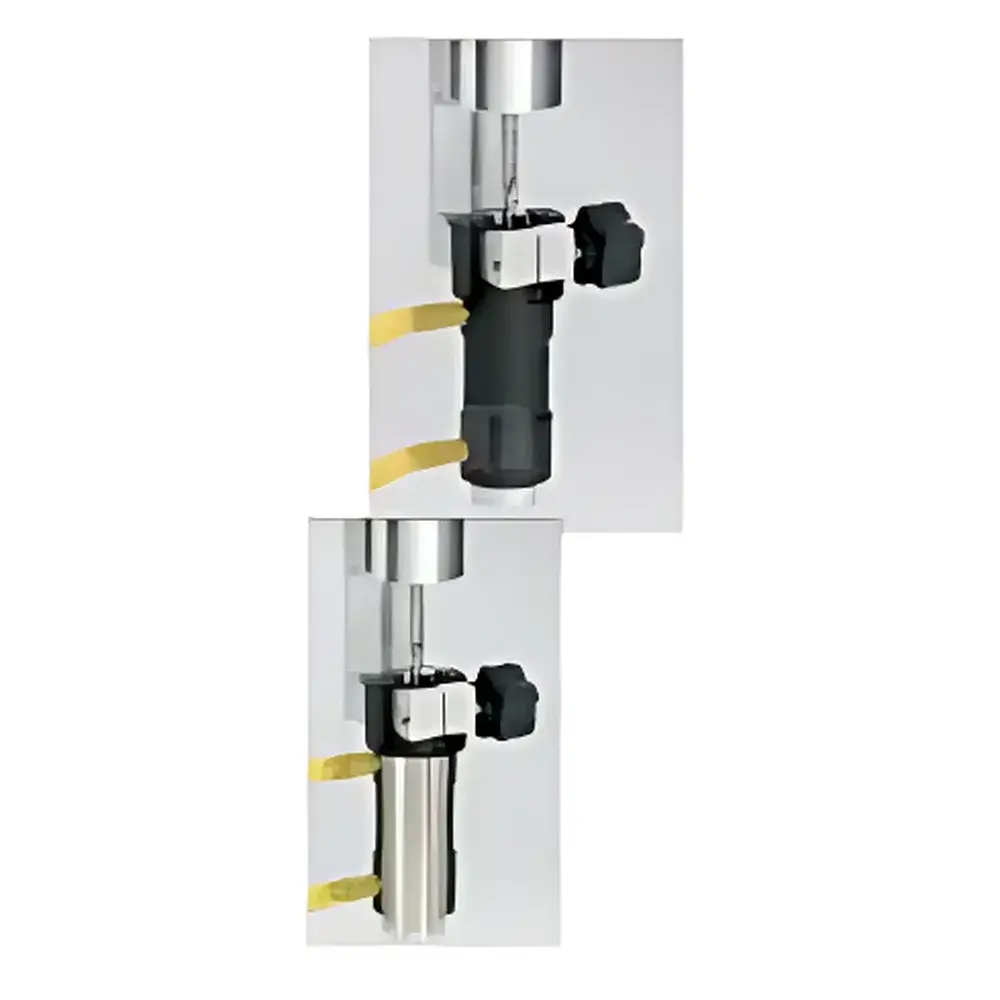
Brookfield ULA Ultra-Low Viscosity Adapter (Reinforced Version)
| Brand | Brookfield |
|---|---|
| Origin | USA |
| Manufacturer Type | Authorized Distributor |
| Origin Category | Imported |
| Model | ULA |
| Pricing | Available Upon Request |
Overview
The Brookfield ULA (Ultra-Low Viscosity Adapter) is an engineered precision peripheral designed to extend the lower viscosity measurement capability of Brookfield rotational viscometers and rheometers. Operating on the principle of coaxial cylinder (Couette) flow geometry, the ULA enables accurate, reproducible viscosity measurements for Newtonian and non-Newtonian fluids in the ultra-low range—down to 1.0 cP (mPa·s)—with high shear rate resolution. It is fully compatible with LV, RV, HA, and HB series viscometers (e.g., DV2T, DV3T, and LVDV3T), and integrates seamlessly into existing instrument platforms without firmware modification or recalibration. The adapter’s mechanical design ensures minimal end-effect errors and eliminates parasitic torque contributions from air damping or bearing friction, critical for low-torque applications. Its operational envelope supports temperature-controlled testing across a wide thermal range (–15 °C to +100 °C) when used with optional accessories such as the ULA-40Y jacketed bath coupling system.
Key Features
- Ultra-low viscosity range extension: measures from 1.0 cP (mPa·s) up to 2,000 cP depending on spindle/speed combination—validated per ASTM D2196 and ISO 2555
- Stainless-steel rotor and sample cup construction for chemical resistance, dimensional stability, and cleanability
- Removable LDPE (low-density polyethylene) base cap—designed for single-use disposal in applications involving difficult-to-clean or cross-contamination-sensitive samples
- Extended-thread rotor mounting interface enhances mechanical coupling rigidity and reduces axial play during rotation
- Ergonomic support bracket with textured grip surface facilitates precise manual alignment and secure hand-tightening of the rotor
- Quick-release sample cup mechanism: rotating the knurled wheel slides the cup axially for rapid exchange—enabling sequential multi-sample analysis without disassembling the entire adapter
- Modular detachment design: rotor and cup can be removed together or independently; water bath jacket remains mounted on the viscometer during cup replacement, minimizing setup downtime
- Integrated collar alignment system ensures concentricity between rotor and cup—critical for maintaining consistent gap geometry and eliminating eccentric shear artifacts
- Universal ½-20 UNF threaded interface compliant with all Brookfield viscometer pivot housings, enabling automatic radial centering upon engagement
Sample Compatibility & Compliance
The ULA accommodates aqueous solutions, solvents, polymer melts (dilute), pharmaceutical formulations (e.g., ophthalmic solutions, injectables), coatings, inks, and food-grade emulsions. Its geometry complies with standard rotational viscometry requirements for defined shear field generation (ISO 3219, ASTM D1084). When operated with GLP/GMP-compliant instruments (e.g., DV3T with audit trail enabled), the ULA supports data integrity workflows under FDA 21 CFR Part 11 when paired with Brookfield’s Rheo3000 or PC-based software with electronic signature and version-controlled method storage. Temperature control—via external baths or the ULA-40Y jacket—is traceable to NIST-certified reference thermometers, satisfying ISO/IEC 17025 calibration documentation needs.
Software & Data Management
The ULA operates natively within Brookfield’s standard software ecosystem—including Rheo3000, ViscoQC 200, and the legacy RheoVision platform—without driver installation. All viscosity, shear rate, and shear stress calculations are performed in real time using factory-calibrated torque constants and geometric correction factors embedded in instrument firmware. Software modules support automated viscosity vs. shear rate sweeps, yield stress estimation (Bingham/Casson models), and export of raw torque/time datasets in CSV or ASTM E1447-compliant formats. Audit trails record operator ID, timestamp, method parameters, environmental conditions (if logged via optional PT100 probe), and calibration status—fully aligned with laboratory quality management systems.
Applications
- Quality control of low-viscosity excipients and active pharmaceutical ingredients (APIs) per USP and
- Rheological profiling of inkjet inks and UV-curable resins during formulation development
- Viscosity monitoring of battery electrolytes and lithium-ion cell slurries
- Process validation of thin-film coating fluids in semiconductor and display manufacturing
- Stability assessment of nanoemulsions and micellar systems in cosmetic and nutraceutical R&D
- Calibration verification of primary viscometer standards in metrology labs
FAQ
Which Brookfield viscometer models are compatible with the ULA?
The ULA is mechanically and electronically compatible with all LV, RV, HA, and HB series instruments—including DV1M, DV2T, DV3T, LVDV3T, RVDV3T, HADV3T, and HBDV3T—with standard pivot housing interfaces.
Can the ULA be used for non-Newtonian fluid characterization?
Yes. When coupled with programmable speed ramps and torque logging, the ULA supports full flow curve acquisition, allowing determination of consistency index (K), flow behavior index (n), and yield stress via standard power-law and Herschel-Bulkley regression protocols.
Is temperature control mandatory for accurate ULA measurements?
While ambient-temperature measurements are possible, temperature stabilization is strongly recommended—especially below 10 cP—to minimize thermal drift effects on torque sensor baseline and fluid density. The ULA-40Y jacket enables ±0.1 °C control over the –15 °C to 100 °C range.
How often should the ULA be recalibrated?
Brookfield recommends annual verification against traceable viscosity standards (e.g., Cannon-Fenske or glass capillary standards) in accordance with ISO/IEC 17025. Mechanical inspection of rotor concentricity and cup gap tolerance should occur prior to high-precision campaigns.



