
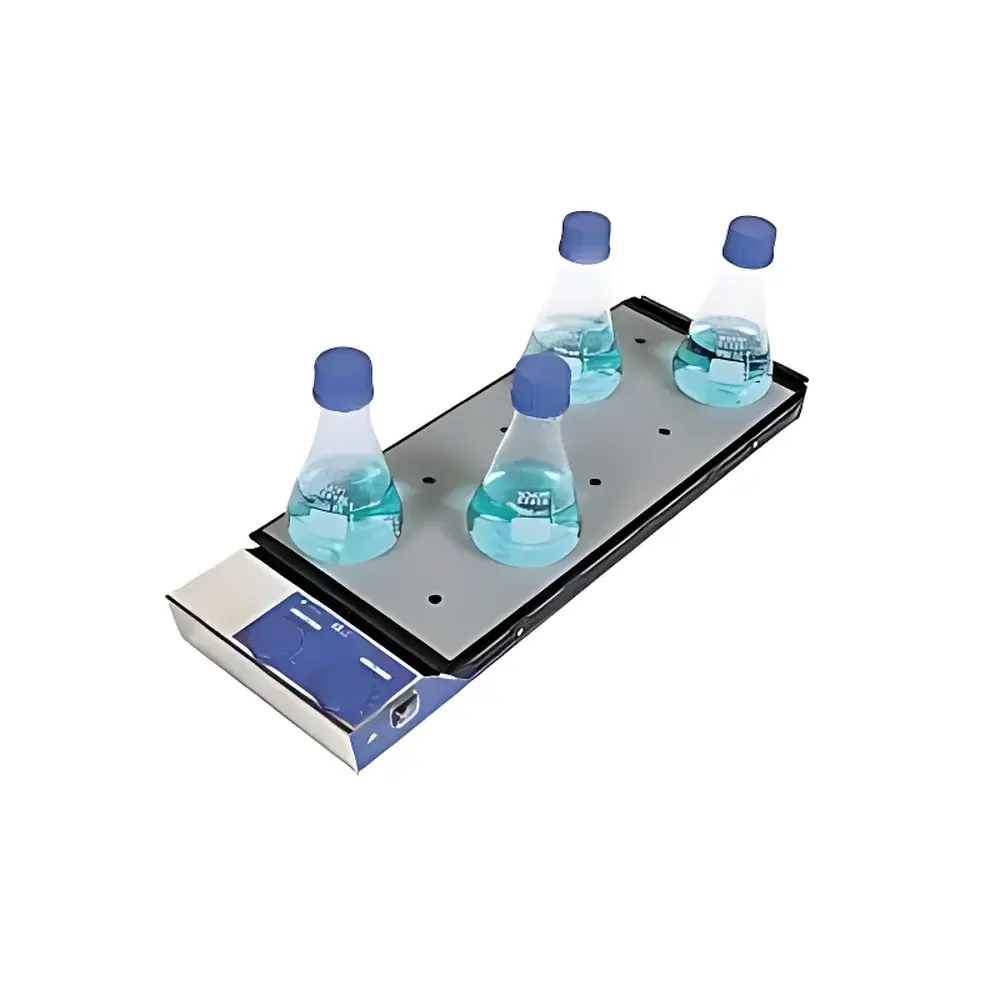
IKA RT 10 Multi-Position Magnetic Stirrer with Heating
| Brand | IKA |
|---|---|
| Origin | Germany |
| Model | RT 10 |
| Instrument Type | Magnetic Stirrer |
| Max. Stirring Volume (H₂O) | 0.4 L |
| Speed Range | 0–1000 rpm |
| Speed Increment | 10 rpm |
| Heating Plate Temp. Range | Ambient to 120 °C |
| Sample Temp. Range | 5–70 °C (dependent on vessel geometry and thermal coupling) |
| Heating Power | 375 W |
| Safety Temp. Limit Adjustable | 50–150 °C |
| Stirring Points | 10 |
| Inter-point Spacing | 90 mm |
| Stir Bar Length Compatibility | 25–30 mm |
| Plate Material | Anodized Aluminum |
| Plate Dimensions | 180 × 495 mm |
| Overall Dimensions | 190 × 60 × 610 mm |
| Weight | 7.5 kg |
| IP Rating | IP40 |
| Input Voltage | 230 / 115 / 100 V, 50/60 Hz |
| Power Consumption | 410 W |
| Operating Ambient | 5–40 °C, ≤80% RH |
Overview
The IKA RT 10 is a precision-engineered, 10-position digital magnetic stirrer with integrated heating functionality, designed for reproducible, parallel sample processing in analytical, quality control, and research laboratories. It operates on the principle of rotating magnetic fields generated by precisely wound copper coils beneath an anodized aluminum heating plate—eliminating mechanical drive shafts and ensuring silent, wear-free operation across all ten positions. Unlike single-point stirrers, the RT 10 delivers synchronized, independent speed control per position with zero inter-channel speed deviation (±0%), enabling statistically valid comparative studies—such as dissolution testing, buffer equilibration, or multi-vial reagent conditioning—under identical thermal and hydrodynamic conditions. Its temperature-controlled heating plate (ambient to 120 °C) enables indirect sample heating up to 70 °C, with programmable safety cutoffs (50–150 °C) compliant with DIN EN 60529 (IP40) and general laboratory safety protocols.
Key Features
- Simultaneous control of 10 independent stirring positions with identical rotational accuracy (0% speed deviation between channels)
- Digitally adjustable speed from 0 to 1000 rpm in precise 10-rpm increments, maintaining setpoint stability under variable load conditions
- Uniformly heated aluminum plate (180 × 495 mm) with ±1.5 K temperature homogeneity across active zones at 100 °C
- LED-display interface with intuitive touch-sensitive controls; real-time error code diagnostics (e.g., E1 = overtemperature, E2 = sensor fault)
- Programmable safety temperature circuit with user-defined lower (min. 50 °C) and upper (max. 150 °C) limits for fail-safe thermal management
- Eco-mode heating algorithm that reduces standby power draw without compromising ramp rate (3 K/min typical heating speed)
- Compatibility with standard PTFE- or glass-coated stir bars (25–30 mm length); optimized magnetic coupling for vessels up to 0.4 L (H₂O equivalent)
Sample Compatibility & Compliance
The RT 10 accommodates standard round-bottom flasks (up to 100 mL), beakers (50–400 mL), and multi-well plates when used with appropriately sized stir bars. Its low-profile design supports compatibility with fume hoods and laminar flow cabinets. The unit conforms to IEC 61010-1 for electrical safety in laboratory environments and meets EMC requirements per EN 61326-1. While not intrinsically rated for hazardous locations, its IP40 enclosure provides protection against solid objects ≥1 mm and limited vertical water drip—suitable for controlled indoor lab use. All thermal and rotational parameters are traceable via front-panel display logs, supporting GLP-aligned documentation practices where manual recordkeeping is required.
Software & Data Management
The RT 10 operates as a standalone instrument with no proprietary software dependency. All operational parameters—including speed, plate temperature, runtime, and error history—are retained in non-volatile memory and accessible via the LED interface. For integration into validated workflows (e.g., pharmaceutical QC labs), users may implement external data capture via RS232 or optional analog output modules (sold separately), enabling linkage to LIMS or electronic lab notebooks. Though lacking native 21 CFR Part 11 compliance features (e.g., electronic signatures, audit trails), its deterministic behavior, calibrated thermal response, and consistent mechanical output support IQ/OQ validation protocols when paired with documented calibration standards (e.g., NIST-traceable thermometers, tachometers).
Applications
- Parallel dissolution testing of solid dosage forms under USP conditions using standardized vessels and stir bar geometry
- Multi-batch buffer preparation and pH equilibration in bioprocessing development
- Simultaneous extraction or digestion of environmental samples (e.g., soil leachates, wastewater solids) in EPA Method-compliant workflows
- High-throughput reagent conditioning for ELISA, PCR master mix prep, or cell culture media sterilization validation
- Stability-indicating studies requiring identical agitation intensity across accelerated aging timepoints
- Teaching laboratories performing kinetic experiments (e.g., iodine clock reaction) with controlled, reproducible mixing rates
FAQ
What is the maximum recommended vessel diameter per position?
Vessels up to 85 mm in base diameter are optimal; larger diameters may reduce magnetic coupling efficiency and require longer stir bars (within 25–30 mm range).
Can the RT 10 be used with corrosive solvents?
Yes—provided vessels are chemically resistant and stir bars are appropriately coated (e.g., PTFE or ETFE); the aluminum plate surface is anodized for enhanced corrosion resistance.
Is speed calibration traceable to national standards?
Speed accuracy is factory-verified against ISO 17025-accredited tachometry; users may perform periodic verification using an external optical tachometer.
Does the unit support continuous operation (24/7)?
Yes—the RT 10 is rated for unattended operation within specified ambient conditions (5–40 °C, ≤80% RH) and includes thermal cut-off redundancy.
How is temperature uniformity verified across the 10 positions?
IKA specifies ±1.5 K deviation at 100 °C across the plate surface; users should validate spatial uniformity during installation qualification using calibrated PT100 probes at each position center.



