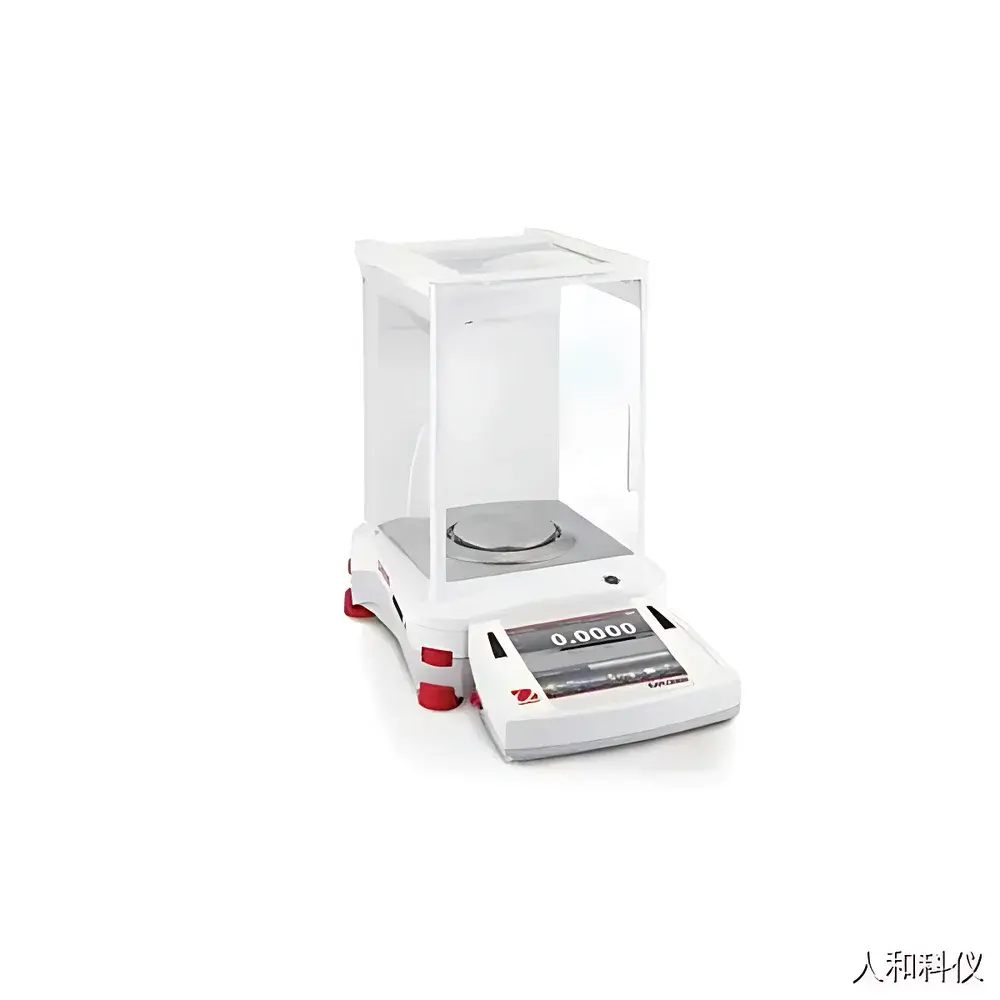
OHAUS EXPLORER Professional Analytical and Precision Balance Series
| Brand | OHAUS |
|---|---|
| Origin | USA |
| Model | EXPLORER Professional Balance |
| Instrument Type | Precision Balance |
| Maximum Capacity | 12 kg |
| Readability | 0.1 g |
| Repeatability | 0.1 g |
| Linearity Error | ±0.2 g |
| Stabilization Time | ≤1 s |
| Calibration | Internal AutoCal™ (triggered every 11 h or upon ΔT ≥1.5 °C) |
| Protection Rating | IP54 (base unit) |
| Accuracy Class | Class II (per OIML R76) |
| Minimum Weight (USP <781>, K=2, U=0.10%) | 160 g |
| Operating Temperature | 10–30 °C |
| Humidity Range | 15–80% RH (non-condensing, ≤30 °C) |
| Display | 5.7″ color VGA TFT resistive touchscreen |
| Interface | RS-232, USB host/device |
| Data Export | Direct save to USB drive (TXT, CSV) |
| Software | SmartText™ 2.0 with 14 GLP/GMP-compliant weighing applications |
| Compliance | Fully supports FDA 21 CFR Part 11 audit trail requirements via optional software configuration |
Overview
The OHAUS EXPLORER Professional Balance Series represents a rigorously engineered platform for high-throughput precision mass measurement in regulated laboratory, quality control, and industrial production environments. Built on a dual-column mechanical architecture with reinforced aluminum alloy base and integrated anti-vibration damping, these balances operate on electromagnetic force compensation (EMFC) principle—ensuring direct proportionality between applied load and restoring current, thereby delivering traceable, drift-compensated results without mechanical levers or knife edges. Designed for Class II accuracy per OIML R76 and compliant with ISO/IEC 17025 metrological requirements, the EXPLORER series delivers sub-second stabilization (<1 s), exceptional linearity (±0.2 g across full range), and repeatability of 0.1 g—critical for pharmacopeial minimum weight validation (USP , EP 2.1.3) and GMP batch release testing.
Key Features
- AutoCal™ Internal Calibration System: Fully automated temperature- and time-triggered recalibration (every 11 hours or after ≥1.5 °C ambient shift), eliminating manual intervention while maintaining NIST-traceable accuracy.
- Intelligent Filtration Architecture: 3×3 configurable filter matrix—including dynamic stability threshold, environmental damping, and auto-zero tracking—enables optimization for volatile samples, draft-prone labs, or vibration-sensitive installations.
- Motorized Draft Shield Doors (AD models): Contactless bidirectional sliding and upward-lifting shield operation via proximity sensors; eliminates hand contact during sample handling and reduces static-induced errors.
- Modular Separation Design: Detachable display module enables remote mounting up to 2 m from base unit via proprietary cable, supporting ergonomic workflows in fume hoods or confined manufacturing cells.
- IP54-Rated Base Unit: Dust-protected and splash-resistant housing meets IEC 60529 specifications—validated for routine cleaning with 70% ethanol and compatibility with ISO 14644-1 Class 7 cleanroom protocols.
- Wireless Proximity Sensing: Six independent capacitive sensors enable hands-free tare, print, calibration initiation, and door actuation—reducing cross-contamination risk in aseptic or cytotoxic processing areas.
Sample Compatibility & Compliance
The EXPLORER Professional Balance accommodates diverse sample forms—from bulk powders and viscous suspensions to fragile biological specimens and metallic components—via interchangeable pan geometries (standard 377 × 311 mm stainless steel pan; optional 190 × 200 mm or Ø90 mm pans). Its robust mechanical design tolerates repeated loading/unloading cycles without hysteresis degradation. All models comply with ASTM E898–22 (Standard Practice for Calibration of Laboratory Balances), USP (Weighing Requirements), and EU GMP Annex 11 (Computerized Systems) when paired with SmartText™ 2.0’s optional electronic signature and audit trail modules. The system supports full ALCOA+ data integrity principles: attributable, legible, contemporaneous, original, accurate, complete, consistent, enduring, and available.
Software & Data Management
SmartText™ 2.0 firmware provides an intuitive, icon-driven interface with QWERTY keyboard overlay for rapid entry of GLP/GMP metadata (operator ID, sample ID, lot number, timestamp). It embeds 14 validated application modes—including statistical quality control (SQC), differential weighing, density determination (with optional density kit), and USP-compliant minimum weight verification—with real-time color-coded feedback (green/yellow/red) indicating whether measured mass exceeds pharmacopeial minimum thresholds. Raw data exports directly to USB storage in CSV or plain-text formats, preserving full metadata and audit trail records. When connected to OHAUS LabConnect™ PC software (optional), balances support centralized instrument management, remote firmware updates, and 21 CFR Part 11–compliant electronic signatures with role-based access control.
Applications
These balances serve as primary mass standards in pharmaceutical formulation QC labs (API dispensing, blend uniformity checks), chemical synthesis scale-up (reagent dosing, yield calculation), food safety testing (moisture loss-on-drying, additive compliance), and materials science R&D (powder rheology feed calibration, catalyst loading verification). Their fast stabilization and high repeatability make them ideal for dynamic processes such as continuous manufacturing feed-forward control loops, where real-time mass feedback informs downstream extrusion or granulation parameters. In academic settings, they support ISO/IEC 17025-accredited proficiency testing programs requiring documented uncertainty budgets and traceable calibration chains.
FAQ
What regulatory standards does the EXPLORER Professional Balance meet?
It conforms to OIML R76 Class II, ASTM E898–22, USP and , ISO/IEC 17025, and supports 21 CFR Part 11 compliance when configured with SmartText™ 2.0 audit trail functionality.
Is external calibration supported?
Yes—select models (e.g., EX223ZH/E, EX423ZH/E) are designated for external calibration using certified weights; all others feature AutoCal™ internal calibration only.
Can the balance be integrated into LIMS or MES systems?
Via RS-232 or USB CDC mode, it outputs ASCII-formatted data compatible with standard SCADA, LIMS, and MES middleware using OHAUS’ documented command protocol (compatible with legacy Sartorius, Mettler Toledo, and A&D interfaces).
What is the warranty coverage?
OHAUS provides a 3-year limited warranty covering parts and labor for defects in materials and workmanship under normal laboratory use conditions.
How is temperature drift compensated?
The balance employs dual-sensor thermal monitoring (housing + load cell) combined with real-time gain adjustment algorithms—achieving 5 ppm/°C typical temperature coefficient across the operational range.