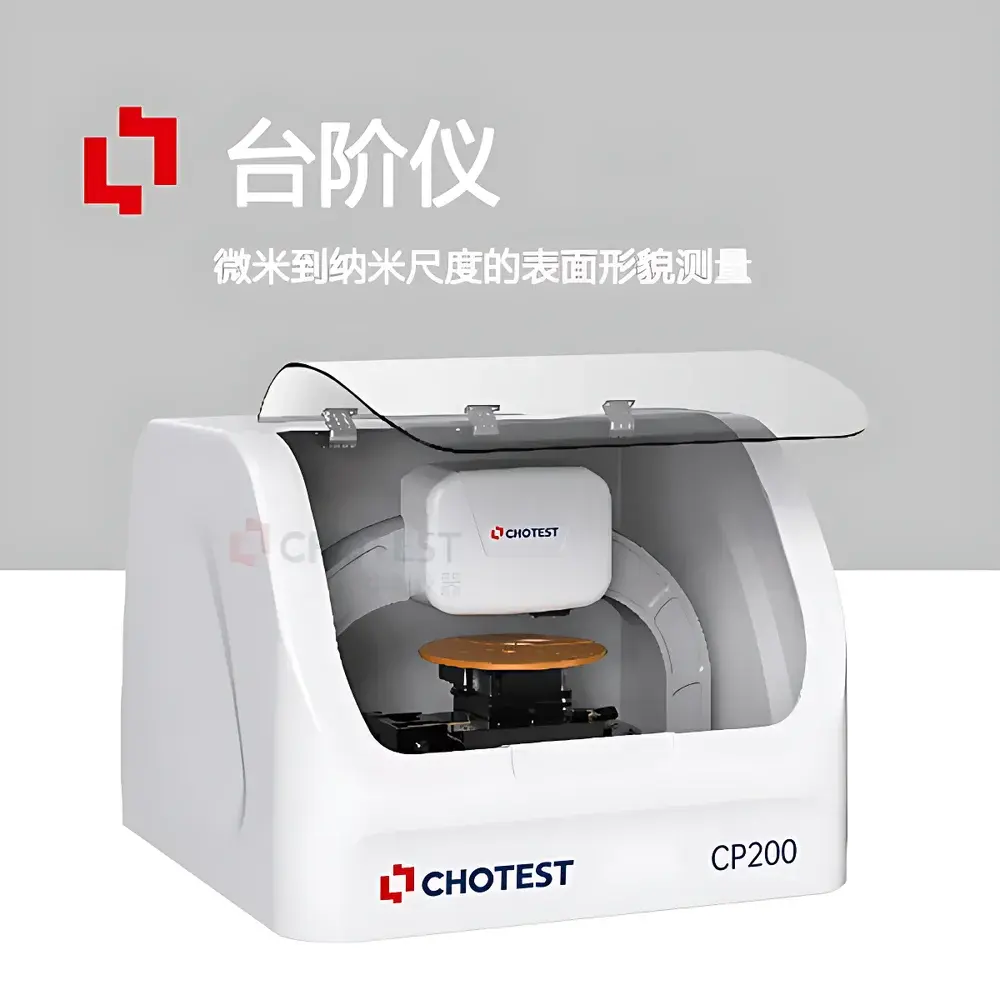
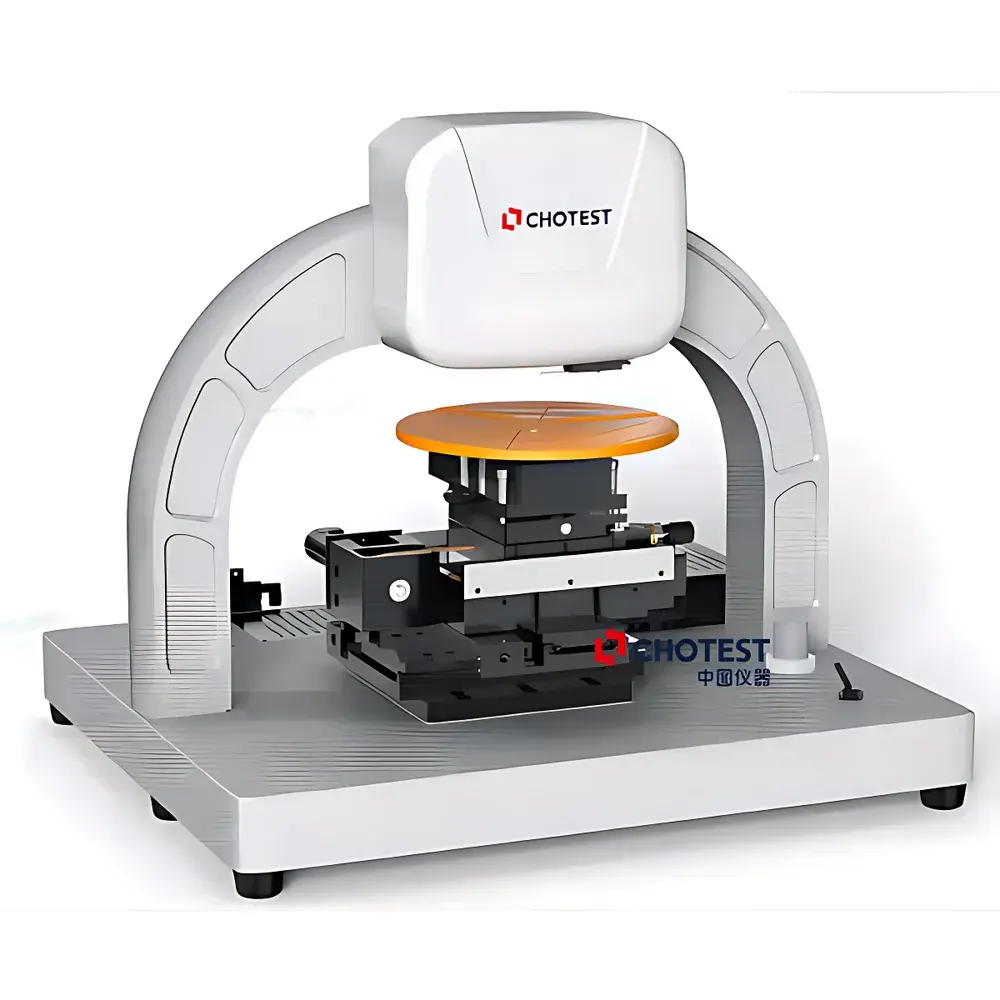
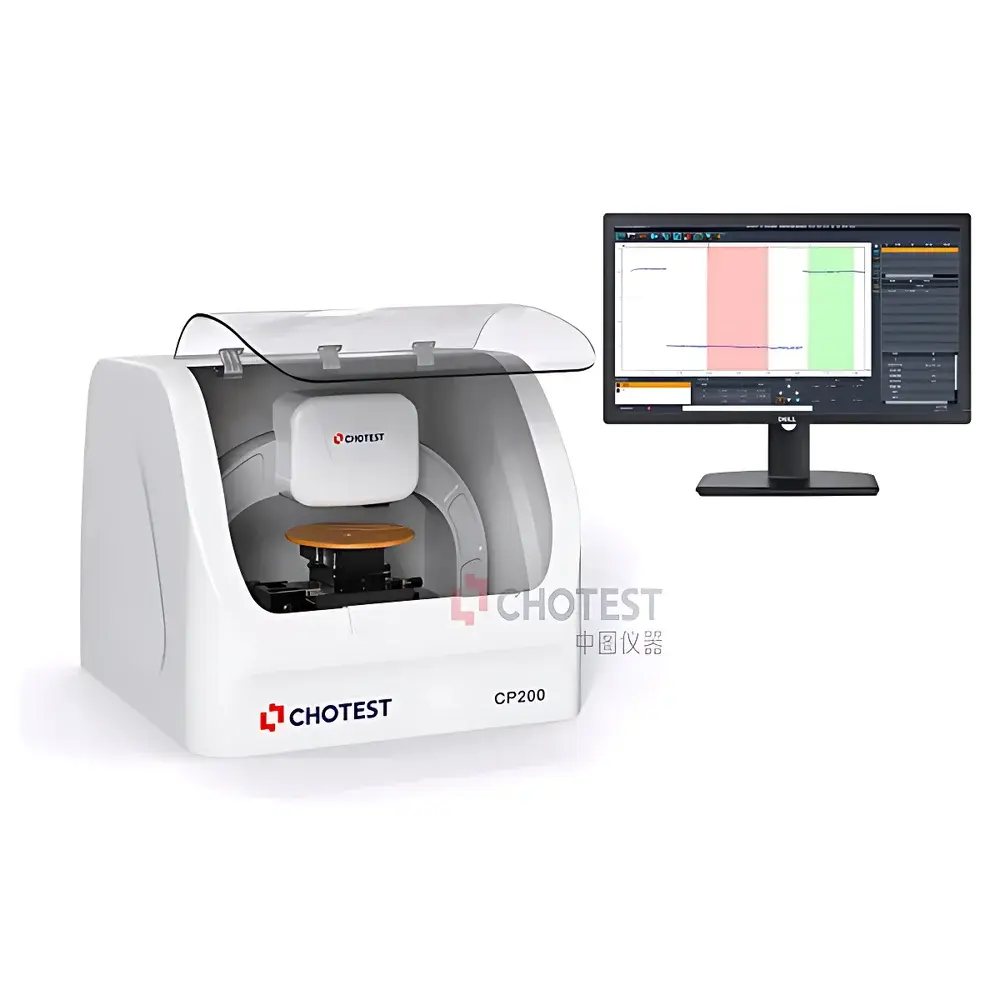
Chotest NS391 Nanoscale Precision Contact Profilometer for Surface Topography Measurement
| Brand | Chotest |
|---|---|
| Origin | Guangdong, China |
| Model | NS391 |
| Measurement Principle | Capacitive (LVDC Sensor) |
| Measurement Area | 150 mm × 150 mm |
| Scan Length | 55 mm |
| Step Height Repeatability | 5 Å |
| Maximum Sample Size | 200 mm (8-inch wafer) |
| Sensor Resolution | ≤0.01 Å (at 13 µm range) |
| Force Control | Adjustable constant contact force, ultra-low inertia electromagnetic actuation |
| Structural Design | Single-arch龙门 (monolithic龙门) frame with vibration isolation |
| Optical Navigation | 5 MP color camera, coaxial & oblique viewing options |
| Software Modules | SPC analysis, multi-region auto-scan, 3D surface reconstruction, stress calculation, roughness/waviness parameter extraction (Ra, Rq, Rv, Rp, Rz, etc.) |
Overview
The Chotest NS391 is a nanoscale-precision contact profilometer engineered for quantitative characterization of surface topography in research and industrial metrology environments. It operates on the principle of mechanical stylus profiling, where a diamond-tipped probe traverses the sample surface under precisely regulated contact force, converting vertical displacement into high-fidelity analog signals via a Linear Variable Differential Capacitance (LVDC) transducer. This capacitive sensing architecture delivers sub-ångström resolution—0.01 Å at full 13 µm range—with exceptional linearity (<0.02% F.S.) and signal-to-noise ratio (>100 dB), enabling traceable measurement of step heights from single-digit nanometers up to 1050 µm. The instrument’s monolithic single-arch龙门 frame minimizes structural compliance and isolates the measurement axis from ambient acoustic and seismic disturbances, ensuring stability across extended scan durations and multi-point repeatability within ±5 Å (1σ). Designed to meet ISO 25178-2:2012 and ASTM E1912–22 requirements for areal surface texture measurement, the NS391 supports calibration traceability to NIST-traceable step height standards.
Key Features
- LVDC sensor with dual-force capability: switchable between ultra-low-force mode (≤10 µN) for soft polymers and compliant films, and standard-force mode (1–50 mN) for hard substrates including SiC, sapphire, and fused silica.
- Motorized XYZ stage with continuous 360° rotation: precision-ground linear guides ensure <0.1 µm bidirectional positioning repeatability; angular resolution of 0.001° enables precise alignment of anisotropic features such as grating lines or MEMS comb drives.
- Dual-optical navigation system: 5-megapixel color camera provides both coaxial (top-down) and oblique-view imaging for real-time probe trajectory verification and sub-pixel scan path definition—critical for off-center or asymmetric features.
- Magnetic quick-change stylus mount: allows tool-free replacement of cantilever probes (e.g., 2 µm radius diamond, 330 µm range) with software-guided recalibration in <90 seconds, maintaining measurement integrity without manual re-alignment.
- Integrated active vibration damping: pneumatic isolation platform coupled with internal mass-spring compensation reduces floor-borne noise below 1 Hz, preserving signal fidelity during long-range scans (>40 mm).
Sample Compatibility & Compliance
The NS391 imposes no constraints on sample reflectivity, electrical conductivity, or chemical composition—making it suitable for non-conductive photoresists, transparent dielectrics (e.g., SiO₂, Ta₂O₅), metallic thin films (Al, TiN, Cu), and brittle compound semiconductors (GaN, InP). Its adjustable contact force accommodates materials ranging from soft hydrogels (modulus ~10 kPa) to hardened steel (HV > 600). All firmware and data handling comply with FDA 21 CFR Part 11 requirements for electronic records and signatures, including audit trail logging, user access control, and secure data export (CSV, X3P, ISO-standard .sdf). Calibration certificates conform to ISO/IEC 17025:2017 and include uncertainty budgets per GUM (JCGM 100:2008).
Software & Data Management
The proprietary ProfilSoft™ v5.2 platform includes modular workflows aligned with ISO 4287, ISO 4288, and ISO 13565-2 for profile-based roughness analysis, plus ISO 25178-601 for areal parameters. Key capabilities include: automated multi-site batch measurement with coordinate mapping; SPC dashboards with Cpk/Ppk trend charts and outlier detection; 3D surface reconstruction from dense line-scan arrays (up to 1024 × 1024 points); stress calculation using Stoney’s equation with thermal expansion coefficient input; and export-ready reports supporting GLP/GMP documentation (PDF + raw binary + metadata XML). All datasets are stored with embedded timestamp, operator ID, environmental conditions (temperature/humidity), and sensor calibration state.
Applications
The NS391 serves as a primary metrology tool in semiconductor front-end process control (CMP endpoint detection, etch depth uniformity, resist thickness after develop), photovoltaic cell texturing validation, optical coating thickness verification (anti-reflective, HR, beam-splitter stacks), MEMS device release inspection (stiction assessment, gap height), and advanced packaging (TSV depth, redistribution layer step coverage). Academic applications include nanomaterial synthesis characterization (graphene flake height, MOF film porosity), tribology studies (wear scar cross-sectioning), and biomaterial surface engineering (cell-adhesion topography correlation). Its ability to resolve atomic-layer deposition (ALD) cycles (0.1 nm/layer) and quantify picoliter-volume inkjet droplet spreading makes it indispensable for process development labs requiring SI-traceable dimensional metrology.
FAQ
What is the minimum measurable step height with guaranteed uncertainty?
The NS391 achieves a calibrated lower limit of quantification (LoQ) of 0.2 nm (2 Å) for steps ≥10 nm tall, with expanded uncertainty (k=2) of ±0.08 nm under controlled lab conditions (20 ±0.5°C, <45% RH).
Can the system measure through transparent layers such as glass or quartz substrates?
Yes—the capacitive LVDC sensor is insensitive to optical transmission; measurements are performed directly on the top surface regardless of substrate transparency or refractive index.
Is the instrument compatible with cleanroom Class 100/ISO 5 environments?
The NS391 meets SEMI S2-0215 safety guidelines and can be configured with HEPA-filtered air purge ports and static-dissipative housing for integration into ISO 5 cleanrooms; full qualification requires customer-specific particle shedding testing.
Does the software support automated pass/fail judgment against user-defined tolerances?
Yes—threshold-based go/no-go logic can be embedded in measurement sequences, with visual alerts and automatic log flagging upon tolerance violation; results feed directly into MES/QMS systems via OPC UA interface.
How often does the LVDC sensor require factory recalibration?
Annual recalibration is recommended per ISO/IEC 17025; however, built-in self-diagnostic routines and on-site reference step standards allow daily verification without interrupting production workflow.