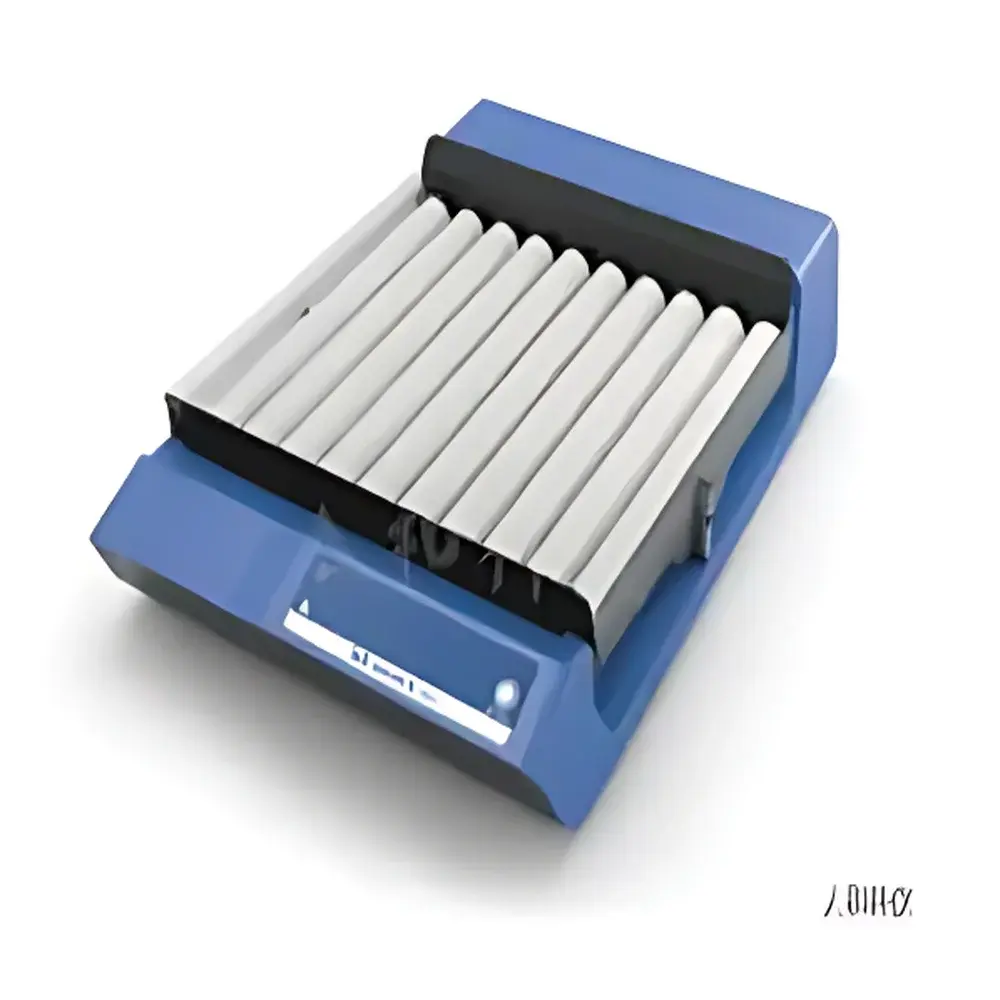
IKA ROLLER 10 basic 10-Axis Rolling Mixer
| Brand | IKA |
|---|---|
| Origin | Germany |
| Model | ROLLER 10 basic |
| Oscillation Frequency | 0–30 rpm |
| Oscillation Amplitude | 16 mm |
| Temperature Range | 4–50 °C |
| Roll Diameter | 32 mm |
| Roll Length | 327 mm |
| Working Surface Length | 350 mm |
| Tilt Angle | 3° |
| IP Rating | IP21 |
| Input Voltage | 100–240 V, 50/60 Hz |
| Power Consumption | 24 W |
| Weight | 6 kg |
| Dimensions (W × H × D) | 380 × 115 × 545 mm |
| Operating Ambient Temperature | 4–50 °C |
| Max. Relative Humidity | 80 % |
| Roll Count | 10 |
| Roll Mounting | Removable & Replaceable |
| Stacking Capability | Yes |
Overview
The IKA ROLLER 10 basic is a precision-engineered 10-axis rolling mixer designed for gentle, continuous, and reproducible mixing of biological and viscous samples under controlled thermal conditions. Unlike orbital or vortex shakers, this device employs a low-shear rolling motion—combining rocking and end-over-end rotation—optimized to maintain sample integrity during extended incubation periods. Its fixed-speed operation at 30 rpm (with 0 rpm standby) ensures consistent mechanical input without speed variability, making it ideal for applications where process repeatability and minimal shear stress are critical. The unit is fully compatible with standard laboratory vessels—including conical tubes (15–50 mL), centrifuge tubes, glass vials, and cylindrical bottles—enabling uniform suspension of cells, precipitates, immunoassay reagents, and high-viscosity matrices such as agarose gels or polymer solutions. Its compact footprint and stackable design support modular integration into cold rooms, incubators, and biosafety cabinets.
Key Features
- 10 independently mounted rollers with 32 mm diameter and 327 mm length, each adjustable to a fixed 3° tilt angle for optimized fluid displacement and laminar flow development
- Gentle end-over-end rolling motion with 16 mm maximum axial travel per roller, minimizing bubble formation and cellular damage in sensitive suspensions
- Thermally robust construction rated for continuous operation within ambient environments from 4 °C to 50 °C—fully validated for placement inside refrigerated incubators and CO2 chambers
- Removable and replaceable roller assemblies facilitate rapid decontamination and maintenance; spill-resistant surface geometry allows efficient wipe-down after accidental overflow
- Stackable chassis design enables vertical expansion of throughput without requiring additional bench space—ideal for high-volume sample processing workflows
- IP21-rated enclosure provides protection against vertically falling drips and solid objects >12.5 mm, meeting essential safety requirements for laboratory-grade equipment in non-hazardous environments
- Universal power supply (100–240 V, 50/60 Hz) with low-power DC drive system (24 V, 1 A) delivering energy-efficient operation at just 24 W nominal consumption
Sample Compatibility & Compliance
The ROLLER 10 basic accommodates a broad range of vessel geometries and materials, including polypropylene, polycarbonate, borosilicate glass, and silicone-capped tubes. Its fixed-tilt roller configuration ensures stable retention of upright or near-vertical containers without clamping mechanisms—reducing risk of tube deformation or cap loosening during prolonged runs. The device complies with DIN EN 60529 for ingress protection and conforms to IEC 61010-1:2010 for electrical safety in laboratory equipment. While not equipped with digital communication interfaces (e.g., RS232, USB), its passive analog architecture supports GLP-compliant documentation when integrated into validated workflows using external environmental loggers or chamber monitoring systems.
Software & Data Management
The ROLLER 10 basic operates as a stand-alone, hardware-controlled instrument with no embedded microprocessor, touchscreen interface, or software-driven parameter adjustment. This architecture eliminates firmware dependencies, reduces validation burden, and ensures deterministic behavior across installations—particularly advantageous in regulated environments where change control and audit trail requirements apply. Time-based protocols are managed externally via incubator timers or facility scheduling systems. For laboratories implementing 21 CFR Part 11–compliant processes, the device may be documented as a “fixed-parameter auxiliary device” within electronic batch records, with operational status verified through physical inspection and temperature mapping reports.
Applications
- Long-term hybridization and washing steps in Southern/Northern blotting protocols
- Antibody incubation and antigen retrieval in immunohistochemistry (IHC) and ELISA plate preparation
- Homogenization of blood-derived samples (e.g., serum separation, clot retraction studies)
- Preparation of uniform cell suspensions prior to FACS sorting or cryopreservation
- Stabilization of protein–ligand complexes during binding kinetics assays
- Mixing of viscous reagents such as glycerol stocks, DNA ligation master mixes, and hydrogel precursors
- Continuous agitation of microbial cultures in stationary-phase studies under temperature-controlled conditions
FAQ
Is the ROLLER 10 basic suitable for use inside a CO2 incubator?
Yes—the unit is rated for continuous operation at temperatures up to 50 °C and relative humidity ≤80 %, making it compatible with standard CO2 incubator environments when placed on stable internal shelving.
Can the rotation speed be adjusted?
No—the ROLLER 10 basic operates exclusively at a fixed 30 rpm; it does not feature variable-speed control or programmable timing functions.
Are replacement rollers available as spare parts?
Yes—individual rollers and mounting brackets are orderable as genuine IKA consumables (part numbers available upon request), supporting long-term serviceability and contamination control.
Does the device include overtemperature or motor overload protection?
Yes—integrated thermal cut-off circuitry prevents sustained operation beyond safe thermal thresholds, and current-limiting drivers protect against stalling-induced coil damage.
Can multiple units be synchronized or daisy-chained?
No—each unit operates independently with no inter-device communication capability; synchronization must be achieved manually or via external timing infrastructure.