
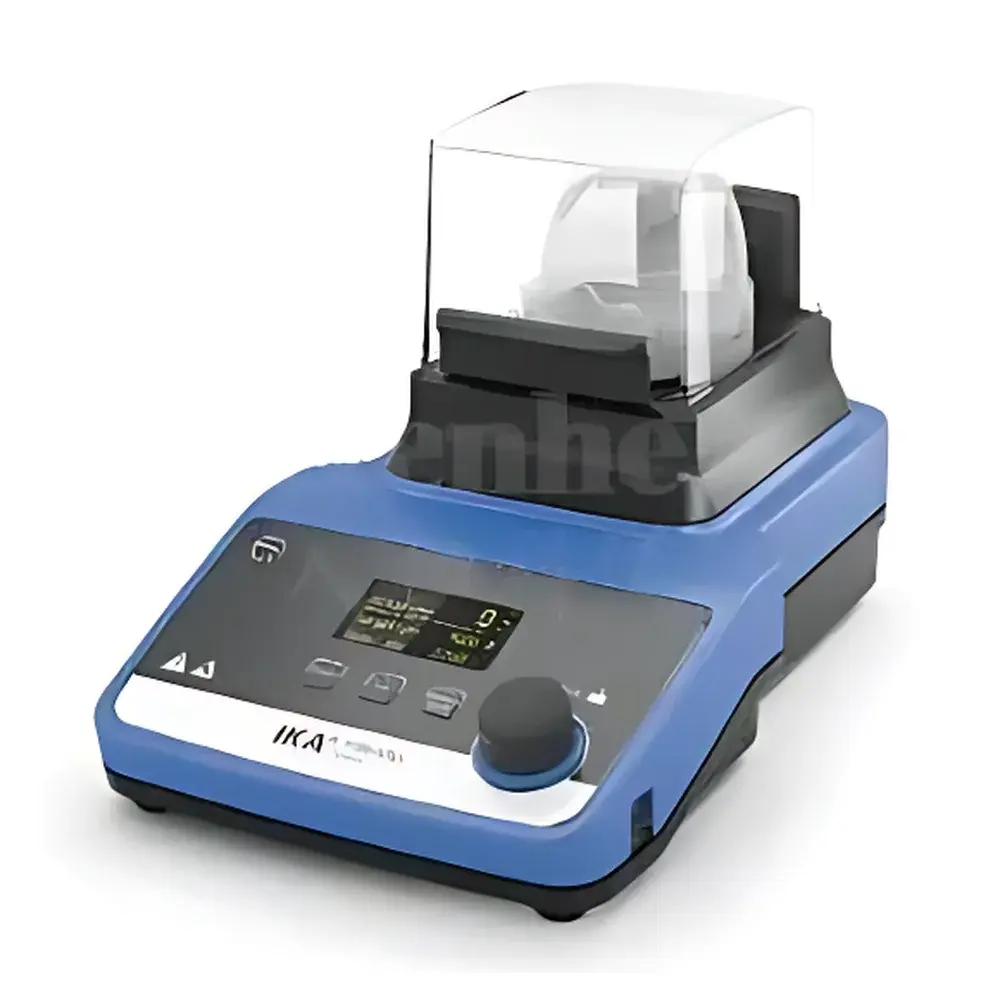
IKA Tube Mill control Controlled Tube Mill Grinder
| Brand | IKA |
|---|---|
| Origin | Germany |
| Model | Tube Mill control |
| Instrument Type | Grinder |
| Sample Applicability | Hard and brittle samples (max. hardness 5 Mohs) |
| Feed Particle Size | ≤10 mm |
| Final Particle Size | 0.01–0.5 mm (with <100 µm achievable under optimized conditions) |
| Batch Volume | 40 mL |
| Speed Range | 5,000–25,000 rpm |
| Speed Accuracy | ±2% |
| Max. Peripheral Speed | 65 m/s |
| Motor Input Power | 100 W |
| Motor Output Power | 80 W |
| Operating Time | Up to 3 min continuous |
| Cooling Options | Ambient air only (no integrated water/liquid nitrogen cooling ports) |
| Dimensions (W×D×H) | 180 × 170 × 300 mm |
| Weight | 2.7 kg |
| Ambient Operating Conditions | 5–40 °C, ≤80% RH |
| Protection Rating | IP30 (per DIN EN 60529) |
| Interface | USB (for remote control & data logging) |
| RS-232 | No |
| Analog Output | No |
| Voltage | 220–240 V / 100–120 V AC |
| Frequency | 50/60 Hz |
Overview
The IKA Tube Mill control is a precision-engineered, batch-type tube mill grinder designed for reproducible, contamination-free size reduction of hard, dry, and brittle laboratory samples. It operates on the principle of high-speed rotational impact and shear, generated by a vertically oriented, motor-driven grinding element within a disposable polycarbonate grinding cup. Unlike conventional jaw or disc mills, the Tube Mill control employs a sealed, single-use consumable cup system—eliminating cross-contamination risks and eliminating cleaning validation requirements between runs. Its operational safety architecture conforms to IEC 61000-6-2/6-4 and incorporates multiple hardware interlocks: grinding initiates only when both the transparent protective hood is fully closed and the grinding cup is correctly seated and locked. The motor–cup interface features a labyrinth seal (curved-path dynamic seal), preventing dust ingress into the drive assembly and ensuring long-term reliability in particulate-rich environments.
Key Features
- True single-use grinding cups: Transparent polycarbonate construction enables real-time visual monitoring of sample comminution without interrupting operation.
- Programmable digital control: OLED display supports multi-language UI (English, German, French, Spanish), precise timing (5 s – 3 min), and variable speed selection (5,000–25,000 rpm) with ±2% speed stability.
- Configurable operating modes: Continuous, intermittent (pulse), and programmable ramp-up/down profiles for thermal-sensitive or cohesive materials.
- Integrated safety logic: Automatic shutdown and error-code display (e.g., E01 = cup misalignment, E02 = hood open) prevent unintended activation or unsafe operation.
- USB interface compliant with CDC ACM class: Enables host PC-based remote start/stop, parameter upload/download, and timestamped event logging (start time, duration, speed, error events) — supporting audit-ready GLP workflows.
- Acoustically optimized housing: Sound-dampened enclosure maintains noise levels below 72 dB(A) at 1 m distance during peak operation.
- Robust mechanical design: Aluminum die-cast chassis, IP30-rated enclosure, and brushless DC motor ensure consistent torque delivery across the full speed range (max. peripheral speed: 65 m/s).
Sample Compatibility & Compliance
The Tube Mill control is validated for processing samples with Mohs hardness up to 5 — including seeds (maize, wheat, barley), pharmaceutical tablets, mineral fragments, polymer granules, and botanical tissues. It accepts feed particles ≤10 mm and delivers final particle distributions typically within 0.01–0.5 mm, with sub-100 µm output achievable using optimized speed/time combinations and appropriate cup geometry. While not equipped with active cryogenic or liquid-cooling ports, its short-cycle operation (≤3 min) inherently limits thermal buildup — making it suitable for thermolabile analytes where extended grinding is contraindicated. The device complies with CE marking requirements (2014/30/EU EMC Directive, 2014/35/EU LVD), RoHS 2011/65/EU, and meets essential health and safety requirements per EN 61000-1-2. Its USB data logging capability supports traceability needs aligned with FDA 21 CFR Part 11 (when paired with compliant host software), and its deterministic batch processing supports ISO/IEC 17025 method validation frameworks.
Software & Data Management
The Tube Mill control does not include embedded firmware-based method storage; instead, it relies on host-side configuration via USB-connected PCs running vendor-supplied or third-party Lab Automation Software (e.g., LabVIEW, Python pySerial scripts). All operational parameters — start time, target speed, duration, actual speed profile (sampled at 10 Hz), and fault events — are streamed in ASCII-formatted CSV packets. This architecture allows integration into LIMS or ELN systems via standard serial-to-TCP/IP gateways. Audit trails generated include operator ID (if entered manually), method name, timestamped run logs, and checksum-verified error codes — fulfilling documentation requirements for ISO 17025 Clause 7.7 and GMP Annex 11 data integrity expectations.
Applications
- Pre-analytical sample homogenization prior to elemental analysis (ICP-OES/MS), XRF, or NIR spectroscopy.
- Routine QC grinding of cereal grains for moisture, protein, and mycotoxin testing (aligned with AACC Method 22-02 and ISO 6540).
- Pharmaceutical solid dosage form comminution for content uniformity testing (USP <905>).
- Environmental soil and sediment sample preparation for heavy metal extraction (EPA Method 3050B).
- Materials science R&D of ceramic precursors, battery electrode powders, and additive manufacturing feedstocks.
FAQ
Is cryogenic grinding supported?
No. The Tube Mill control lacks provisions for liquid nitrogen or dry ice integration; cooling is passive via ambient air convection only.
Can grinding parameters be saved onboard?
No. The device has no internal memory; all methods must be stored externally and uploaded via USB prior to each run.
What maintenance is required?
Annual inspection of the labyrinth seal integrity and motor brushless commutation electronics is recommended; no routine lubrication is needed.
Is the grinding cup autoclavable?
No. Polycarbonate cups are single-use and not rated for steam sterilization; reuse compromises structural integrity and contamination control.
Does the instrument support 21 CFR Part 11 compliance?
Yes — when used with validated, Part 11-compliant host software that enforces electronic signatures, audit trails, and role-based access control over USB command sequences.



