
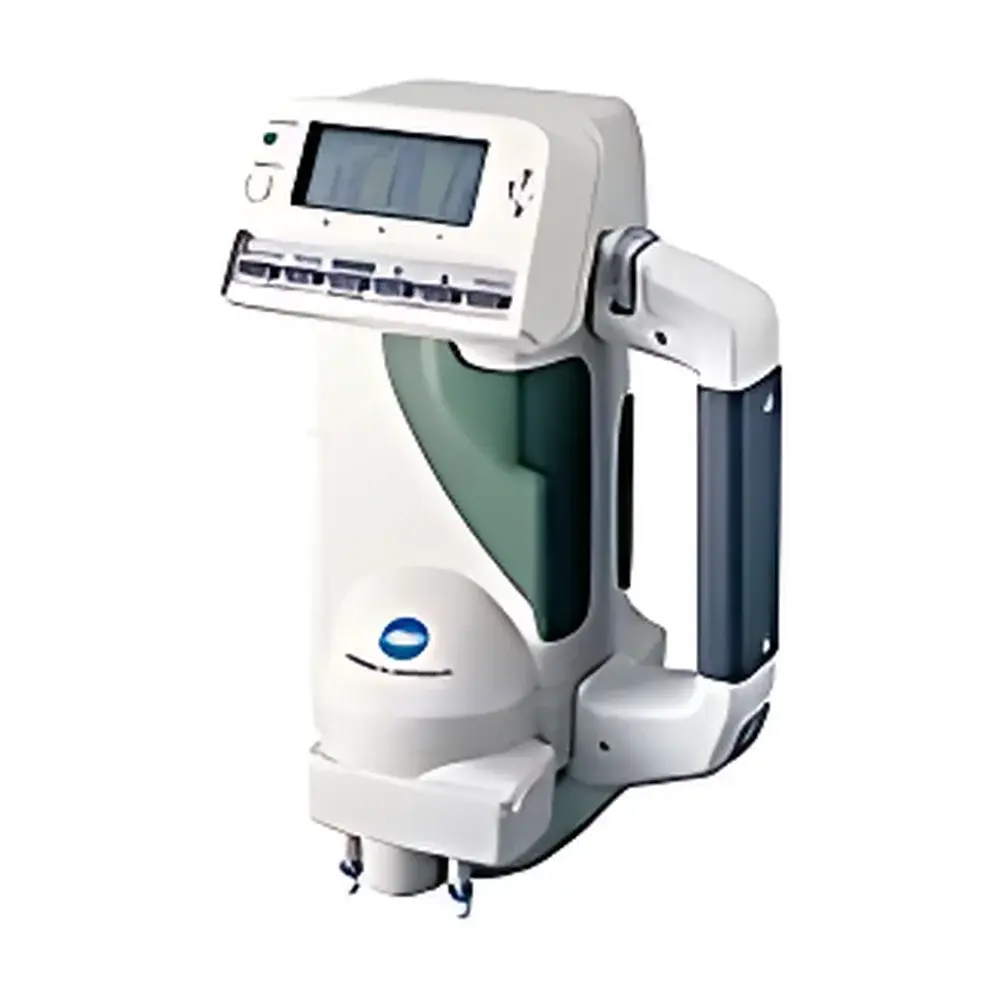
Konica Minolta CM-512m3 Multi-Angle Spectrophotometer
| Brand | Konica Minolta |
|---|---|
| Origin | Japan |
| Model | CM-512m3 |
| Illumination/Reception Geometry | 25°/0°, 45°/0°, 75°/0° (annular multi-angle) |
| Wavelength Range | 400–700 nm |
| Wavelength Interval | 20 nm |
| Reflectance Range | 25°: 0–300% |
| 45°/75° | 0–200% |
| Photometric Resolution | 0.01% |
| Light Source | Pulsed Xenon Arc Lamp |
| Minimum Measurement Interval | 7 s (with white calibration tile, at 23°C) |
| Repeatability | ΔE*ab ≤ 0.05 (n=30, 10-s interval), Spectral Reflectance SD ≤ 0.30% |
| Aperture | Measuring Ø12 mm / Illuminating Ø20 mm |
| Temperature Sensing | Thermopile detector (8–13 µm), Range: −10 to +80°C (±2.5°C accuracy at 0–50°C, ε=0.93) |
| Display | 128×56-dot reflective LCD (21 chars × 7 lines) |
| Interface | RS-232C (D-sub 9-pin female) |
| Power | 4× AA alkaline batteries or optional AC adapter |
| Dimensions (W×H×D) | 115×257×164 mm |
| Weight | ≈1.4 kg (battery-free) |
Overview
The Konica Minolta CM-512m3 is a dedicated multi-angle spectrophotometer engineered for precise color evaluation of effect pigments—particularly metallic and pearlescent coatings widely used in automotive OEM and refinish applications. Unlike conventional 45°/0° or d/8° instruments, the CM-512m3 implements a rigorously symmetric optical architecture with three discrete illumination angles—25°, 45°, and 75°—all referenced to a fixed 0° viewing axis. This geometry replicates human visual perception under varying incident lighting conditions, enabling quantitative capture of goniochromatic behavior such as flop, sparkle, and graininess. The annular arrangement of 18 independent light sources ensures isotropic illumination, eliminating orientation-dependent measurement bias—a known limitation in earlier rotating-gonio systems. Its solid-state design incorporates no moving mechanical parts, enhancing long-term stability and field robustness in production environments. Integrated thermal sensing (8–13 µm thermopile) records surface temperature synchronously with spectral acquisition, supporting correlation of chromatic shifts with thermal history—an essential capability for evaluating thermochromic response in cured coatings.
Key Features
- Triple-angle simultaneous measurement: Captures reflectance spectra at 25°, 45°, and 75° in a single 7-second cycle—enabling direct calculation of flop index (e.g., 25°/75° ratio) and angular color difference metrics without manual repositioning.
- Annular multi-directional illumination: 18-point circumferential xenon flash array eliminates directional sensitivity, ensuring consistent results regardless of instrument rotation or sample curvature—critical for measuring complex geometries like door handles, mirror housings, or wheel rims.
- Integrated surface temperature monitoring: Real-time thermal data (−10 to +80°C, ±2.5°C accuracy) logged alongside spectral readings supports root-cause analysis of heat-induced hue shifts during process qualification or accelerated aging studies.
- On-device graphical display: Built-in 128×56-pixel reflective LCD renders spectral curves and L*C*h vectors as line plots—allowing immediate visual assessment of angular variation directly on the instrument, even in high-ambient-light factory settings.
- High photometric fidelity: Pulse xenon source delivers stable, UV-stable output across 400–700 nm (20 nm resolution); repeatability validated per ISO 13655:2017—ΔE*ab ≤ 0.05 (n=30, white tile, 10-s interval).
- Industrial-grade portability: Compact form factor (115×257×164 mm), 1.4 kg mass (battery-free), and IP54-equivalent sealing against dust/moisture support extended use in paint shops, QC labs, and supplier audit sites.
Sample Compatibility & Compliance
The CM-512m3 is optimized for non-contact measurement of flat, curved, and textured metallic surfaces—including basecoat/clearcoat systems, aluminum-flake paints, mica-based effect finishes, and electroplated substrates. Its Ø12 mm measuring aperture and Ø20 mm annular illumination field accommodate typical automotive panel samples while minimizing edge effects. The instrument complies with CIE No. 15:2018 for colorimetric observation conditions (2° and 10° standard observer), supports all major illuminants (A, C, D50, D65, F2–F12), and reports color data in industry-standard spaces: CIELAB (L*a*b*, ΔE*ab), CIELCH (L*C*h), CMC(l:c), and CIEDE2000 (ΔE₀₀). While not FDA 21 CFR Part 11-certified out-of-the-box, its RS-232C interface enables integration into GLP/GMP-compliant workflows when paired with validated third-party data acquisition software featuring audit trail and electronic signature capabilities. Calibration traceability follows JIS Z 8722 and ISO 13655 protocols using Konica Minolta’s certified ceramic white reference tiles.
Software & Data Management
Data export occurs via RS-232C serial interface to host PCs running Konica Minolta’s proprietary SpectraMagic NX software (v2.90+), which provides comprehensive analysis tools including angular scatter plots, flop ratio trend charts, pass/fail tolerance mapping against master standards, and batch statistical summaries (X̄, R, Cp/Cpk). SpectraMagic NX supports IQ/OQ documentation templates aligned with ISO/IEC 17025 requirements and permits user-defined report generation compliant with internal QA formats. Raw spectral files (.spc) are stored in ASCII format for interoperability with MATLAB, Python (NumPy/Pandas), or enterprise LIMS platforms. Firmware updates are delivered via USB-to-serial adapters; no cloud connectivity or remote telemetry is implemented—ensuring full data sovereignty and network isolation in regulated manufacturing facilities.
Applications
- Automotive OEM color approval: Quantitative verification of metallic finish conformance across multiple viewing geometries per PPAP submission requirements.
- Refinish paint formulation: Correlating pigment orientation, flake size distribution, and binder refractive index with angular reflectance profiles.
- Supplier quality control: Monitoring batch-to-batch consistency of coated components under standardized lighting and temperature conditions.
- R&D of effect coatings: Characterizing thermal hysteresis in thermoset systems or UV-induced chromatic drift in clearcoats.
- Color matching in complex geometries: Validating color uniformity on Class-A surfaces where traditional spectrophotometers yield inconsistent results due to curvature-induced cosine error.
FAQ
Does the CM-512m3 support automatic pass/fail judgment against stored standards?
Yes—SpectraMagic NX allows definition of multi-angle tolerance ellipsoids (ΔL*, Δa*, Δb*, ΔE*ab, ΔE₀₀) with configurable weighting per angle, enabling automated go/no-go decisions during inline inspection.
Can it measure transparent or translucent films over metallic substrates?
No—the instrument is designed exclusively for opaque, diffusely reflecting surfaces. Translucent layers require specialized transmission-capable goniospectrophotometers.
Is the temperature sensor calibrated to NIST-traceable standards?
The thermopile sensor is factory-calibrated against blackbody references per JIS C 1606; full NIST traceability documentation is available upon request for metrology-critical deployments.
What maintenance is required to sustain optical accuracy?
Annual recalibration using Konica Minolta’s CM-A110 calibration kit (including spectral and geometric verification tiles) is recommended; daily white calibration with supplied ceramic tile ensures short-term stability.
Does it meet automotive OEM-specific color measurement specifications (e.g., Ford WSS-M99P1111-A, GM 6091M)?
Yes—the 25°/0°, 45°/0°, 75°/0° geometry and reporting algorithms comply with the angular measurement requirements defined in these specifications when configured with appropriate illuminants and observers.




