
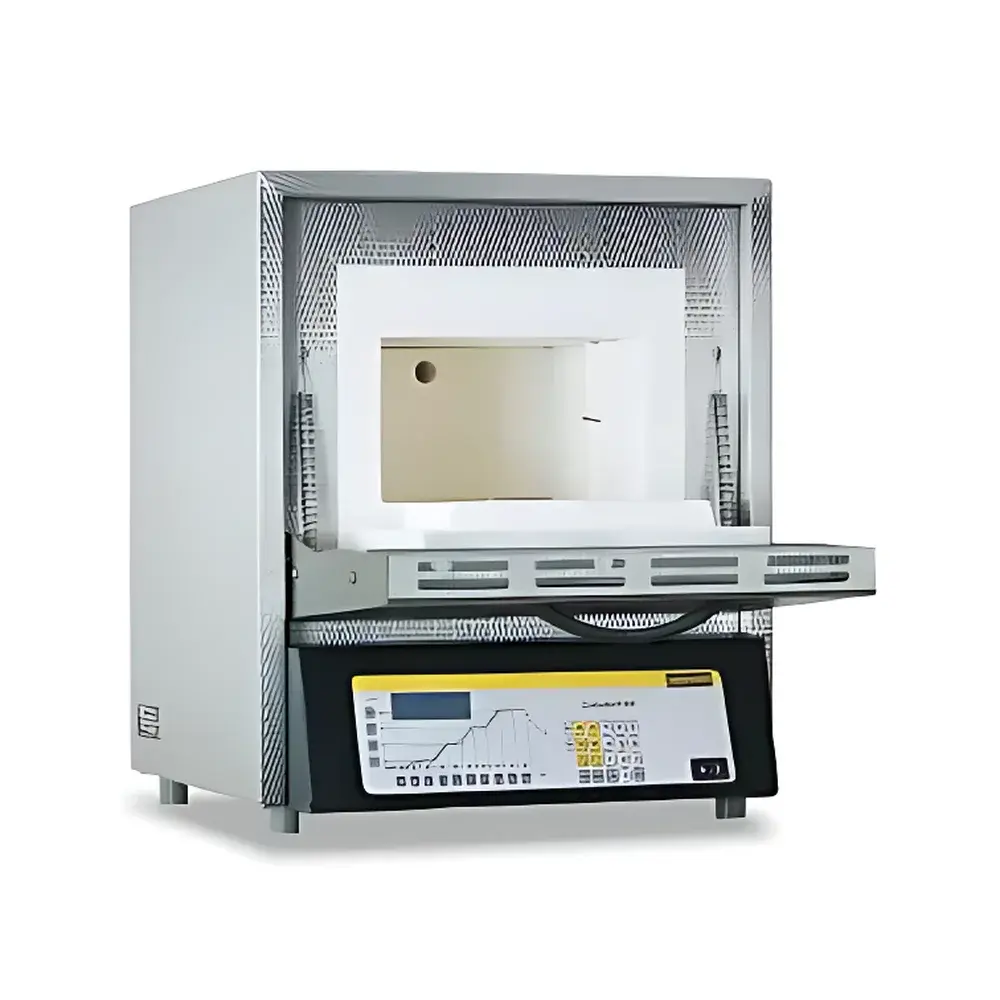
Nabertherm L5/12/P330 Tilting-Door Laboratory Muffle Furnace
| Brand | Nabertherm |
|---|---|
| Origin | Germany |
| Model | L5/12/P330 |
| Max Temperature | 1200 °C |
| Internal Dimensions (W×D×H) | 200 × 170 × 130 mm |
| Chamber Volume | 5 L |
| External Dimensions (W×D×H) | 440 × 470 × 520 mm |
| Power Supply | 1-phase, 2.4 kW |
| Net Weight | 35 kg |
| Heating Time to Max Temp | ~75 min |
| Controller | P330 Programmable Digital Controller (9 programs, 40 segments, color graphic display, 1 °C/1 min resolution, skip function, manual MV override, kWh counter, real-time clock, self-optimizing PID) |
Overview
The Nabertherm L5/12/P330 is a precision-engineered laboratory muffle furnace designed for routine thermal processing in research, quality control, and materials development laboratories. Operating on resistive heating principles with high-purity ceramic fiber insulation and a robust double-walled steel housing, it delivers uniform temperature distribution and excellent thermal stability across its 1200 °C maximum operating range. The tilting-door configuration—mechanically balanced and pneumatically assisted—enables safe, ergonomic sample loading and unloading while minimizing heat loss and operator exposure to radiant energy. As a Class I industrial furnace conforming to EN 61000-6-3 (EMC) and EN 61000-6-2 (immunity), it integrates seamlessly into GLP-compliant workflows requiring traceable, repeatable thermal treatment.
Key Features
- Tilting furnace door with smooth, low-effort actuation—optimized for frequent access without compromising chamber integrity or operator safety
- High-density ceramic fiber insulation ensuring rapid heat-up (≤75 min to 1200 °C), low surface temperature (<60 °C at ambient), and minimal standby energy consumption
- P330 programmable controller featuring a 3.5″ full-color graphical LCD, intuitive menu navigation, and dual-language interface (English/German)
- Advanced thermal management: self-optimizing PID algorithm with adaptive tuning, real-time deviation monitoring, and automatic drift compensation
- Comprehensive process logging: built-in kWh meter, runtime counter, start-time scheduling (for off-peak electricity utilization), and timestamped event history
- Two configurable auxiliary outputs supporting external devices such as exhaust dampers, cooling fans, or gas purge solenoids
- Robust construction: stainless-steel interior lining, corrosion-resistant exterior coating, and CE-marked electrical architecture compliant with IEC 61000-3-2 (harmonic current limits)
Sample Compatibility & Compliance
The L5/12/P330 accommodates standard crucibles (alumina, quartz, silicon carbide) up to Ø80 mm × 60 mm height within its 5 L chamber. Its uniformity profile (±5 °C at 1000 °C per ASTM E220-22 Annex A3) supports applications requiring strict adherence to ISO 5667-17 (water quality—sample preservation), ASTM C114 (cement chemical analysis), and USP (heavy metals testing). The furnace meets essential requirements of the EU Machinery Directive 2006/42/EC and carries full conformity documentation—including Declaration of Conformity, EC Type Examination Certificate, and detailed risk assessment report—for integration into auditable GMP and ISO/IEC 17025 environments.
Software & Data Management
While the P330 controller operates autonomously, its RS485 interface enables connection to PC-based supervision systems via optional Nabertherm LabSoft software (Windows-compatible). This permits remote program upload/download, live temperature curve visualization, and export of CSV-formatted process logs with timestamps, setpoint history, and actual temperature traces. All controller operations—including parameter changes, program starts/stops, and alarm acknowledgments—are recorded with user ID, timestamp, and action type, satisfying FDA 21 CFR Part 11 requirements for electronic records when deployed with validated system configurations. Audit trails are non-erasable and support GLP audit readiness.
Applications
- Thermal gravimetric analysis (TGA) sample preparation and residue quantification
- Ash content determination per AOAC 942.05, ISO 2171, and DIN 51718
- Calcination of catalyst precursors, metal oxides, and battery cathode materials
- Heat treatment of ceramics, dental prosthetics, and metallurgical samples
- Pre-burning of filter papers and crucibles prior to elemental analysis (ICP-OES, AAS)
- Controlled oxidation studies under ambient air or inert gas purge (with optional gas inlet kit)
- Calibration verification of thermocouples and reference materials per ISO/IEC 17025 Clause 6.4.10
FAQ
What is the heating principle employed by the L5/12/P330?
It utilizes Joule heating via embedded Kanthal A1 resistance wire elements embedded in high-alumina ceramic fiber insulation, ensuring efficient energy transfer and minimal thermal mass.
Does the furnace support inert or reducing atmospheres?
Yes—when equipped with the optional gas inlet adapter (part no. 00029712), it accepts continuous N₂, Ar, or forming gas flows up to 1 L/min with adjustable pressure regulation.
Is the P330 controller compliant with 21 CFR Part 11?
The controller itself is not standalone Part 11 compliant; however, when integrated into a validated LabSoft-controlled environment with electronic signatures, audit trail logging, and access controls, it fulfills applicable requirements for regulated laboratories.
What maintenance is required for long-term reliability?
Annual inspection of door gasket integrity, thermocouple calibration verification against NIST-traceable standards, and visual check of heating element continuity using a multimeter are recommended.
Can the furnace be integrated into a central laboratory automation system?
Yes—via Modbus RTU over RS485, it supports polling of temperature, status flags, and error codes by SCADA or LIMS platforms using standard protocol mapping.



