
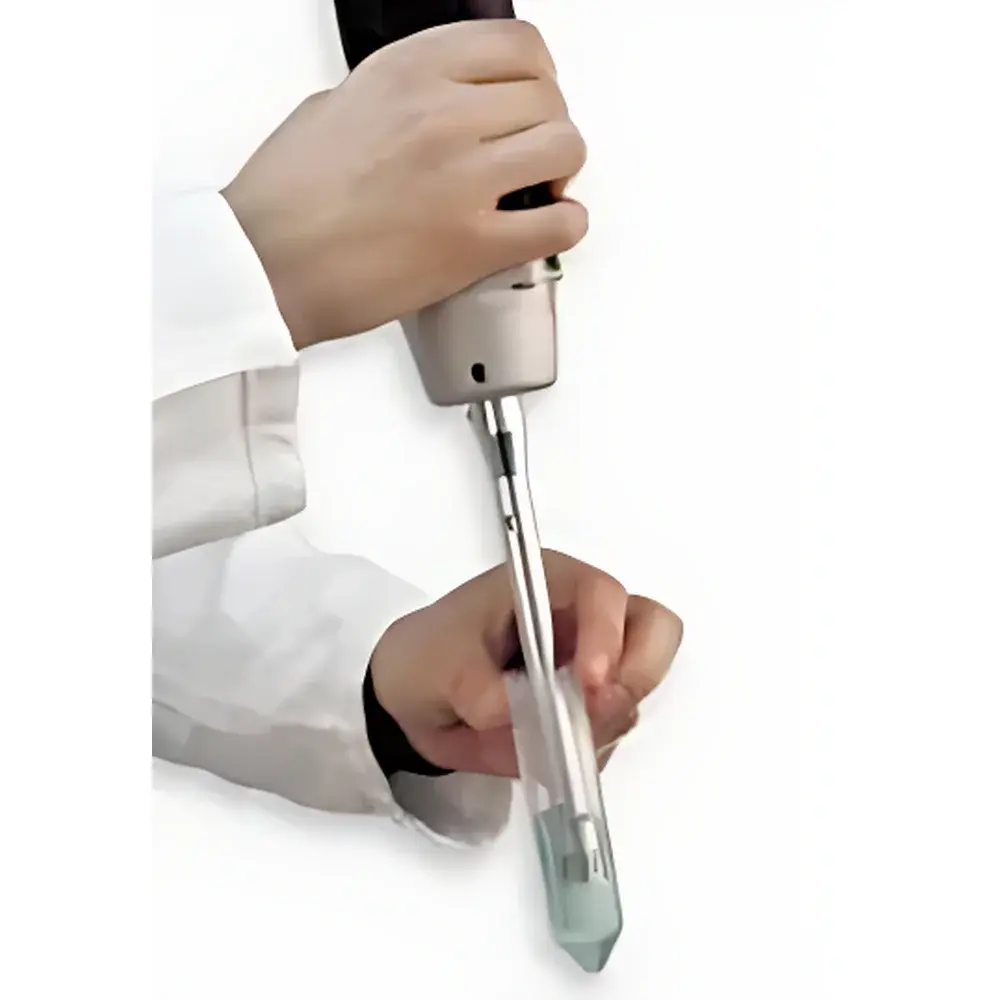
MicCRA Pico Series Micro-Dispersion Homogenizer Probes (DS-5, PEDS-8, PDS-14)
| Brand | MicCRA |
|---|---|
| Origin | Germany |
| Model | DS Series (Stator Diameter: 5–14 mm) |
| Probe Types | DS-5 / PEDS-8 / PDS-14 |
| Stator Outer Diameter | 5 mm / 8 mm / 14 mm |
| Rotor Outer Diameter | 3.6 mm / 5.6 mm / 10.6 mm |
| Max Tip Speed | 7.3 m/s / 11.4 m/s / 21.6 m/s |
| Probe Length | 115 mm / 155 mm / 200 mm |
| Minimum Immersion Depth | 30 mm (DS-5), 80 mm (PEDS-8), 125 mm (PDS-14) |
| Recommended Sample Volume (Water) | 0.1–20 mL / 1–100 mL / 10–500 mL |
| Rotor Type | Shearing Rotor |
| Stator Type | Toothed (Peg-Type) Stator |
| Application Domain | Microscale Biological Homogenization |
Overview
The MicCRA Pico Series micro-dispersion homogenizer probes are precision-engineered stainless steel rotor-stator assemblies designed for low-volume, high-shear biological sample processing under thermally sensitive conditions. Based on the Couette–Taylor flow principle and high-speed shear gradient generation, these probes deliver controlled mechanical disruption of cells, tissues, and macromolecular aggregates without significant viscous heating—a critical requirement in RNA integrity preservation, PCR-grade nucleic acid extraction, and enzyme activity retention. Compatible exclusively with MicCRA D-1 and D-9 high-speed dispersing units (operating up to 30,000 rpm), the Pico probes generate localized shear rates exceeding 10⁶ s⁻¹ at the rotor-stator interface, enabling rapid lysis of mammalian cells, bacterial suspensions, and fibrous plant tissues while maintaining biomolecular conformational stability.
Key Features
- Three standardized probe configurations (DS-5, PEDS-8, PDS-14) optimized for distinct volume ranges—0.1–20 mL, 1–100 mL, and 10–500 mL—ensuring geometric scalability without compromising shear fidelity.
- Toothed peg-type stators paired with precision-ground shearing rotors generate uniform turbulent micro-eddies, minimizing dead zones and ensuring reproducible particle size reduction across replicate samples.
- Stainless steel 316L construction meets ISO 8573-1 purity class 4 for particulate contamination and complies with FDA 21 CFR Part 11 requirements for material traceability when used in regulated workflows.
- Probe lengths (115–200 mm) and minimum immersion depths (30–125 mm) are engineered to ensure stable submersion during operation, preventing vortex-induced cavitation and air entrainment in low-viscosity aqueous media.
- Tip speeds ranging from 7.3 to 21.6 m/s provide tunable shear intensity—enabling method transfer between analytical-scale RNA isolation and preparative-scale organelle fractionation protocols.
Sample Compatibility & Compliance
The Pico probes demonstrate validated compatibility with a broad spectrum of biological matrices: intact mammalian tissues (liver, brain, spleen), cultured cell pellets (HEK293, Jurkat, primary neurons), microbial cultures (E. coli, S. cerevisiae), and plant leaf homogenates. Each probe variant is routinely employed in workflows aligned with ISO/IEC 17025-accredited laboratories for nucleic acid extraction prior to qRT-PCR, NGS library preparation, and Western blot sample conditioning. The absence of measurable temperature rise (<0.5 °C over 30 s at maximum speed in 1 mL buffer) satisfies USP criteria for analytical instrument qualification in thermal-sensitive applications. All probes are supplied with CE marking per Directive 2006/42/EC (Machinery Directive) and conform to RoHS 2011/65/EU restrictions on hazardous substances.
Software & Data Management
While the Pico probes themselves are passive hardware components, their performance is fully integrated into the MicCRA D-1/D-9 digital control ecosystem. Host instruments feature programmable speed ramps, time-controlled duty cycles (1–300 s), and real-time torque monitoring—data logged via USB or RS-232 to compliant LIMS environments. Audit trails include timestamped parameter sets (speed, duration, probe ID), operator credentials, and calibration status flags—all retained for ≥24 months to support GLP/GMP audit readiness. Export formats include CSV and XML, compatible with laboratory informatics platforms adhering to ASTM E1469-20 standards for analytical data interchange.
Applications
- Routine RNA/DNA extraction for diagnostic PCR and multiplexed gene expression profiling, where RNase inhibition and transcript integrity (RIN >9.0) are mandatory.
- Preparation of subcellular fractions—including mitochondria, nuclei, and synaptic vesicles—from neural tissue with minimal proteolytic activation.
- Homogenization of cryopreserved biobank specimens where ice crystal-induced membrane damage must be avoided.
- Shear-mediated disaggregation of amyloid fibrils and protein aggregates for structural biology studies requiring monodisperse suspensions.
- Standardized dispersion of nanocarriers (liposomes, polymeric micelles) in preformulation development under ICH Q5A-compliant process controls.
FAQ
Are Pico probes autoclavable?
Yes—full sterilization is achievable at 121 °C, 15 psi for 20 minutes; repeated cycles do not compromise dimensional tolerance or surface finish.
Can DS-5 be used with the D-9 disperser?
Yes—MicCRA D-9 supports all Pico probes via its universal quick-lock coupling; speed limits remain governed by probe-specific tip velocity constraints.
What cleaning protocol is recommended between samples?
Rinse with 70% ethanol followed by deionized water; ultrasonic bath cleaning (5 min, 40 kHz) is validated for residual protein removal per ASTM E3069-17.
Is there documentation supporting ISO 13485 compliance for clinical use?
MicCRA provides a Device Master Record (DMR) and Design History File (DHF) upon request; probes are classified as Class I non-sterile accessories under MDR 2017/745 Annex VIII.
How does rotor-stator geometry affect shear distribution compared to bead-based homogenizers?
Rotor-stator systems produce laminar-to-turbulent transition zones with defined shear gradients, whereas bead mills induce stochastic impact forces—making Pico probes preferable for quantitative, reproducible lysis kinetics modeling.



