
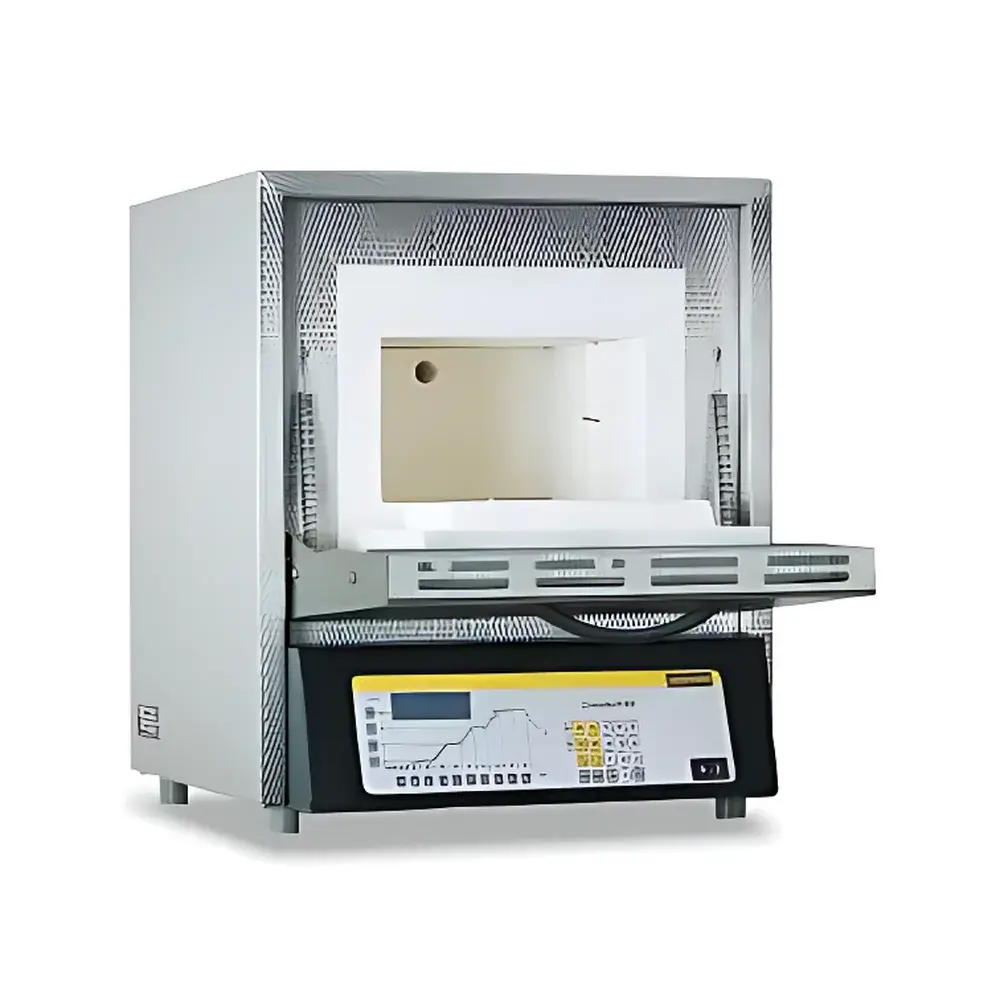
Nabertherm L5/11/B180 Tilting-Door Laboratory Muffle Furnace
| Brand | Nabertherm |
|---|---|
| Origin | Germany |
| Model | L5/11/B180 |
| Max Operating Temperature | 1100 °C |
| Internal Dimensions (W×D×H) | 200 × 170 × 130 mm |
| Chamber Volume | 5 L |
| External Dimensions (W×D×H) | 440 × 470 × 520 mm |
| Power Supply | 2.4 kW, Single-phase |
| Weight | 35 kg |
| Heating Time to Max Temp | ~60 min |
| Controller Type | B180 Programmable Digital Controller with Color Graphic Display |
| Programmable Steps | 2 per program (1 program memory) |
| Heating Method | Dual-sided ceramic heating plates with embedded resistance wire |
| Insulation | Vacuum-reinforced fiber modules |
| Construction | Double-walled stainless steel housing (brushed finish) |
| Door Options | Optional tilting door (standard for L5/11 series) or lifting door (LT variant) |
| Safety | EN 60519-2 Class 2 overtemperature protection limiter |
| Gas Inlet | Rear-mounted protective gas interface |
| Ventilation | Adjustable air inlet on door, exhaust outlet on rear wall |
| Optional Accessories | Exhaust chimney with fan or catalytic converter, kWh meter, programmable socket |
Overview
The Nabertherm L5/11/B180 is a precision-engineered laboratory muffle furnace designed for routine thermal processing tasks in research, quality control, and materials development laboratories. Operating on the principle of radiant heat transfer within an electrically heated, fully insulated chamber, this furnace delivers uniform temperature distribution and high thermal stability across its 5-liter working volume. Its core architecture integrates dual-sided ceramic heating plates — each containing embedded resistance wire — ensuring rapid thermal response and long-term immunity to chemical volatiles and splashes common in ashing, calcination, sintering, and heat treatment applications. The furnace conforms to IEC 60519-2 safety standards for industrial electroheating equipment and is built to meet the mechanical and thermal reliability expectations of GLP-compliant laboratory environments.
Key Features
- Dual-sided ceramic heating elements with encapsulated resistance wire — resistant to corrosion and contamination from sample outgassing or condensates.
- Vacuum-reinforced fiber insulation modules providing low thermal conductivity and high structural integrity at elevated temperatures.
- Double-walled stainless steel housing (brushed AISI 304) minimizing external surface temperature and enhancing mechanical rigidity.
- Standard tilting-door configuration (L-type), enabling safe and ergonomic loading/unloading of crucibles or samples without direct exposure to radiant heat zones.
- Adjustable air inlet integrated into the door and rear-mounted exhaust port for controlled atmosphere management during oxidative or semi-inert processes.
- EN 60519-2 Class 2 overtemperature protection limiter — independently wired, thermally actuated safety cutoff preventing chamber or sample overheating under fault conditions.
- Quiet solid-state electronic relay switching — eliminating mechanical contact wear and acoustic noise associated with conventional electromechanical relays.
Sample Compatibility & Compliance
The L5/11/B180 accommodates standard ceramic, alumina, and quartz crucibles (up to Ø100 mm × H120 mm), as well as metal trays and refractory boats used in gravimetric analysis, residue determination (e.g., ASTM D874, ISO 2160), and pre-treatment prior to elemental analysis. Its muffle design ensures full thermal isolation between heating elements and samples — critical for applications requiring contamination-free thermal profiles. The furnace complies with EU Machinery Directive 2006/42/EC, Low Voltage Directive 2014/35/EU, and Electromagnetic Compatibility Directive 2014/30/EU. Optional protective gas interfaces support nitrogen, argon, or forming gas purging per ISO 8501-1 and ASTM F1921 protocols.
Software & Data Management
The B180 controller features a 3.5-inch color graphic display with intuitive touch-and-keypad input, supporting parameter entry in 1 °C or 1-minute increments. It stores one multi-step program (2 segments maximum), with functions including delayed start scheduling (for off-peak electricity utilization), runtime logging, self-optimizing PID tuning, and segment skip capability. The controller maintains non-volatile memory for program retention during power loss and includes a cumulative operating hour counter. While the B180 lacks native Ethernet or USB connectivity, it supports optional analog output (0–10 V or 4–20 mA) for external data acquisition systems. Full audit trail functionality — including user access logs, parameter change timestamps, and deviation alerts — is achievable when integrated with validated third-party SCADA or LIMS platforms compliant with FDA 21 CFR Part 11 requirements.
Applications
- Residue-on-ignition (ROI) and ash content analysis per AOAC 923.03, USP <281>, and ISO 1171.
- Thermal decomposition studies of polymers, catalysts, and battery electrode materials.
- Pre-sintering of ceramic green bodies and binder burnout in powder metallurgy workflows.
- Calibration of thermocouples and reference materials up to 1100 °C (using appropriate secondary standards).
- Heat treatment of small-volume metal alloys and intermetallic samples under controlled ambient or inert gas flow.
- Pre-drying and conditioning of filter media, sorbents, and geological specimens prior to XRF or ICP-MS analysis.
FAQ
What is the recommended maintenance interval for the L5/11/B180 furnace?
Nabertherm recommends visual inspection of door gasket integrity and heating element continuity every 200 operating hours, with full calibration verification against traceable reference thermocouples annually or after any major repair.
Can the B180 controller be upgraded to support more complex programming?
No — the B180 is a fixed-function controller with single-program memory. For multi-program, multi-segment, or networked operation, Nabertherm offers the T300 or T400 series controllers as factory-installed alternatives.
Is the tilting door compatible with automated sample handling systems?
The standard L-type tilting mechanism is manually operated and not motorized; however, custom integration with pneumatic actuators or robotic end-effectors is feasible via third-party engineering using the furnace’s mechanical mounting interface and safety interlock signals.
Does the furnace include validation documentation for GMP environments?
The L5/11/B180 ships with a Factory Acceptance Test (FAT) report and CE Declaration of Conformity. IQ/OQ documentation packages and on-site PQ support are available as optional services through authorized Nabertherm application engineers.
What protective gas flow rates are supported through the rear gas inlet?
The standard 6-mm BSP gas inlet accepts continuous flow rates of 0.5–5 L/min, compatible with mass flow controllers meeting ISO 8501-1 purge rate guidelines for oxygen reduction in oxide-sensitive processes.



