
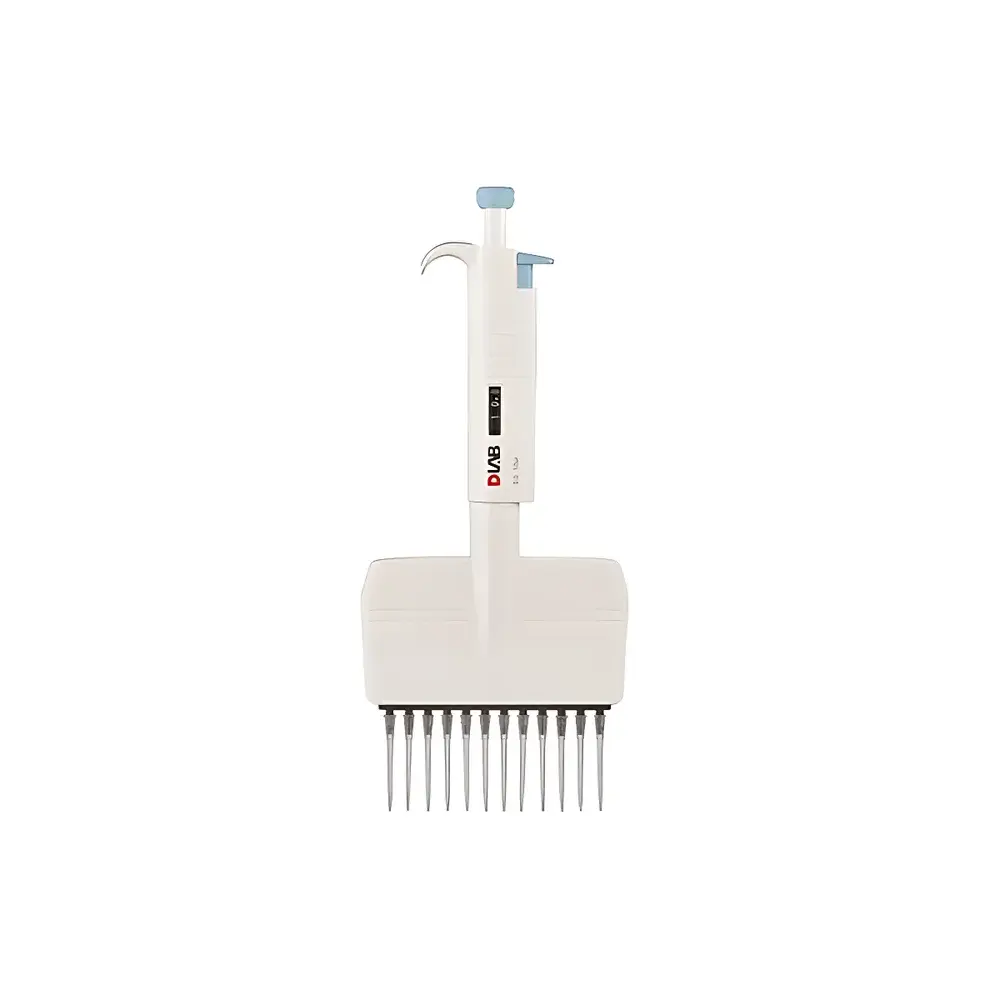
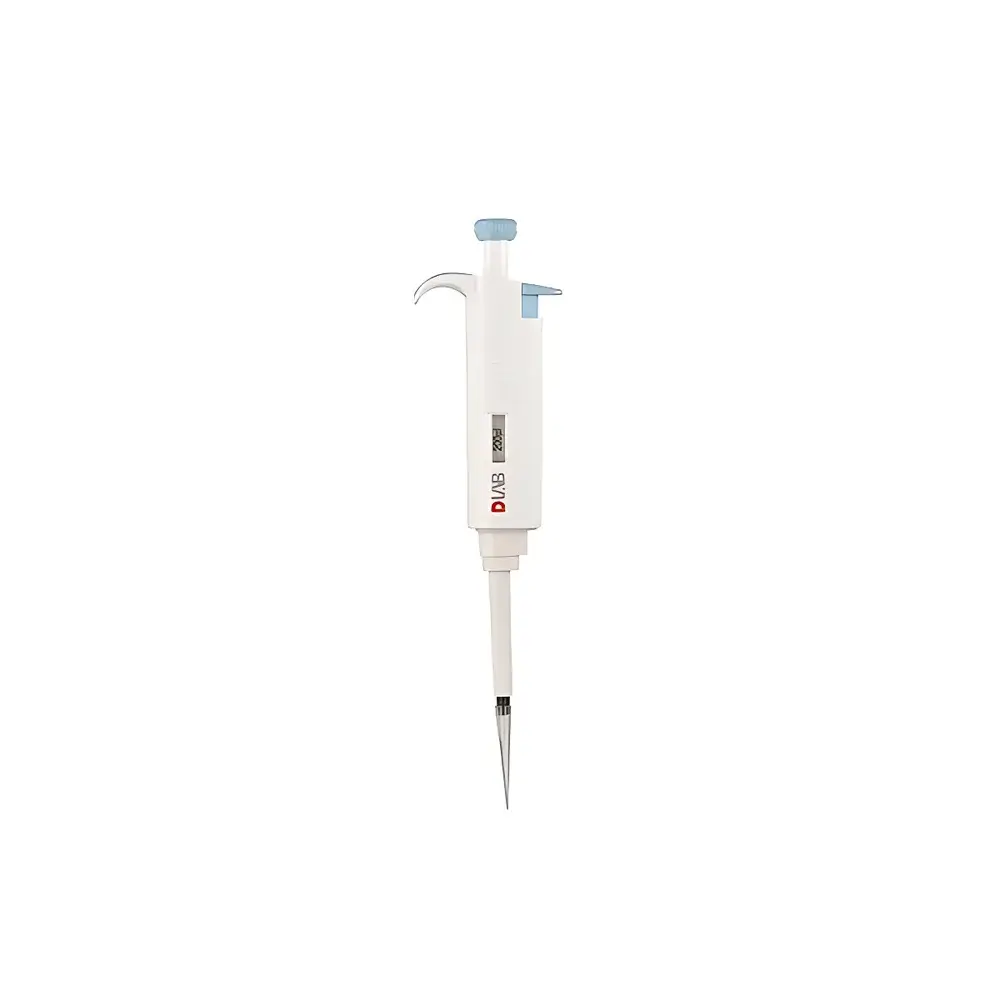
DLAB Scientific MicroPette Plus Sterilizable Manual Pipette
| Brand | DLAB |
|---|---|
| Origin | Beijing, China |
| Manufacturer Type | Authorized Distributor |
| Product Category | Domestic (China-manufactured) |
| Model | MicroPette Plus Sterilizable |
| Instrument Type | Multi-channel Pipette |
| Automation Level | Manual Pipette |
| Sterilization Compatibility | Full-unit Autoclavable (121°C, 20 min) |
| Calibration Standard | EN/ISO 8655-compliant |
| Volume Range | 0.1 µL – 10 mL |
| Incremental Volume Steps | Variable by range (0.05–0.1 mL) |
| Max Systematic Error | 0.50%–3.00% (volume-dependent) |
| Max Random Error | 0.15%–0.70% (volume-dependent) |
| Material | Chemically resistant, autoclave-grade thermoplastics and stainless-steel components |
Overview
The DLAB Scientific MicroPette Plus Sterilizable Manual Pipette is a precision-engineered liquid handling instrument designed for high-reproducibility volumetric transfer in regulated laboratory environments. Built upon the mechanical principles of air displacement, the pipette operates via a spring-loaded piston system that generates controlled negative pressure to aspirate and dispense aqueous and low-viscosity solutions. Its fully autoclavable construction—validated for repeated sterilization at 121 °C for 20 minutes—ensures compliance with biosafety protocols in microbiology, molecular diagnostics, and cell culture workflows. Unlike disposable or semi-sterilizable alternatives, the MicroPette Plus maintains metrological integrity across sterilization cycles, eliminating cross-contamination risks without compromising accuracy or repeatability. Each unit undergoes individual calibration traceable to national standards and certified per EN/ISO 8655:2022, the internationally recognized specification for piston-operated volumetric apparatus.
Key Features
- Full-unit autoclavability: Entire pipette body—including tip cone, plunger, and internal seals—endures standard steam sterilization (121 °C, 103 kPa, 20 min) without dimensional drift or seal degradation.
- Ergonomic design: Low-force activation mechanism and balanced weight distribution reduce operator fatigue during high-throughput pipetting sessions; optimized thumb rest and textured grip enhance tactile control.
- Broad volume coverage: Single pipette accommodates 14 discrete volume ranges—from 0.1 µL to 10 mL—via interchangeable volume-setting mechanisms, minimizing equipment redundancy in multi-assay labs.
- Tool-free calibration: Internal adjustment screw allows field recalibration using standard gravimetric or photometric methods; no specialized tools or service dispatch required.
- Chemical resilience: Critical wetted parts fabricated from PTFE-coated stainless steel and medical-grade polypropylene resist corrosion from ethanol, dilute acids/bases, and common solvents (e.g., isopropanol, 70% v/v).
- ISO 8655 traceability: Delivered with individual calibration certificate listing systematic and random error values at three test points per volume range, aligned with Clause 6.3 (accuracy verification) and Clause 7.2 (repeatability assessment).
Sample Compatibility & Compliance
The MicroPette Plus handles aqueous buffers, saline solutions, serum, DNA/RNA suspensions, and cell culture media with viscosity ≤10 mPa·s and surface tension ≥30 mN/m. It is not recommended for highly viscous liquids (e.g., glycerol >30%), volatile organics (e.g., chloroform), or corrosive agents (e.g., concentrated HNO₃). The device conforms to ISO 8655-2:2022 (volumetric performance), ISO 8655-5:2022 (calibration procedures), and IEC 61010-1:2010 (safety requirements for electrical equipment—applicable to optional electronic calibration docks). While inherently non-electronic, its mechanical architecture supports integration into GLP/GMP workflows where manual instruments are explicitly permitted under SOP-controlled conditions. Documentation packages include calibration records, material declarations (RoHS/REACH), and sterilization validation summaries suitable for internal audit or regulatory inspection.
Software & Data Management
As a manually operated, non-digital instrument, the MicroPette Plus does not incorporate embedded firmware, Bluetooth connectivity, or onboard data logging. However, its EN/ISO 8655 certification enables seamless inclusion in electronic lab notebook (ELN) systems and LIMS platforms via structured metadata import—specifically, calibration certificates may be uploaded as PDF/A-1b compliant files with embedded XMP metadata (manufacturer, model, serial number, calibration date, uncertainty budget). For laboratories operating under FDA 21 CFR Part 11, the pipette supports audit-trail integrity when used in conjunction with validated calibration management software (e.g., LabWare LIMS or Thermo Fisher SampleManager), where user actions (e.g., recalibration events, sterilization logs) are timestamped and digitally signed. Maintenance logs and usage tracking remain paper-based or spreadsheet-managed unless interfaced with third-party asset-tracking modules.
Applications
- Molecular biology: Accurate dispensing of restriction enzyme master mixes, PCR reagents, and qRT-PCR standards across sub-microliter volumes (0.1–10 µL).
- Clinical diagnostics: Reproducible sample aliquoting for ELISA, immunoassays, and automated analyzer prep—particularly critical in low-volume serum/plasma transfers (2–200 µL).
- Cell culture & bioprocessing: Sterile transfer of trypsin-EDTA, growth media, and transfection reagents without introducing endotoxin or particulate contamination.
- Quality control laboratories: Routine calibration verification against NIST-traceable water standards per USP and EP 2.6.17.
- Academic research: Teaching labs benefit from robustness, intuitive operation, and standardized error reporting aligned with undergraduate analytical chemistry curricula.
FAQ
Is the MicroPette Plus compatible with universal pipette tips?
Yes—it accepts industry-standard conical tips meeting ISO 8655-9:2022 geometry specifications, including low-retention and filtered variants from major OEMs (e.g., Eppendorf, Gilson, Thermo Fisher). Tip ejection force remains consistent across brands.
How often should it be recalibrated?
DLAB recommends quarterly calibration for routine use; monthly for high-frequency applications (>200 operations/day); and immediately after autoclaving if more than five cycles have elapsed since last verification.
Can it be used with organic solvents like acetone or DMSO?
No. Acetone, DMSO, chloroform, and other halogenated or strongly polar aprotic solvents degrade O-ring elastomers and compromise seal integrity. Use only with aqueous or alcohol-based solutions.
Does the pipette include a calibration certificate?
Each unit ships with a factory-issued EN/ISO 8655 calibration certificate, listing measured errors at three volume points per range, uncertainty budgets, and traceability to CNAS-accredited reference standards.
What maintenance is required beyond autoclaving?
Routine cleaning with 70% ethanol wipe-down; annual visual inspection of piston smoothness and tip cone wear; replacement of O-rings every 12 months or after 200 autoclave cycles—kits available under part number MP-OR-KIT.



