
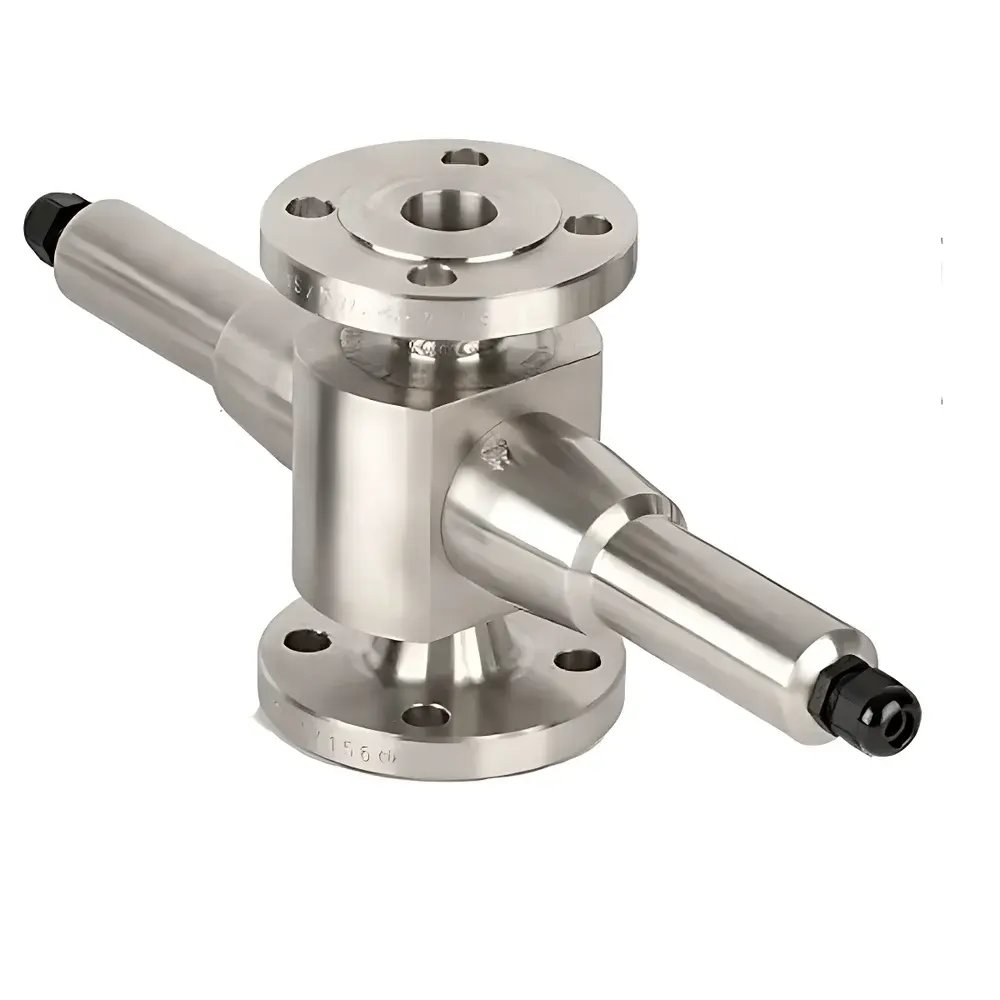
Galvanic Monispec-AD Gardner Color Analyzer
| Brand | Galvanic |
|---|---|
| Origin | USA |
| Manufacturer Type | Authorized Distributor |
| Origin Category | Imported |
| Model | Monispec-AD |
| Price | Upon Request |
| Accuracy | ±0.1% FS |
| Linearity | ±0.1% FS |
| Repeatability | ±0.1% FS |
| Sensitivity | ±0.1% FS |
| Process Temperature Range | 0–140 °C (customizable up to 200 °C) |
| Process Pressure Range | 0–16 bar (customizable up to 30 bar) |
| Response Time | <1 s |
| Power Supply | 220 V AC or 24 V DC |
| Analog Output | 4–20 mA (loop-powered) |
| Measurement Ranges | Redness (0–8 Lov or 8–20 Lov), Yellowness (0–15 Lov or 15–80 Lov), Chlorophyll Concentration (0–1 ppm, typical range 0–200 ppb) |
| Process Connection | 10–100 mm (½″–4″ NPT or flanged) |
Overview
The Galvanic Monispec-AD Gardner Color Analyzer is a purpose-built in-line spectrophotometric instrument engineered for real-time, non-invasive color quantification of edible oils and lipid-based food products during continuous processing. Unlike benchtop colorimeters requiring manual sampling and offline analysis, the Monispec-AD employs fiber-optic-coupled UV-Vis absorption spectroscopy with dual-wavelength differential detection optimized for Gardner scale compliance. It measures absorbance at specific spectral bands (typically 420–470 nm for yellowness and 500–550 nm for redness) to compute standardized Gardner Lovibond® units—directly traceable to ASTM D1544 and ISO 4630 reference methods. Its robust stainless-steel wetted path and high-temperature/pressure-rated optical flow cell enable direct integration into refining, deodorizing, and blending lines without process interruption. The analyzer delivers continuous, drift-compensated readings essential for monitoring decolorization efficiency, detecting chlorophyll carryover from crude oil feedstock, and ensuring batch-to-batch color consistency across vegetable oil grades including canola, sunflower, peanut, corn, and olive oils.
Key Features
- True in-line operation with no sample extraction, eliminating delays, contamination risk, and operator dependency
- High-stability tungsten-halogen light source and thermally stabilized photodiode array ensure <1 s response time and long-term photometric stability
- Calibration traceable to NIST-traceable Gardner standard solutions; field recalibration supported via certified reference cuvettes
- Process-rated optical flow cell constructed from 316L stainless steel with sapphire windows; rated for continuous operation at up to 140 °C and 16 bar (optional 200 °C / 30 bar variants available)
- Integrated temperature and pressure compensation algorithms correct for refractive index shifts under dynamic process conditions
- 4–20 mA loop-powered analog output compliant with ISA-50.00.01 and IEC 61000-6-2 EMC standards; optional Modbus RTU/TCP and HART 7 interfaces
- IP66/NEMA 4X enclosure with explosion-proof (ATEX II 2G Ex db IIB T4 Gb / UL Class I Div 2) certification options
Sample Compatibility & Compliance
The Monispec-AD is validated for transparent to semi-transparent liquid matrices with kinematic viscosity ≤150 cSt and suspended solids <50 ppm. It is routinely deployed in edible oil refineries for monitoring bleaching earth efficiency, detecting chlorophyll degradation intermediates (e.g., pheophytin-a), and verifying final product conformance to Codex Alimentarius standards for refined vegetable oils (e.g., CODEX STAN 210–1999). Instrument design adheres to FDA 21 CFR Part 11 requirements for electronic records and signatures when paired with Galvanic’s Monispec Control Suite. All measurement protocols align with AOAC Official Method 2012.01 (color assessment in fats and oils) and support GLP/GMP audit readiness through full data lineage, user access logs, and electronic signature workflows.
Software & Data Management
The analyzer operates natively with Galvanic’s Monispec Control Suite—a Windows-based SCADA-integrated platform supporting real-time trend visualization, statistical process control (SPC) charting (X̄-R, CUSUM), and automated alarm escalation via email/SMS. Raw absorbance spectra, computed Gardner values, and environmental metadata (T, P, timestamp) are stored in SQLite or SQL Server databases with configurable retention policies. Data export complies with ASTM E2500-13 for analytical instrument qualification and supports CSV, PDF report generation, and OPC UA connectivity for MES/ERP integration (e.g., SAP PI, Rockwell FactoryTalk). Audit trails include full change history for calibration parameters, user logins, and configuration edits—fully compliant with 21 CFR Part 11 Annex 11 requirements.
Applications
- Continuous monitoring of decolorization efficacy in clay/activated carbon bleaching towers
- Early detection of chlorophyll breakthrough indicating spent adsorbent saturation
- Real-time grading of refined oil lots against internal specifications (e.g., “Grade A” = Gardner ≤5.0)
- Feed-forward control of deodorizer steam injection based on real-time redness trends
- Verification of blend uniformity in multi-oil formulations (e.g., olive/canola blends)
- Quality gate enforcement prior to packaging—preventing off-spec product release
FAQ
Is the Monispec-AD compatible with high-viscosity oils such as palm olein at 60 °C?
Yes—the flow cell design accommodates viscosities up to 150 cSt at operating temperature; optional heated jacketing maintains laminar flow and prevents wax crystallization in tropical oils.
How frequently does the instrument require calibration verification?
Under stable process conditions, quarterly verification using NIST-traceable Gardner standards is recommended; daily zero checks via solvent flush are automated and logged.
Can the analyzer distinguish between natural pigment variation and oxidation-induced browning?
While Gardner scale alone does not speciate compounds, the dual-band ratio (red/yellow) combined with trending analysis provides empirical differentiation—oxidation typically elevates redness disproportionately relative to yellowness.
Does the system support integration with DeltaV or Emerson DCS platforms?
Yes—native Modbus TCP and OPC UA drivers are supplied; certified DCS interface modules are available for DeltaV, Honeywell Experion, and Yokogawa CENTUM VP.
What maintenance is required beyond routine optical window cleaning?
No consumables or moving parts exist in the optical path; annual verification of thermal compensation coefficients and photodiode linearity is advised per ISO/IEC 17025 calibration schedules.




