
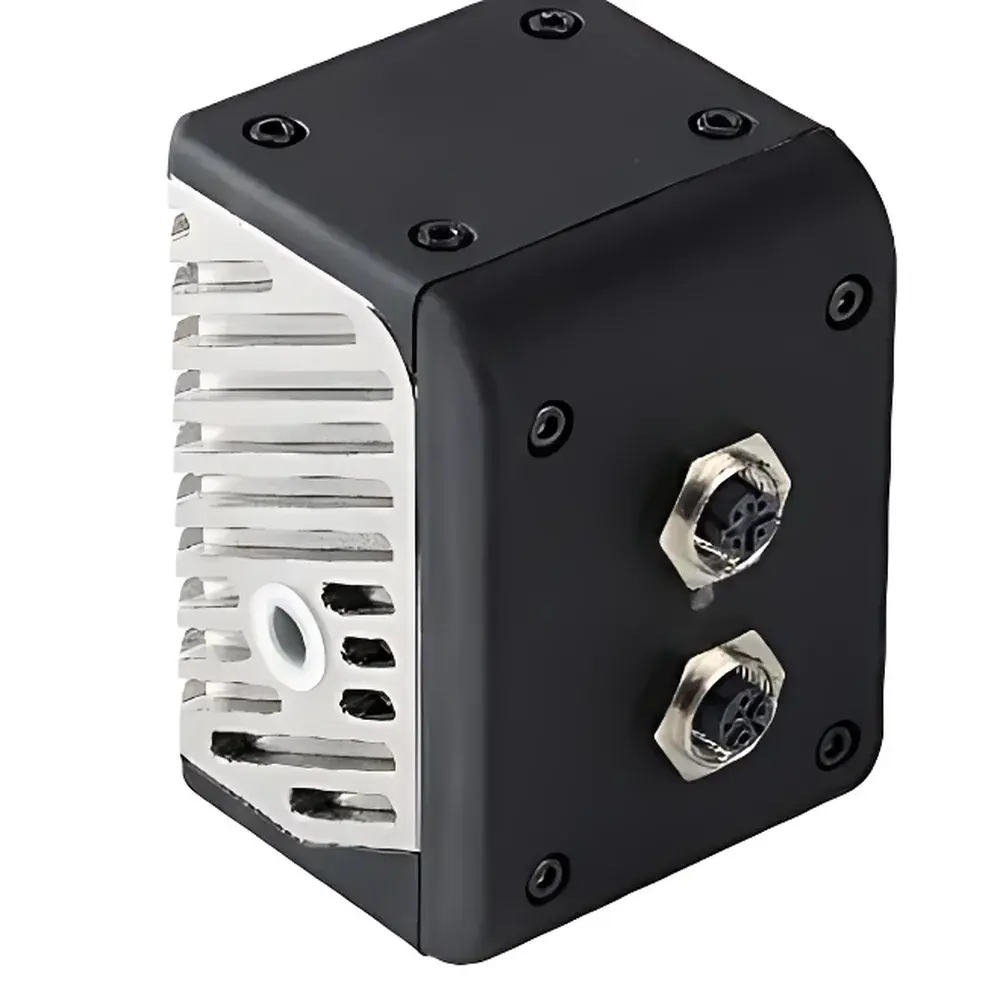
Atten2 EXC100 Intrinsically Safe Online Oil Cleanliness Sensor
| Brand | Atten2 |
|---|---|
| Origin | Spain |
| Model | EXC100 |
| Product Type | Online Instrument |
| Detection Parameter | Mechanical Contaminants |
| Compliance | ATEX/IECEx Certified for Hazardous Areas |
| Particle Detection Threshold | ≥4 µm |
| Output Standards | ISO 4406, NAS 1638 |
| Compatible Fluids | Hydraulic oil, lubricating oil, fuel, mineral & synthetic oils, coolants, cleaning fluids, cutting fluids |
| Data Interface | Wired Ethernet Gateway / Wireless (Wi-Fi/LoRaWAN) |
| AI Engine | Trained on >500 commercial lubricant models and ironographic particle morphology database |
Overview
The Atten2 EXC100 Intrinsically Safe Online Oil Cleanliness Sensor is an explosion-proof, real-time particulate monitoring system engineered for continuous in-line assessment of mechanical contamination in circulating lubricants and hydraulic fluids within hazardous industrial environments. Operating on the principle of high-resolution digital image acquisition and AI-driven morphological analysis, the EXC100 captures microscopic particles suspended in flowing oil—without requiring offline sampling or fluid diversion. Its optical imaging module, coupled with calibrated LED illumination and a temperature-stabilized CMOS sensor, enables consistent particle detection down to 4 µm under dynamic flow conditions. Unlike conventional particle counters relying solely on light obscuration or pore-blockage methods, the EXC100 performs root-cause attribution by classifying wear debris morphology (e.g., fatigue spalls, cutting chips, pitting fragments, oxidation agglomerates) using a proprietary deep learning model trained on over a decade of laboratory ferrographic data and validated against ASTM D7690 (Standard Guide for Ferrography). Designed for Zone 1/21 (ATEX/IECEx) and Class I Div 1 (UL) classified areas, it integrates seamlessly into existing lubrication circuits without compromising system integrity or safety certification.
Key Features
- Intrinsically safe design certified to ATEX II 2G Ex ib IIB T4 Gb and IECEx Ex ib IIB T4 Gb, enabling deployment in explosive atmospheres including refineries, offshore platforms, and coal mine machinery compartments
- Real-time, non-invasive inline measurement—no bypass loops, no sample extraction, no fluid loss
- AI-powered particle morphology classification engine trained on >500 commercial lubricant formulations and >10 years of ferrographic reference data
- Simultaneous output of standardized cleanliness codes (ISO 4406:2017 and NAS 1638) alongside wear mode diagnostics (fatigue, abrasion, adhesion, corrosion)
- Multi-fluid compatibility: validated for mineral oils, PAOs, ester-based synthetics, water-glycol hydraulics, coolants, and aqueous metalworking fluids
- Embedded environmental compensation for temperature, flow rate, and viscosity-induced optical distortion
- Configurable alarm thresholds with event-triggered logging and time-synchronized metadata tagging
Sample Compatibility & Compliance
The EXC100 maintains analytical fidelity across a broad operational envelope: fluid temperatures from −20 °C to +80 °C, flow velocities from 0.3 to 3.0 m/s, and viscosities ranging from 2 to 400 cSt. It complies with ISO 4406:2017 for particle count reporting and supports traceability per ISO/IEC 17025–accredited laboratories through raw image export and audit-ready metadata logs. The sensor’s firmware architecture adheres to IEC 62443-4-2 for secure embedded device development and includes cryptographic signing of firmware updates. All diagnostic outputs are structured to support integration into enterprise CMMS/EAM systems compliant with ISO 55000 asset management frameworks. For regulated sectors—including power generation (NRC-regulated facilities), maritime (IMO MARPOL Annex VI), and aerospace (SAE AS5681)—the EXC100 provides documented traceability of calibration history, algorithm versioning, and particle classification confidence scores.
Software & Data Management
The Atten2 OilWear Intelligence Platform delivers secure, scalable data handling via TLS 1.2–encrypted RESTful APIs and OPC UA server integration. Raw image sequences (12-bit TIFF), particle centroid coordinates, shape descriptors (aspect ratio, convexity, roundness), and classification probabilities are stored locally on an industrial-grade microSD card (optional cloud sync). The platform implements full 21 CFR Part 11–compliant electronic signatures, audit trails, and role-based access control (RBAC) for QA/QC personnel. Batch-level reporting includes trend analysis of particle population shifts across ISO code bands, wear mode heatmaps, and correlation with OEM-recommended maintenance intervals. Historical datasets can be exported in CSV, HDF5, or ASTM E2921-compliant format for third-party statistical process control (SPC) or predictive maintenance modeling.
Applications
The EXC100 serves as a foundational element in condition-based and predictive maintenance strategies across high-reliability infrastructure. In thermal and wind power generation, it monitors gearbox and bearing sump oils to detect early-stage micropitting before catastrophic failure—reducing unplanned outages by up to 98% in pilot deployments. Within mining operations, it safeguards dragline hoist motors and conveyor gearboxes operating in methane-rich underground environments. In marine propulsion systems, it tracks contamination ingress in main engine lubrication circuits aboard LNG carriers and offshore support vessels. Additional validated use cases include rail traction motor oil health in high-speed fleets, shield tunnel boring machine (TBM) hydraulic systems, and aviation ground support equipment where lubricant integrity directly impacts safety-critical actuation performance.
FAQ
Does the EXC100 require periodic recalibration?
No—its optical path is factory-aligned and sealed; drift compensation is performed continuously via internal reference frames and fluid property feedback loops. Annual verification against NIST-traceable particle standards is recommended per ISO/IEC 17025.
Can the AI model be updated for custom lubricants not in the default library?
Yes—Atten2 provides a validated model ingestion protocol allowing customers to submit ferrographic samples and corresponding operational metadata for supervised retraining of the classification engine.
Is bubble discrimination validated under high-pressure hydraulic conditions?
Yes—bubble identification accuracy exceeds 99.2% at pressures up to 350 bar, verified per ISO 11171 Annex B protocols using controlled air-injection test rigs.
How is intrinsic safety maintained during firmware updates?
All firmware payloads are cryptographically signed and verified pre-execution; update procedures follow IEC 60079-27 Annex C requirements for hot-swappable intrinsically safe devices.
What data latency can be expected between particle capture and dashboard visualization?
End-to-end latency is ≤1.2 seconds from optical capture to timestamped classification in the OilWear Intelligence Platform, assuming standard Ethernet backhaul with QoS prioritization.




