
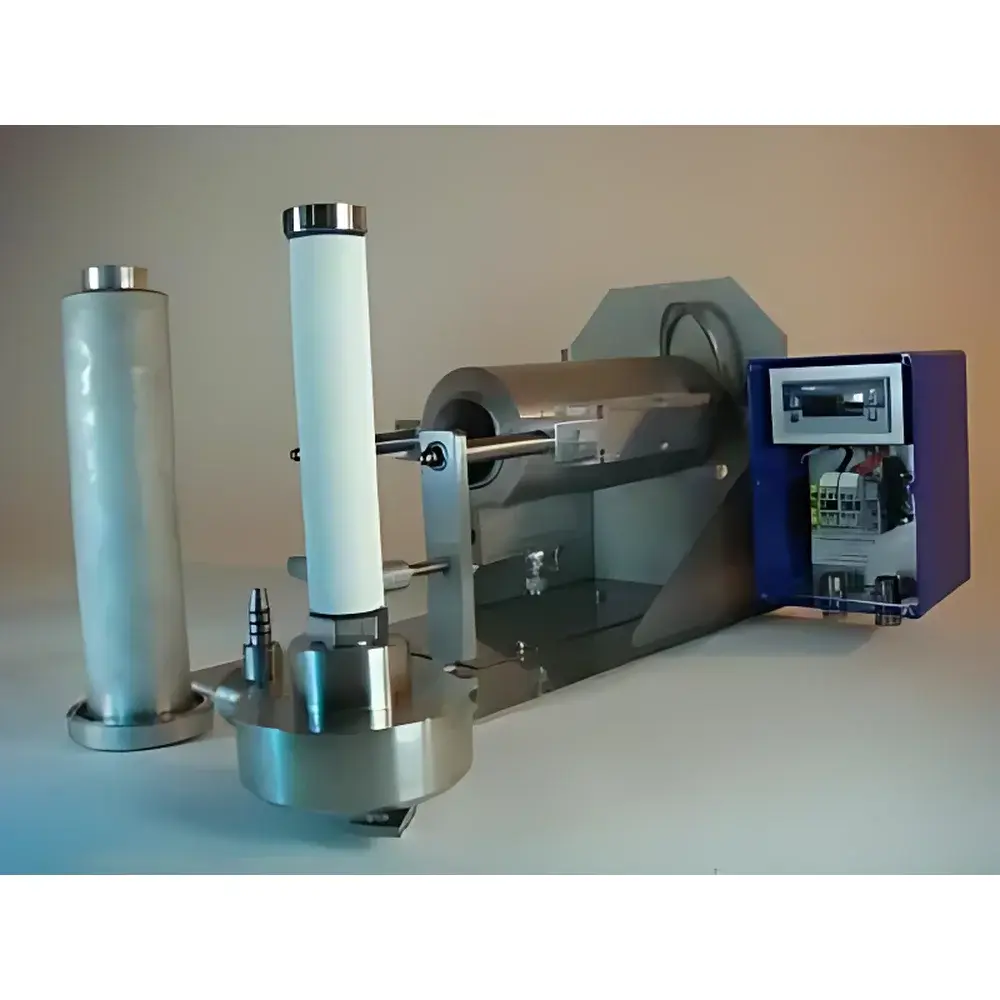
ASP Gas Measurement Probe
| Origin | Netherlands |
|---|---|
| Manufacturer Type | Distributor |
| Origin Category | Imported |
| Model | ASP Gas Measurement Probe |
| Pricing | Upon Request |
Overview
The ASP Gas Measurement Probe is an industrial-grade, continuous-duty gas sampling probe engineered for reliable operation in harsh and demanding environmental monitoring applications. Designed around a robust stainless-steel housing and thermally stable internal flow path, the probe operates on the principle of extractive sampling—drawing representative gas streams from ducts, stacks, or ambient zones for downstream analysis by connected analyzers (e.g., NDIR, electrochemical, or PID sensors). Its core architecture supports isokinetic sampling alignment where required, minimizing particle bias and ensuring compositional fidelity—critical for regulatory-grade emissions monitoring (e.g., EN 15267, EPA Method 3A/7E) and long-term air quality surveillance.
Key Features
- Extreme-environment resilience: Rated for continuous operation across –20 °C to +180 °C ambient temperatures and up to 100 % relative humidity, with condensate management via integrated heated sample line interface.
- Dust-tolerant filtration system: Dual-stage, field-replaceable particulate filters—including sintered metal pre-filter and hydrophobic membrane final filter—installed without probe removal.
- Tool-assisted maintenance: All filter elements are accessible using standard 4-mm Allen key; average filter swap time ≤ 90 seconds, reducing personnel exposure during routine servicing.
- Corrosion-resistant construction: 316L stainless steel probe body and flange, compliant with ISO 9223 C5-M corrosion class for offshore and industrial stack installations.
- Modular integration: Standardized 1/2″ NPT and DIN 16226 mounting interfaces enable seamless coupling with sample conditioning systems, heated transport lines, and analyzer manifolds.
Sample Compatibility & Compliance
The ASP Gas Measurement Probe accommodates a broad spectrum of gaseous matrices, including flue gas (SO₂, NOₓ, CO, O₂), biogas (CH₄, H₂S, CO₂), landfill emissions, and ambient urban/industrial air. It maintains sample integrity for reactive species (e.g., NH₃, Cl₂) through inert wetted-path materials (PTFE-lined internal bore, FEP tubing options) and optional integrated thermoelectric cooling for dew point control. The probe meets structural and functional requirements outlined in EN 14181 (QAL2/QAL3 validation), supports QAL1-certified analyzer systems, and is compatible with continuous emission monitoring systems (CEMS) deployed under EU IED Directive and U.S. 40 CFR Part 60 Subpart A.
Software & Data Management
While the ASP probe itself is a passive hardware component, it is fully interoperable with industry-standard CEMS data acquisition platforms—including Siemens Desigo CC, Emerson DeltaV, and third-party SCADA systems via 4–20 mA analog output or Modbus RTU (RS-485). When paired with certified sample conditioning units, the full measurement chain supports audit-ready data logging per FDA 21 CFR Part 11 (electronic signature and change tracking) and GLP/GMP-aligned calibration documentation workflows. Real-time status indicators (filter clogging, temperature deviation, flow interruption) are relayed as discrete digital signals for predictive maintenance scheduling.
Applications
- Regulatory stack emissions monitoring in cement, power generation, and waste incineration facilities
- Process gas analysis in chemical and petrochemical plants with high particulate loadings
- Biogas quality control at anaerobic digestion sites and landfill gas recovery systems
- Indoor air quality (IAQ) assessment in industrial hygiene studies requiring extended unattended deployment
- Research-grade atmospheric profiling in field campaigns involving fog-prone or arid-dusty environments
FAQ
Is the ASP Gas Measurement Probe certified for use in explosion-hazardous areas?
No—this model is not intrinsically safe or ATEX/IECEx certified. For Zone 1/2 applications, consult the distributor for explosion-proof enclosure variants or associated barrier kits.
Can the probe be used for hydrogen sulfide (H₂S) sampling without material degradation?
Yes—when specified with PTFE/FEP wetted components and optional gold-plated sensor interface ports, it maintains compatibility with H₂S concentrations up to 10,000 ppm over 12-month service intervals.
Does the probe include built-in flow measurement or regulation?
No—the ASP probe is a passive sampling interface. Flow control and verification must be implemented upstream via calibrated mass flow controllers or critical orifices aligned to EN 15267-3 requirements.
What is the recommended calibration frequency for systems incorporating this probe?
Per EN 14181, zero/span checks should occur at least every 7 days; full QAL3 performance validation is required semi-annually when used in legally mandated CEMS deployments.







