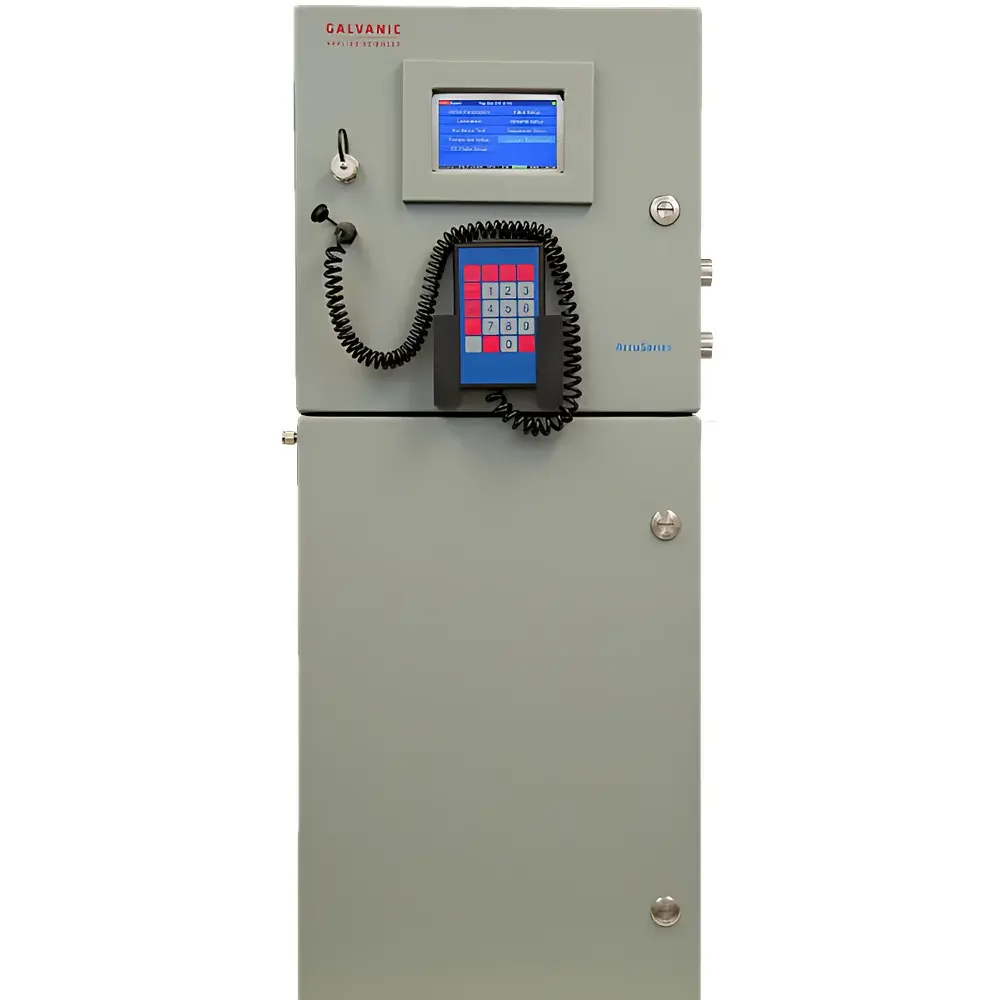
Galvanic AccuSeries1 Online Sulfuric Acid Analyzer
| Brand | Galvanic |
|---|---|
| Origin | USA |
| Model | AccuSeries1 |
| Measurement Principle | Potentiometric Acid-Base Titration with pH Endpoint Detection |
| Range Options | 0–20 mg/L or 0–500 mg/L (customizable per application) |
| Accuracy | ±1% of Full Scale |
| Linearity | ±1% of Full Scale |
| Repeatability | ±1% of Full Scale |
| Response Time | 8–12 minutes |
| Operating Temperature | −20 °C to +60 °C |
| Dimensions | 1016 mm × 406 mm × 241 mm |
| Weight | 45.3 kg |
| Power Supply | 10–32 VDC or 90–240 VAC |
| Power Consumption | 300 W |
| Analog Outputs | up to eight 4–20 mA isolated channels |
| Communication Protocols | Modbus RTU/ASCII (RS232/RS485), Modbus TCP/IP, USB, GUI PC Direct Connection |
| Digital I/O | Relay outputs, status alarms |
| Enclosure Rating | IP65-rated corrosion-resistant housing |
| Sample Stream Capacity | Up to six independent flow paths |
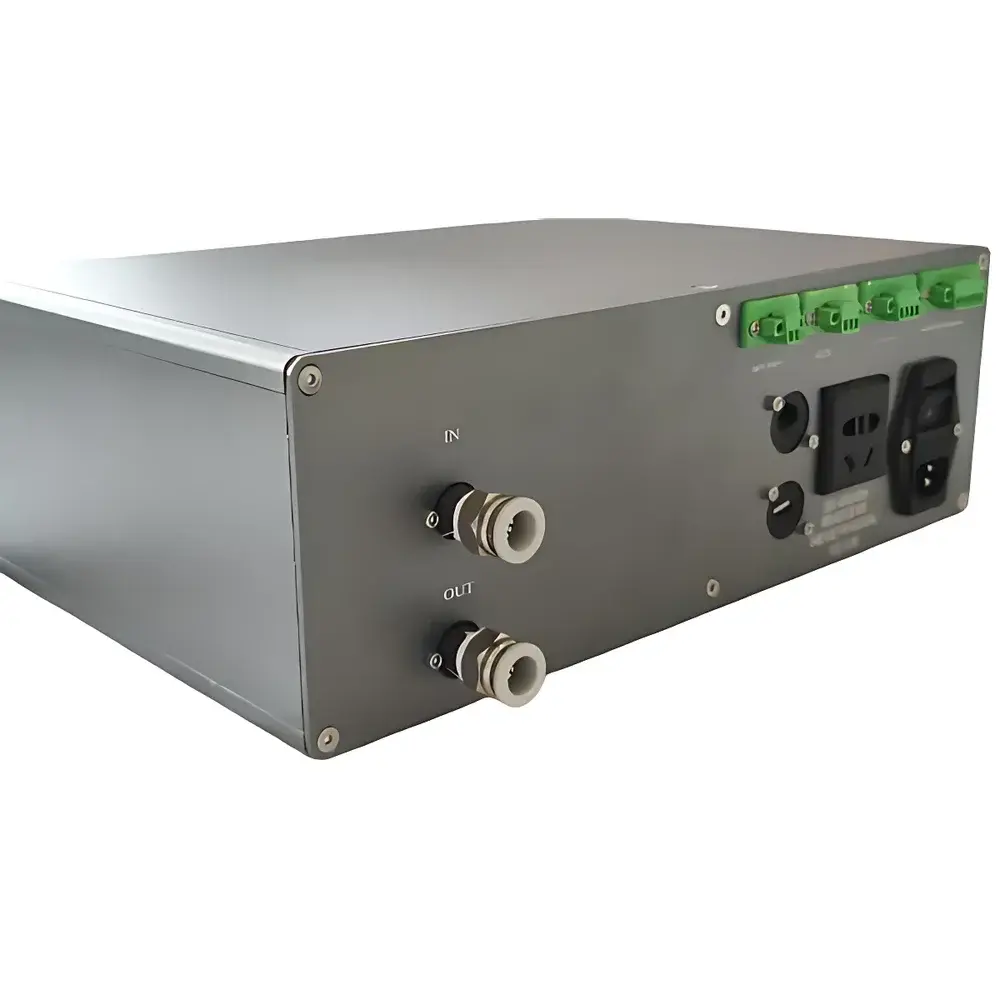
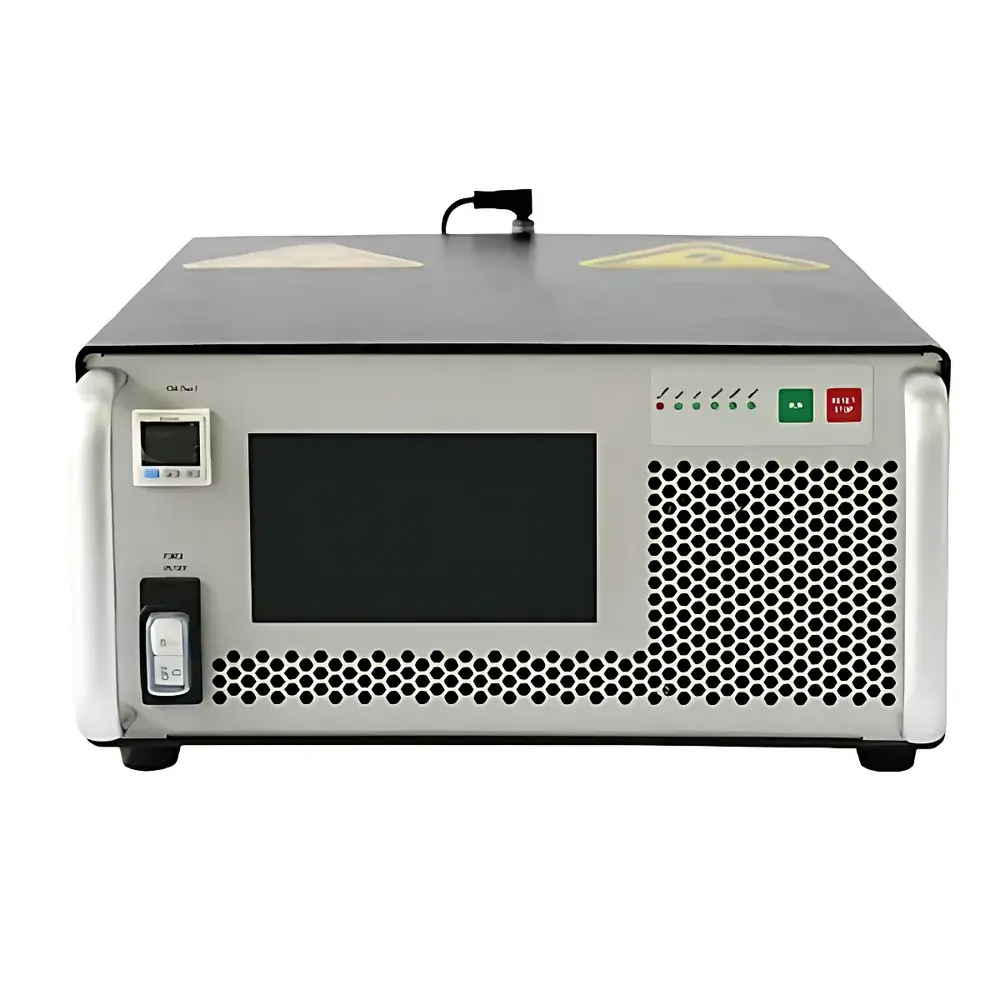
| System Architecture | Physically segregated electronics and wet chemistry modules |
| Compliance | Designed for continuous operation in hazardous area-adjacent industrial environments |
Overview
The Galvanic AccuSeries1 Online Sulfuric Acid Analyzer is an industrial-grade, fully automated potentiometric titration system engineered for continuous, real-time quantification of sulfuric acid concentration in aggressive process streams—particularly in bisphenol-A (BPA) production where precise acid control at the decomposition stage directly impacts yield, catalyst integrity, and downstream purification efficiency. Unlike optical or conductivity-based proxies, the AccuSeries1 employs a validated pH electrode-driven acid-base titration method, delivering trace-level accuracy (down to 0–20 mg/L) or mid-range quantification (0–500 mg/L), with ±1% full-scale accuracy and sub-12-minute cycle time. Its architecture separates sample handling from electronic control—eliminating cross-contamination risk and enabling hot-swap maintenance without system shutdown. The analyzer operates unattended for 24/7 cycles, executing auto-calibration, reagent replenishment, endpoint detection, post-measurement cleaning, and zero-point verification—all governed by programmable sequence logic.
Key Features
- Modular, field-configurable titration engine: Users define reagent addition order, pre-/post-analysis rinse steps, and dynamic endpoint sensitivity via intuitive GUI or DCS-integrated scripting.
- Dual-domain isolation: Electronics compartment and wet chemistry manifold are physically decoupled—ensuring controller uptime even during fluidic subsystem faults, with fault codes relayed to DCS/PLC via Modbus or discrete relays.
- Corrosion-resilient construction: Housing and wetted components resist H2S, Cl2, and acidic condensates; conformal-coated PCBs and gasket-sealed enclosures meet IP65 requirements for humid, chemically laden environments.
- Multi-stream scalability: Supports up to six independent sample inlets with synchronized or staggered analysis scheduling—ideal for parallel reactor effluent monitoring or feedstock quality verification.
- Comprehensive diagnostics: Real-time monitoring of reagent levels, sample presence, electrode drift, pump stroke integrity, and temperature-compensated pH response—triggering configurable alarms via relay, 4–20 mA, or network protocols.
- Plug-and-play integration: Native support for Modbus RTU/ASCII (RS232/RS485), Modbus TCP/IP, and USB-hosted GUI enables direct connection to legacy DCS, modern SCADA, or cloud-based MES platforms.
Sample Compatibility & Compliance
The AccuSeries1 is optimized for aqueous sulfuric acid solutions within complex chemical process matrices—including BPA decomposition liquors containing residual phenols, acetone, and trace metal ions. It accommodates suspended solids up to 50 µm via integrated filtration and handles sample temperatures from 5 °C to 50 °C without external conditioning. All fluidic materials comply with ASTM D1248 and ISO 10993-5 for chemical resistance. While not intrinsically safe certified, its design aligns with IEC 61511 functional safety principles for SIL-2 capable deployment when integrated with appropriate safety instrumented systems. Data logging meets GLP/GMP expectations through timestamped audit trails, user-access-controlled method files, and non-volatile storage of calibration history—supporting FDA 21 CFR Part 11 compliance when paired with validated IT infrastructure.
Software & Data Management
Configuration, calibration, and diagnostic data are managed via a browser-based GUI or native Windows application, supporting CSV export, alarm event logging, and trend visualization over 90-day rolling buffers. Firmware updates are performed remotely via secure HTTPS or local USB. Each analysis cycle stores raw pH curves, titrant volume consumed, calculated concentration, and system health metrics. The 4–20 mA outputs are individually scalable and linearized per range; all digital communications include CRC error checking and configurable polling intervals. Optional OPC UA gateway modules enable seamless federation into IIoT architectures.
Applications
Primary deployment includes continuous sulfuric acid monitoring in bisphenol-A synthesis reactors, alkylation units, spent acid regeneration circuits, and wastewater neutralization basins. Secondary use cases span petrochemical desulfurization scrubbers, titanium dioxide sulfate leach processes, and pharmaceutical intermediate synthesis where stoichiometric acid control governs reaction selectivity. The system’s programmability also supports adaptation to other strong acid analytes (e.g., hydrochloric or nitric acid) using compatible reagents and electrode chemistries.
FAQ
What titration method does the AccuSeries1 use, and how is endpoint detection achieved?
It performs potentiometric acid-base titration using a high-stability pH electrode; the endpoint is determined by first-derivative analysis of the pH vs. titrant volume curve.
Can the analyzer operate in explosive atmospheres?
It is not certified for Zone 0/1 installation; however, it may be installed in adjacent safe areas with sample transport via explosion-proof pumps or purge systems.
Is remote firmware update supported over Modbus TCP/IP?
Firmware updates require local USB or HTTPS-initiated download; Modbus is used exclusively for operational data exchange and control commands.
How often is manual maintenance required?
Reagent replacement is typically needed every 30–90 days depending on cycle frequency; electrode replacement is recommended every 6–12 months under continuous operation.
Does the system support multi-point calibration?
Yes—up to three standard points can be defined per method, with automatic interpolation and deviation reporting against NIST-traceable reference standards.