
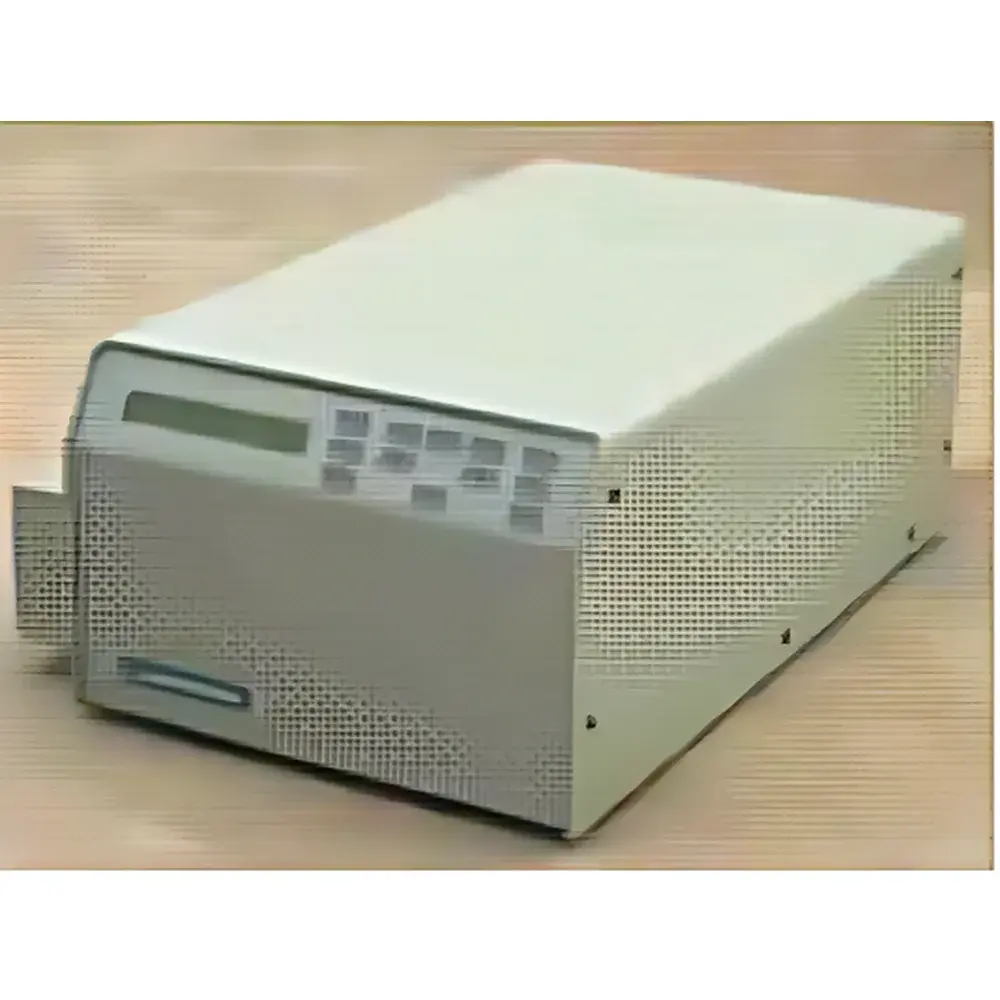
201/525 UV Programmable Detector
| Origin | USA |
|---|---|
| Manufacturer Type | Authorized Distributor |
| Origin Category | Imported |
| Model | 201/525 |
| Instrument Type | Ultraviolet-Visible (UV-Vis) Detector |
| Noise | < ±1.0 × 10⁻⁵ AU @ 254 nm |
| Wavelength Range | 190–800 nm |
| Spectral Bandwidth | 6 nm |
| Wavelength Accuracy | ±1.0 nm |
| Wavelength Precision | ±1.0 nm |
| Optical Design | Single-Wavelength (201) / Dual-Wavelength (525) |
Overview
The 201/525 UV Programmable Detector is a high-stability, benchtop ultraviolet-visible absorbance detector engineered for integration with analytical and preparative liquid chromatography systems. Operating on the principle of Beer–Lambert absorption spectroscopy, it measures solute concentration by quantifying light attenuation at user-selectable wavelengths across a broad spectral range (190–800 nm). The detector employs a concave holographic grating monochromator coupled with a dual-beam optical architecture—ensuring consistent baseline stability, minimized drift, and high photometric reproducibility. Its modular design supports both single-wavelength (Model 201) and dual-wavelength (Model 525) operation, enabling simultaneous monitoring of primary and reference channels—a critical capability for gradient elution, background subtraction, and co-elution resolution in complex matrices.
Key Features
- Concave holographic grating monochromator delivering high optical throughput and wavelength fidelity (±1.0 nm accuracy and precision)
- Dual-beam optical path with real-time reference compensation to suppress lamp intensity fluctuations and cell window fouling effects
- Programmable wavelength scanning and time-based wavelength switching—enabling automated spectral acquisition and multi-wavelength peak detection protocols
- Low-noise analog electronics (< ±1.0 × 10⁻⁵ AU @ 254 nm) optimized for high-sensitivity trace analysis and low-volume applications
- Front-accessible D₂ lamp and flow cell—designed for rapid replacement without system disassembly or optical recalibration
- 6 nm spectral bandwidth providing optimal balance between sensitivity and spectral resolution for routine HPLC and UHPLC applications
Sample Compatibility & Compliance
The detector accommodates a wide range of flow cell configurations—including stainless steel, Kel-F®, and fused silica variants—to ensure chemical inertness and biocompatibility across diverse sample types: acidic/basic mobile phases, protein-rich biological fluids, and aggressive organic solvents. Flow cells are available in volumes from 1 µL (microbore) to 10 µL (analytical) and up to 50 µL (preparative), supporting method scalability from analytical development through purification. The instrument complies with fundamental performance criteria outlined in ASTM E260 and ISO 17025 for chromatographic detectors; its programmable data acquisition and audit-ready configuration logs support GLP/GMP environments where traceability and instrument qualification (IQ/OQ/PQ) are required.
Software & Data Management
The 201/525 interfaces via analog output (0–1 V or 0–10 V) and optional RS-232 or USB digital communication to third-party chromatography data systems (CDS), including Empower™, Chromeleon™, and OpenLab CDS. Its programmable functionality allows users to define wavelength sequences, dwell times, and baseline correction algorithms directly within method files—enabling adaptive detection strategies such as peak-specific λmax tracking or solvent front compensation. All operational parameters—including lamp hours, wavelength calibration history, and error logs—are retained in non-volatile memory. When integrated into validated workflows, the detector supports FDA 21 CFR Part 11 compliance through external CDS-enforced electronic signatures, audit trails, and user access controls.
Applications
- Pharmaceutical QC/QA: Assay quantitation of active pharmaceutical ingredients (APIs) per USP and ICH Q2(R2) guidelines
- Biochemical analysis: Monitoring peptide synthesis, oligonucleotide purity, and monoclonal antibody aggregation profiles
- Environmental testing: Detection of aromatic hydrocarbons, nitroaromatics, and phenolic compounds in water extracts
- Food & beverage safety: Quantification of preservatives (e.g., benzoic acid, sorbic acid), colorants, and mycotoxins
- Academic research: Method development for reversed-phase, ion-exchange, and size-exclusion chromatography with variable-wavelength optimization
FAQ
What is the difference between the 201 and 525 models?
The Model 201 operates in single-wavelength mode, ideal for fixed-method applications requiring high stability at one absorption maximum. The Model 525 adds synchronized dual-wavelength detection, allowing real-time ratioing (e.g., 280/260 nm for protein/nucleic acid assessment) or reference-channel correction.
Is the detector compatible with UHPLC systems?
Yes—the optical path and analog response time (< 0.1 s) support flow rates up to 5 mL/min and pressure-rated flow cells compatible with systems operating up to 1000 bar.
Can the wavelength be programmed during a run?
Yes—time-programmable wavelength switching enables dynamic spectral adjustment, such as shifting from 210 nm (peptide backbone) to 280 nm (aromatic residues) mid-run.
How often does the deuterium lamp require replacement?
Typical lamp lifetime exceeds 1,500 hours under standard usage; the instrument tracks cumulative lamp-on time and provides status alerts via front-panel LED indicators.
Does the detector support GLP-compliant data integrity?
While the detector itself does not embed electronic signature or audit trail functionality, its deterministic analog output and parameter logging interface seamlessly integrate with validated CDS platforms that enforce 21 CFR Part 11 requirements.





