
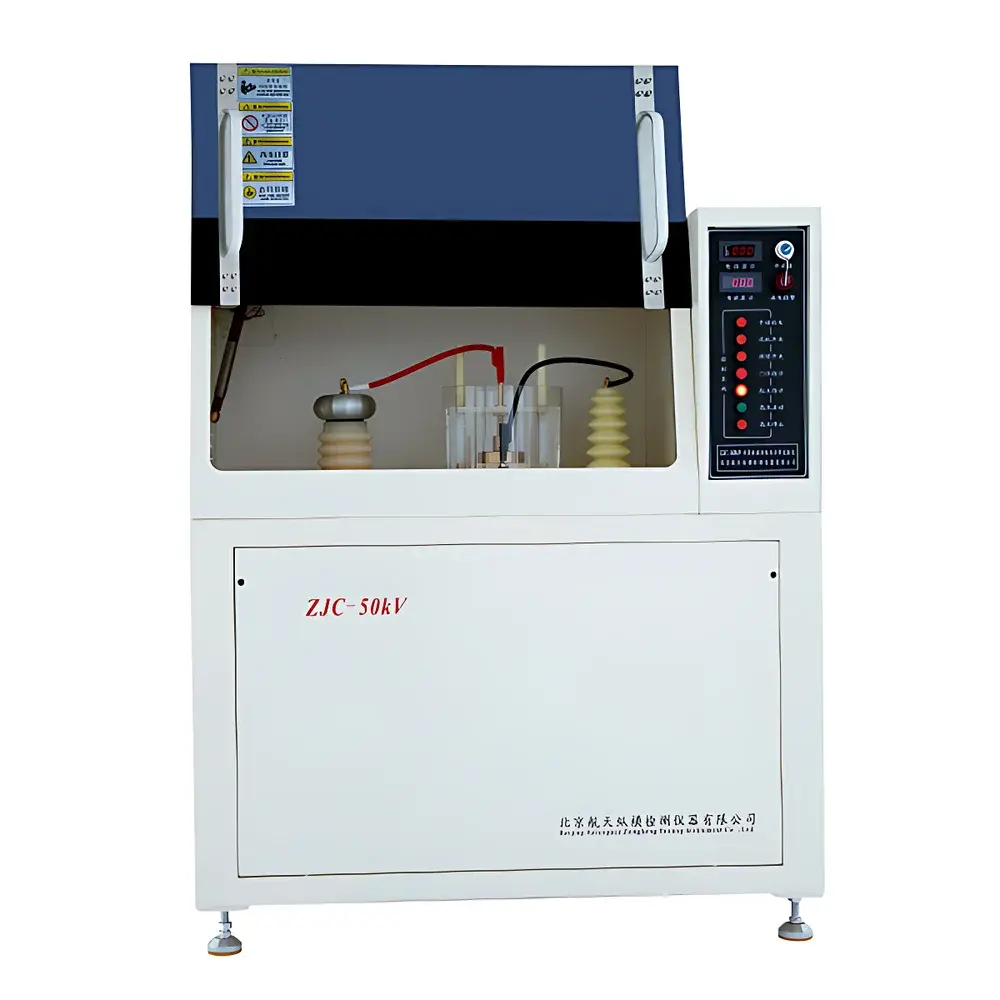
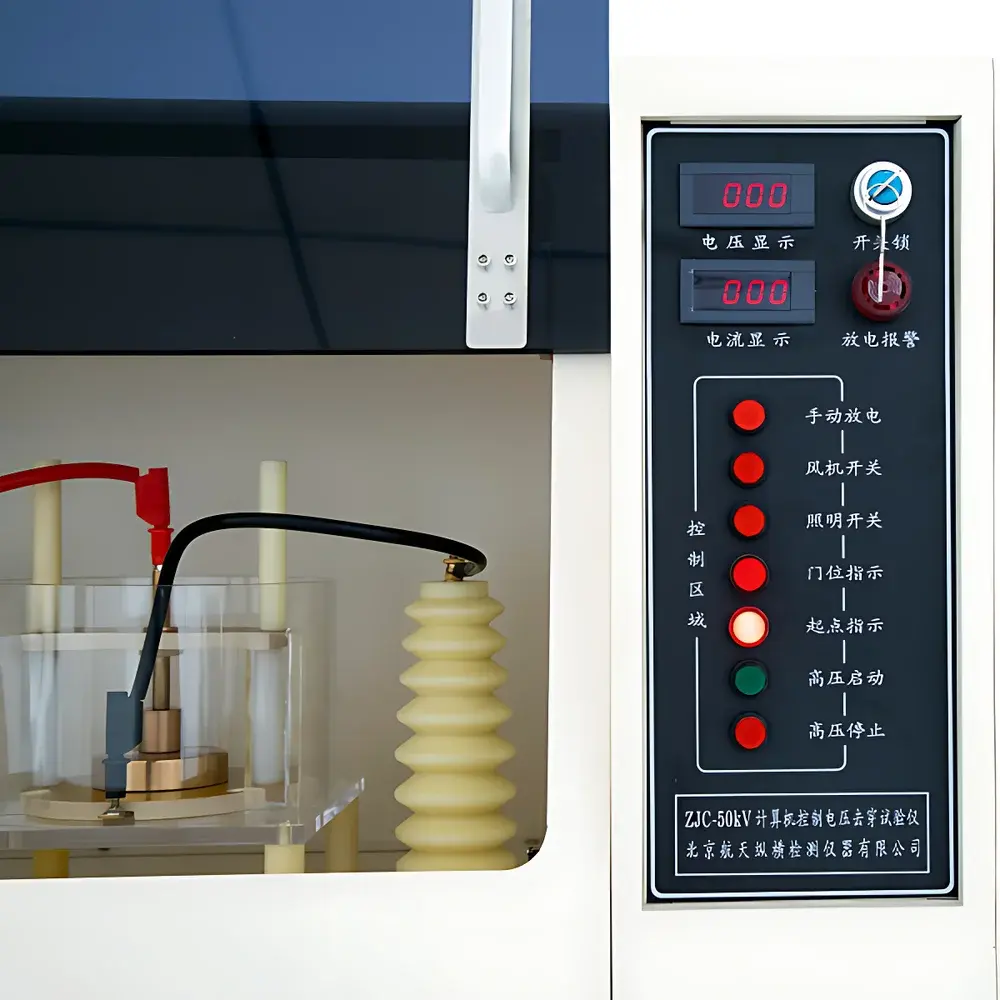
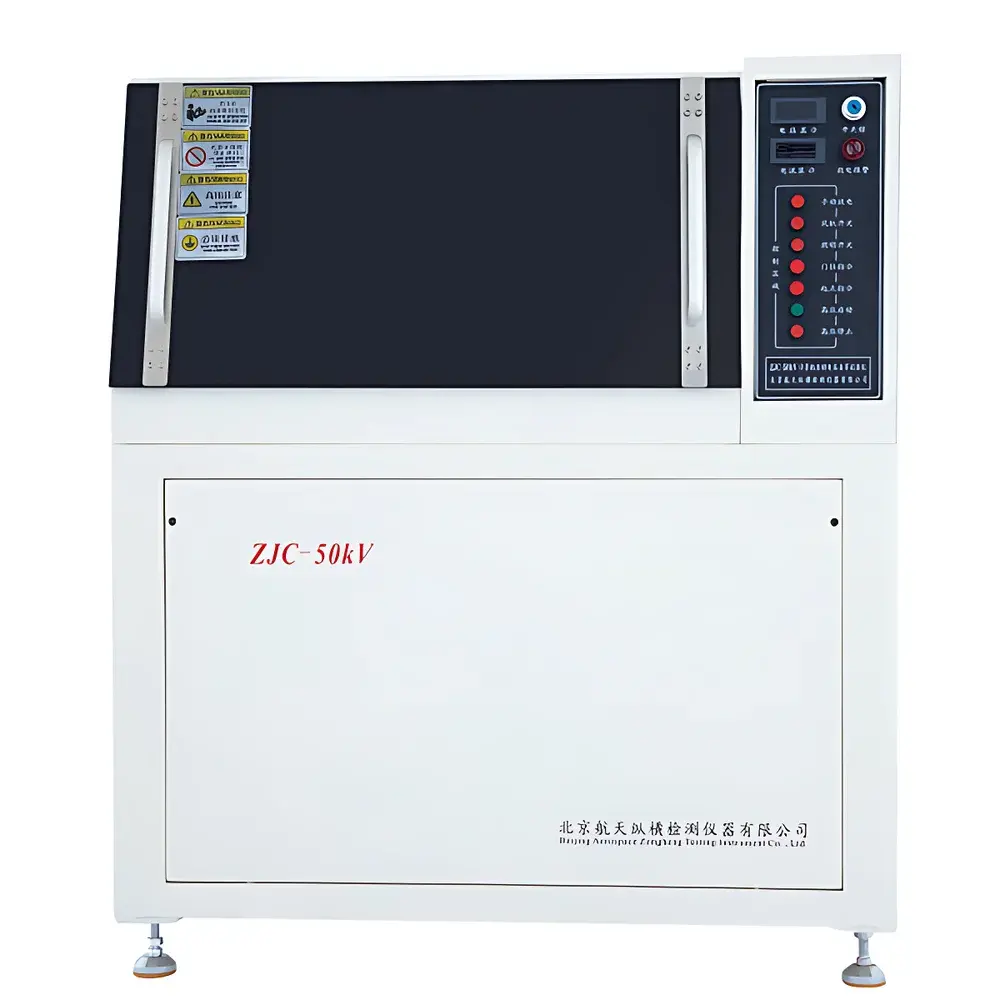
Aerospace ZJC-100KV Voltage Breakdown Strength Tester
| Brand | Aerospace |
|---|---|
| Origin | Beijing, China |
| Model | ZJC-100KV |
| Maximum Output Voltage | 100 kV |
| Compliance Standards | IEC 60243-1, ASTM D149, GB/T 1408.1, ISO 60243 |
| Voltage Regulation Accuracy | ±1% of full scale |
| Rise Rate Control | Adjustable from 0.1 to 5.0 kV/s (linear or stepwise) |
| Current Detection Range | 0.1 μA to 100 mA |
| Electrode Alignment Tolerance | ≤0.1 mm |
| Safety Certification | IEC 61010-1, CAT III 1000 V |
Overview
The Aerospace ZJC-100KV Voltage Breakdown Strength Tester is a precision high-voltage dielectric testing system engineered for quantitative evaluation of electrical insulation integrity under controlled AC or DC stress. It operates on the fundamental principle of controlled voltage ramping until catastrophic dielectric failure—defined as irreversible conduction path formation across the specimen—occurs. The instrument measures the critical breakdown voltage (Ub) and calculates dielectric strength (Eb = Ub/d), expressed in kV/mm, where d is the standardized thickness of the test sample. This measurement directly correlates with material reliability in high-field applications including power transmission insulation, aerospace wiring harnesses, EV battery separators, photovoltaic encapsulants, and medical-grade polymer housings. Unlike empirical pass/fail checks, this system delivers traceable, statistically robust data essential for material qualification, process validation, and failure mode analysis.
Key Features
- Programmable high-voltage source delivering 0–100 kV DC or AC (50/60 Hz) with ripple ≤3% and regulation accuracy ±1% FS
- Digitally adjustable voltage ramp rates (0.1–5.0 kV/s) compliant with IEC 60243-1, ASTM D149, and GB/T 1408.1 test protocols
- Modular electrode system featuring precision-machined brass or stainless-steel electrodes (ball-ball, sphere-plate, or cylindrical configurations), with axial alignment tolerance ≤0.1 mm
- Electromagnetically shielded test chamber with borosilicate viewing window, optional inert gas (N₂ or SF₆) purge interface, and grounded Faraday cage construction
- Real-time dual-channel acquisition: high-fidelity voltage divider (±1% accuracy) and low-noise current sensor (0.1 μA resolution, 100 mA full scale)
- Integrated safety architecture including interlocked access door, redundant overcurrent cutoff (<10 ms response), arc energy suppression via RC snubbers, and emergency stop circuitry certified to IEC 61010-1 Category III
Sample Compatibility & Compliance
The ZJC-100KV accommodates solid dielectrics with thicknesses from 0.1 mm to 12 mm—including thermoplastics (e.g., polyimide, PTFE), elastomers (silicone rubber), ceramics, laminates (FR-4), transformer oils, and thin-film battery separators. Sample mounting fixtures ensure uniform pressure distribution and edge clearance per ASTM D149 Clause 7.3. Environmental control is supported via external temperature/humidity chambers (25 ±2 °C, RH ≤65%), though the unit itself does not include climate conditioning. All test procedures adhere to internationally recognized standards: IEC 60243-1 (Methods of Determination of Dielectric Strength), ASTM D149 (Dielectric Breakdown Voltage of Solid Electrical Insulating Materials), GB/T 1408.1 (Chinese national standard equivalent), and ISO 60243. Full audit trails, electronic signatures, and 21 CFR Part 11–compliant data logging are enabled through optional software modules for GLP/GMP-regulated laboratories.
Software & Data Management
The embedded control platform runs deterministic real-time firmware with a Linux-based HMI interface. Test configuration supports linear, stepwise, or custom voltage profiles with programmable hold times, current trip thresholds (configurable from 1 mA to 50 mA), and automatic termination upon breakdown detection. During operation, synchronized voltage–current waveforms are displayed live with dynamic scaling and cursor-based event annotation. Post-test, raw binary data (timestamped at 10 kHz sampling rate) is exported in CSV or HDF5 format. Statistical analysis includes Weibull probability plotting, mean breakdown strength ± standard deviation, confidence intervals (95%), and batch-wise comparative charts. Reports comply with ISO/IEC 17025 documentation requirements and may be digitally signed with PKI certificates. Optional cloud synchronization enables centralized fleet monitoring and remote calibration verification.
Applications
- Qualification of lithium-ion battery separator films for EV traction packs (ASTM F3042 compliance)
- Validation of insulating varnishes used in high-speed motor windings operating above 10 kV
- R&D screening of nano-filled epoxy composites targeting >30 kV/mm dielectric strength
- Quality control of silicone encapsulants in outdoor photovoltaic junction boxes exposed to UV/humidity cycling
- Failure analysis of aged cable insulation in utility grid infrastructure (correlation with partial discharge mapping)
- Regulatory submission support for Class III medical device housing materials per IEC 60601-1 Clause 8.8.3
FAQ
What voltage types does the ZJC-100KV support?
It delivers both AC (50/60 Hz, RMS) and DC output, selectable via front-panel interface or software command. Polarity reversal for DC tests is hardware-enabled.
Is the system compatible with non-standard electrode geometries?
Yes—custom electrode holders and adapter plates are available under OEM engineering support; dimensional specifications must conform to IEC 60243 mechanical tolerances.
How is breakdown event detection validated?
Dual-criteria triggering: simultaneous voltage collapse (>15% drop within 20 ms) and current surge exceeding user-defined threshold (default 10 mA), confirmed by cross-channel correlation to reject false positives from transient noise.
Can test data be integrated into LIMS or MES platforms?
Yes—the instrument supports OPC UA and Modbus TCP protocols for seamless bidirectional communication with laboratory information management systems and manufacturing execution systems.
What maintenance intervals are recommended for long-term calibration stability?
Annual verification of voltage divider ratio and current sensor linearity is advised; NIST-traceable calibration certificates are issued with each service visit. High-voltage bushing cleaning and electrode polishing are recommended every 500 test cycles.



