
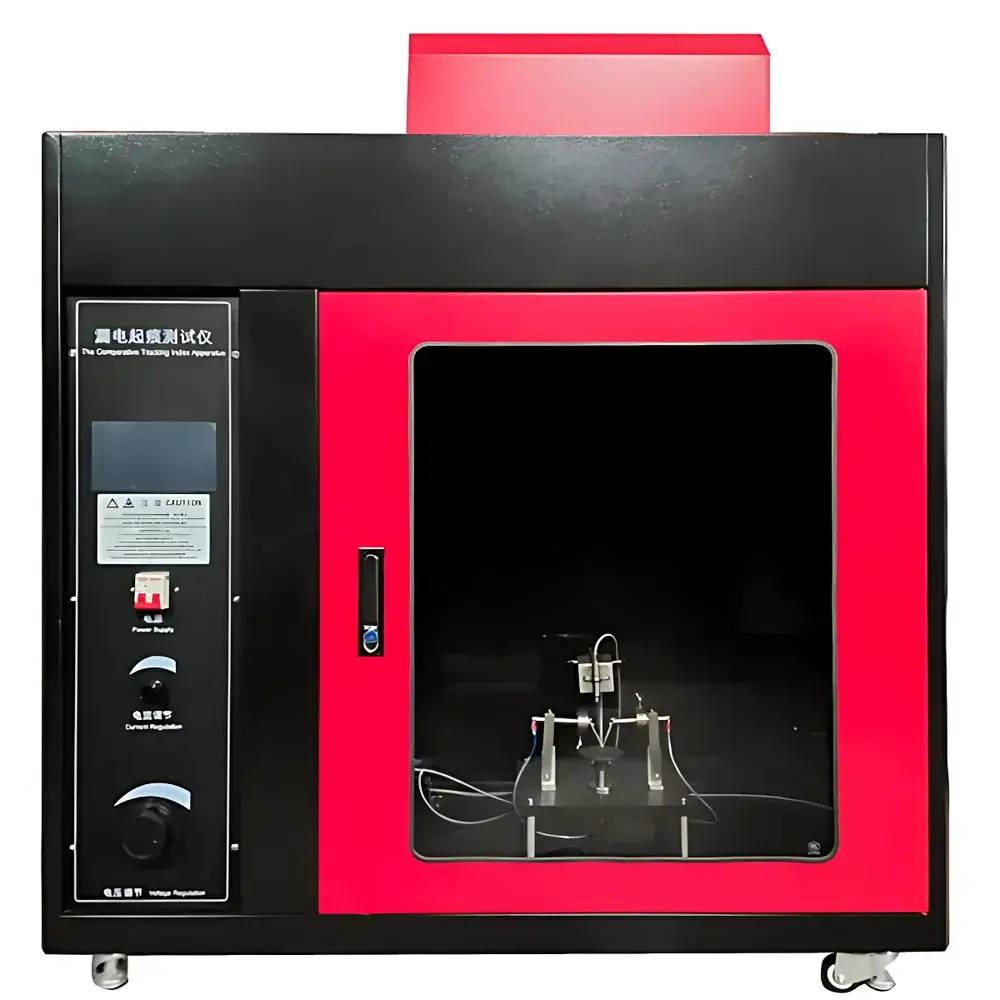
Aerospace CTI-3 Comparative Tracking Index (CTI) Tester for Electrical Insulating Materials
| Brand | Aerospace |
|---|---|
| Origin | Beijing, China |
| Manufacturer Type | Authorized Distributor |
| Country of Manufacture | China |
| Model | CTI-3 |
| Voltage Range | 100–600 V (25 V steps) |
| Electrode Material | Tungsten (99% purity) / Copper electrode holder |
| Electrode Dimensions | (2.0 ± 0.1) mm × (5.0 ± 0.1) mm × (40 ± 5) mm |
| Platinum Electrode Tip | 12 mm, 30° ± 2° bevel |
| Electrode Spacing | 4.00 ± 0.01 mm, 60° ± 5° included angle |
| Electrode Force | 1.00 ± 0.01 N |
| Test Solution Resistivity | Solution A: 3.95 ± 0.05 Ω·m (0.1% NH₄Cl) |
| Solution B | 1.98 ± 0.05 Ω·m |
| Drop Height | 35 ± 5 mm (adjustable) |
| Drop Interval | 30.00 ± 0.01 s (pre-settable) |
| Drops per cm³ | 44–55 |
| Total Drops Programmable | 1–9999 |
| Airflow Velocity | 0.2 m/s |
| Short-Circuit Current | 1.000 ± 0.001 A (voltage drop ≤ 8% at 1.0 A) |
| Tracking Threshold | 0.50 ± 0.05 A for ≥ 2.0 ± 0.2 s |
| Chamber Volume | > 0.5 m³ |
| Ambient Conditions | 0–40 °C, RH ≤ 80%, non-corrosive, vibration-free environment |
| Power Supply | 220 V AC, 0.6 kVA, 50–60 Hz |
| Dimensions (W×D×H) | 1160 × 600 × 1310 mm |
| Weight | Approx. 125 kg |
Overview
The Aerospace CTI-3 Comparative Tracking Index (CTI) Tester is a precision-engineered instrument designed to evaluate the surface resistance of solid electrical insulating materials to tracking degradation under high-voltage stress in the presence of conductive electrolyte contamination. Operating on the principle of comparative tracking index determination per IEC 60112, IEC 60695-2-11, and GB/T 4207 standards, the CTI-3 applies controlled DC or AC voltage (100–600 V, 48–60 Hz) across two calibrated tungsten electrodes while delivering standardized ammonium chloride (NH₄Cl) solution drops onto the specimen surface. Tracking failure is defined as the formation of a conductive carbonized path—initiated by localized dry-band arcing, thermal decomposition, and electrochemical corrosion—that sustains current flow exceeding 0.50 A for ≥2.0 seconds. The CTI value represents the highest voltage at which a material withstands 50 drops without tracking; the Proof Tracking Index (PTI) denotes the lowest voltage causing failure within 50 drops. This test is critical for qualification of polymeric enclosures, circuit boards, connectors, and molded components used in household appliances, industrial control systems, and low-voltage distribution equipment.
Key Features
- Integrated 7-inch full-color touchscreen HMI with PLC-based control architecture enabling real-time monitoring and intuitive operation of all test parameters.
- Programmable voltage ramping (100–600 V in 25 V increments), adjustable drop interval (30.00 ± 0.01 s standard), and configurable drop count (1–9999) with automatic termination logic.
- Tungsten electrodes (≥99% purity) with precision-ground 30° platinum tips, rigidly mounted to maintain 4.00 ± 0.01 mm spacing and 1.00 ± 0.01 N contact force—ensuring repeatability compliant with IEC 60112 Annex A.
- Dual-solution capability supporting both Solution A (3.95 ± 0.05 Ω·m) and Solution B (1.98 ± 0.05 Ω·m) per IEC 60112 Table 1, with integrated resistivity verification protocol.
- Fail-safe interlock system: High-voltage output is disabled unless the test chamber door is fully closed and latched; real-time door status monitoring with visual/audible alert.
- Overcurrent protection with dual-stage response: Instantaneous cut-off upon detection of ≥0.50 A sustained for ≥2.0 s; secondary alarm triggered if short-circuit current exceeds 1.000 ± 0.001 A with voltage sag >8%.
- Integrated quiet anti-backflow exhaust fan (Ø100 mm duct) maintaining 0.2 m/s laminar airflow during and post-test to evacuate corrosive fumes and combustion byproducts.
- On-device data storage with timestamped test records—including peak current, voltage profile, drop count, pass/fail status, and operator ID—accessible via History Data browser.
Sample Compatibility & Compliance
The CTI-3 accommodates flat, rigid specimens up to 100 mm × 100 mm × 12 mm (L × W × H), including thermoplastics (e.g., PBT, PA66, PC), thermosets (e.g., epoxy, phenolic), filled composites, and laminated substrates. Specimen mounting uses a stainless-steel sample tray with adjustable clamping to ensure planar alignment and consistent electrode contact pressure. All mechanical and electrical specifications conform to the dimensional, metrological, and procedural requirements of IEC 60112:2020, IEC 60695-2-11:2020, and GB/T 4207–2022. The instrument’s calibration traceability supports ISO/IEC 17025-compliant laboratory accreditation. While not inherently GLP/GMP-certified, its audit-ready data logging—featuring immutable timestamps, operator identification fields, and electronic signature support—facilitates integration into regulated quality systems requiring 21 CFR Part 11-aligned documentation practices.
Software & Data Management
The embedded control firmware implements deterministic real-time scheduling for synchronized voltage application, drop timing, current sampling (1 kHz acquisition rate), and safety interlock validation. Test data—including raw current/voltage waveforms, event logs (door open/close, voltage start/stop, drop triggers), and final pass/fail verdicts—are stored locally in non-volatile memory with SHA-256 hash integrity verification. Each record contains metadata: test date/time, operator name, specimen ID, standard reference (e.g., “IEC 60112 Ed. 4.0”), solution type, voltage setpoint, drop count, and observed failure mode (tracking, erosion, flaming). Export is supported via USB flash drive in CSV format compatible with LIMS and statistical process control (SPC) platforms. Future firmware updates—accessible via the reserved Ethernet port—will enable remote diagnostics, cloud-based result synchronization, and role-based user access control.
Applications
This instrument serves core qualification workflows in polymer R&D laboratories, component manufacturing QA/QC departments, and third-party testing service providers. Typical use cases include: evaluating halogen-free flame-retardant (HFFR) formulations for improved CTI stability; validating mold release agent residue effects on tracking resistance; screening PCB substrate materials (e.g., FR-4 variants) for high-humidity outdoor applications; assessing surface contamination tolerance of EV battery module housings; and supporting UL 746A/746B recognition testing for polymeric parts in Class 1 circuits. Its robust construction and validated repeatability (inter-laboratory CV < 3.5% per IEC TR 60112-3) make it suitable for both routine compliance verification and comparative material development studies.
FAQ
What standards does the CTI-3 comply with?
The CTI-3 meets the mechanical, electrical, and procedural requirements of IEC 60112:2020, IEC 60695-2-11:2020, ASTM D3638, and GB/T 4207–2022 for comparative and proof tracking index determination.
Can the CTI-3 perform PTI testing?
Yes—the instrument supports both CTI (voltage escalation method) and PTI (fixed-voltage endurance method) protocols via programmable voltage hold and drop-count termination logic.
Is calibration certification included?
A factory calibration report traceable to national standards is supplied with each unit; users are advised to perform annual verification using certified reference resistors and voltage calibrators per ISO/IEC 17025 Clause 6.6.
How is electrode wear managed?
Tungsten electrodes are consumables with finite service life; the instrument logs cumulative test hours and prompts replacement after 200 test cycles or visible tip deformation, per IEC 60112 Section 7.2.
Does the system support automated reporting?
Raw data export in CSV enables integration with external reporting tools; future firmware will embed configurable PDF report generation with company branding and regulatory statement templates.





