
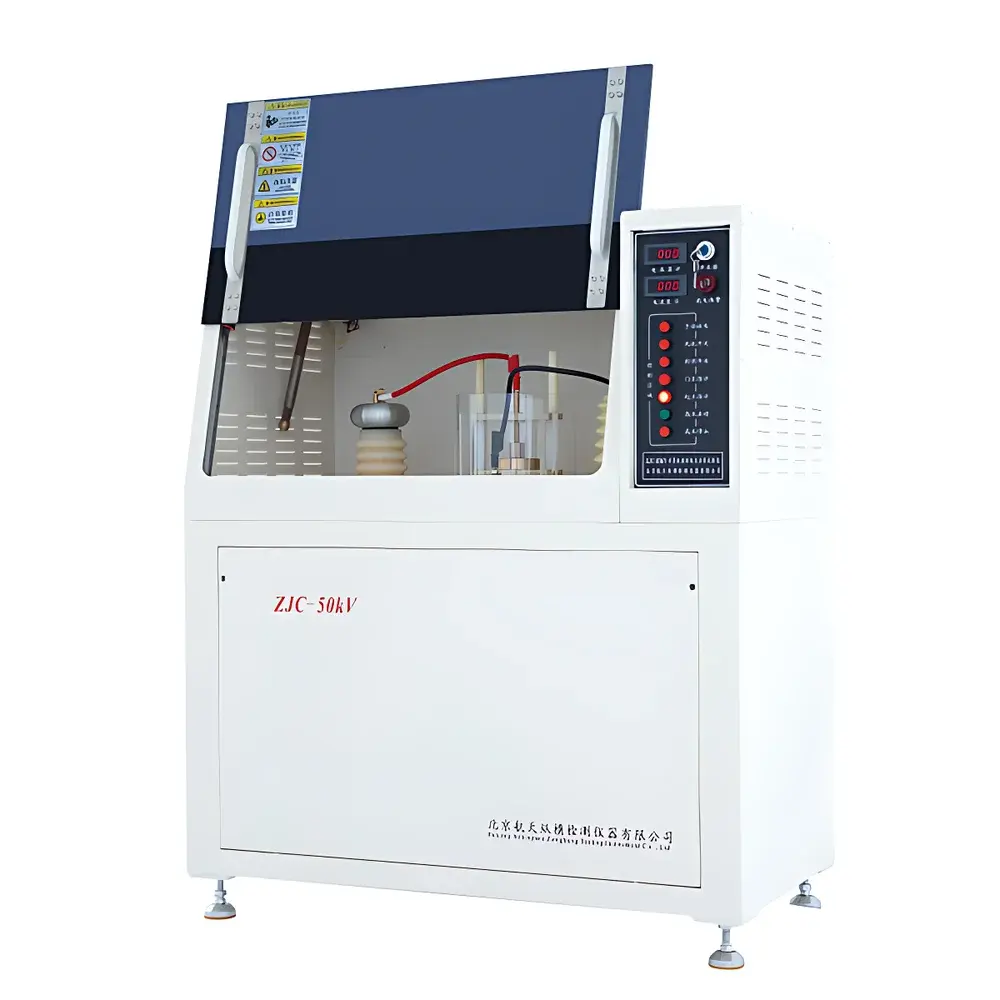
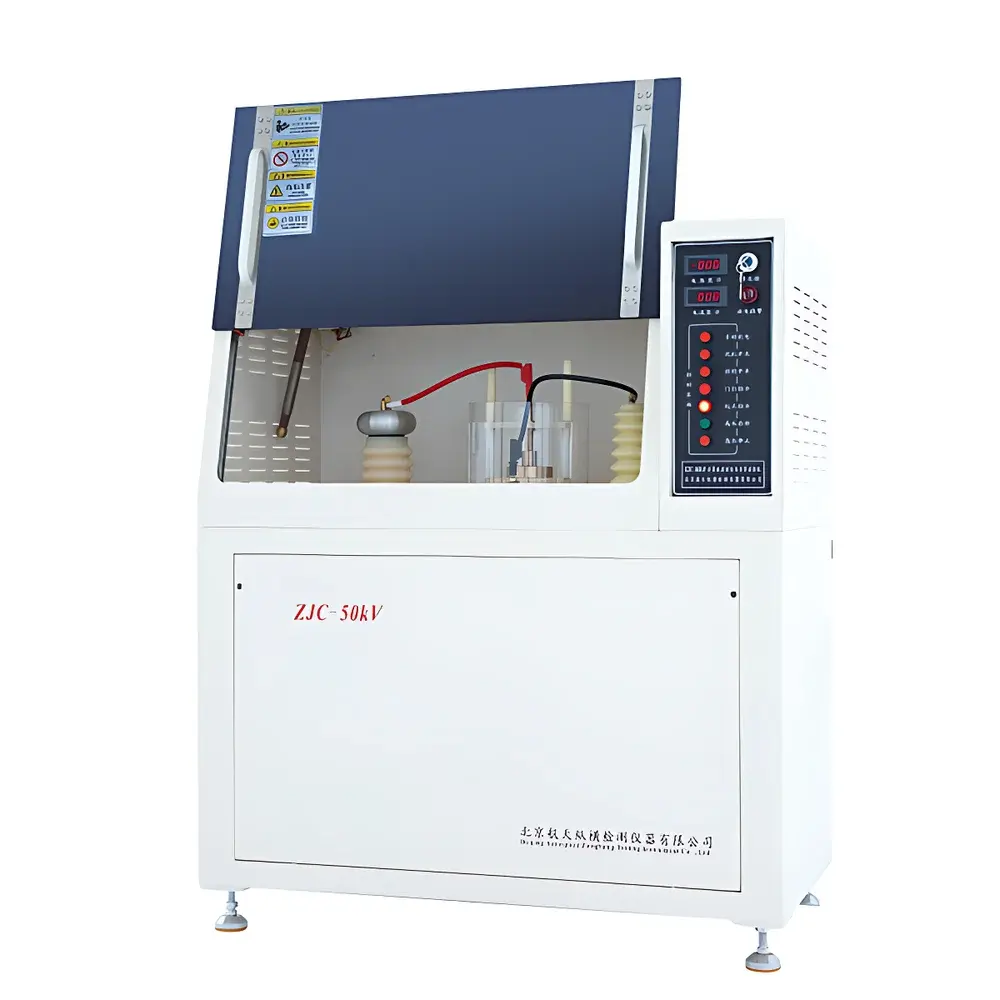
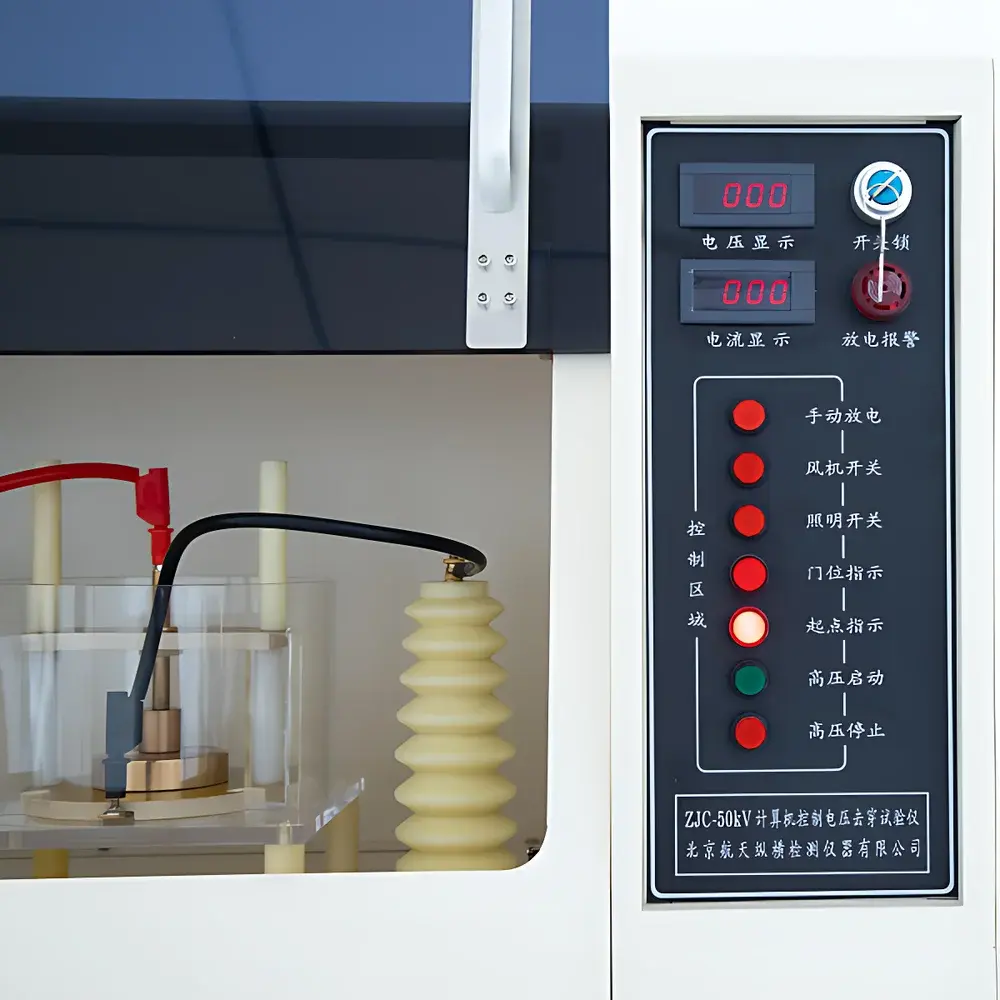
Aerospace ZJC-50kV Film Dielectric Breakdown Voltage Tester
| Brand | Aerospace |
|---|---|
| Origin | Beijing, China |
| Model | ZJC-50kV |
| Maximum Output Voltage | 50 kV |
| Voltage Regulation Range | 0–50 kV AC/DC |
| Ramp Rate | 0.1–5 kV/s (adjustable) |
| Breakdown Detection | Dual-threshold (current ≥1–10 mA + voltage drop >10%) |
| Compliance | IEC 60243-1, ASTM D149, GB/T 1408.1 |
| Safety Enclosure | 1.5 mm 304 stainless steel shielded chamber (≥60 dB shielding effectiveness) |
| Data Acquisition | 100 kHz sampling rate |
| Environmental Compensation | Real-time temperature/humidity correction (0.5%/°C) |
Overview
The Aerospace ZJC-50kV Film Dielectric Breakdown Voltage Tester is an engineered solution for quantitative evaluation of the dielectric strength of thin insulating films and sheet materials. It operates on the fundamental principle of controlled electric field stress application—subjecting a standardized specimen to a precisely ramped high-voltage potential until electrical breakdown occurs. This event marks the point at which the material’s intrinsic dielectric resistance is overcome, resulting in a conductive path formation via electron avalanche, thermal runaway, or electrochemical degradation. The instrument supports both AC (50/60 Hz) and DC testing modes, with a maximum output of 50 kV, enabling compliance with international standards governing insulation integrity assessment in power systems, electronics, and automotive applications. Its architecture integrates high-fidelity voltage regulation, microsecond-level response detection, and real-time environmental compensation—ensuring traceable, reproducible results under GLP-aligned laboratory conditions.
Key Features
- High-stability high-voltage generation system: Dual-mode transformer-based AC source (0–50 kV, ±1% full-scale stability) coupled with a 6-stage silicon stack DC multiplier (ripple factor <3%)
- Programmable ramp control: Linear and stepwise voltage rise profiles (0.1–5 kV/s), fully configurable to meet IEC 60243-1 short-time, step-by-step, and endurance test protocols
- Dual-criteria breakdown detection: Simultaneous monitoring of current threshold (1–10 mA selectable) and voltage collapse (>10% instantaneous drop), minimizing false positives from transient arcing
- Shielded safety enclosure: 1.5 mm 304 stainless steel chamber with electromagnetic shielding ≥60 dB; interlocked door system with magnetic latching relay (<10 ms disconnection response)
- Real-time environmental compensation: Integrated temperature/humidity sensor with automatic correction algorithm (0.5%/°C coefficient applied to raw breakdown voltage values)
- High-speed waveform capture: 100 kHz data acquisition synchronized across voltage and current channels, recording pre-breakdown transients and failure signatures over a 200 ms window
Sample Compatibility & Compliance
The ZJC-50kV is optimized for planar dielectric specimens ranging from 25 µm to 500 µm thickness, including polymeric films (PET, PI, PP, PE), laminated composites, coated substrates, and thin ceramic sheets. Standard electrode configurations include 25 mm diameter spherical brass electrodes (per IEC 60243-1) and 12.7 mm cylindrical electrodes (per ASTM D149). All electrodes meet HRB80 minimum hardness requirements and are surface-polished to Ra ≤0.4 µm to minimize field distortion. The system supports test environments up to 70°C using optional oil-immersion fixtures compliant with IEC 60243-2. Full traceability is maintained through built-in audit trail functionality aligned with FDA 21 CFR Part 11 requirements, including user authentication, electronic signatures, and immutable test record archiving.
Software & Data Management
The proprietary Windows-based control software provides intuitive test method configuration, live parameter visualization, and automated report generation in PDF/CSV formats. Each test session logs timestamped voltage/current waveforms, environmental metadata, operator ID, and calibration status. Statistical analysis modules support Weibull distribution fitting per ASTM D149 Annex A2, mean breakdown field strength calculation (kV/mm), and confidence interval estimation at 95%. Data export complies with ISO/IEC 17025 documentation requirements, and raw binary files are stored in vendor-neutral HDF5 format for third-party post-processing. Software validation documentation (IQ/OQ/PQ summaries) is provided for GMP-regulated laboratories.
Applications
- Power infrastructure: Verification of transformer insulation oil (IEC 60156), cable jacketing compounds, and bushing composite housings
- Electronics manufacturing: Qualification of PCB substrate dielectrics (e.g., FR-4, polyimide), flexible printed circuit overlays, and capacitor dielectric films
- Electric vehicle systems: Validation of battery module insulation barriers, high-voltage busbar coatings, and motor winding tapes per ISO 6469-1
- Medical device packaging: Assessment of sterilization-grade barrier films (e.g., Tyvek®/foil laminates) per ISO 11607-1
- Research & development: Correlation of polymer morphology (crystallinity, filler dispersion) with breakdown performance using controlled humidity/temperature staging
FAQ
What standards does the ZJC-50kV comply with?
It supports IEC 60243-1 (AC/DC short-time tests), ASTM D149 (stepwise and rapid-rise methods), and GB/T 1408.1 (Chinese national standard for solid insulating materials). Optional firmware modules enable custom protocol scripting.
Can the system perform oil-immersion testing?
Yes—when equipped with the optional oil bath fixture and temperature-controlled immersion chamber, it meets IEC 60243-2 requirements for liquid-medium dielectric testing.
Is the software 21 CFR Part 11 compliant?
Yes—the system includes role-based access control, electronic signature capability, audit trail logging, and data integrity safeguards required for regulated pharmaceutical and medical device labs.
What is the typical measurement uncertainty for breakdown voltage?
Under controlled lab conditions (23±2°C, 50±5% RH), expanded uncertainty (k=2) is ≤0.5% of reading for voltages above 5 kV, as verified per ISO/IEC 17025 accredited calibration procedures.
How is operator safety ensured during 50 kV operation?
Through redundant protection layers: hardware interlocks, residual voltage discharge (<50 V within 50 ms post-breakdown), independent grounding (<4 Ω), infrared thermal monitoring, and ozone concentration sensing with auto-ventilation activation at ≤0.1 ppm.



