
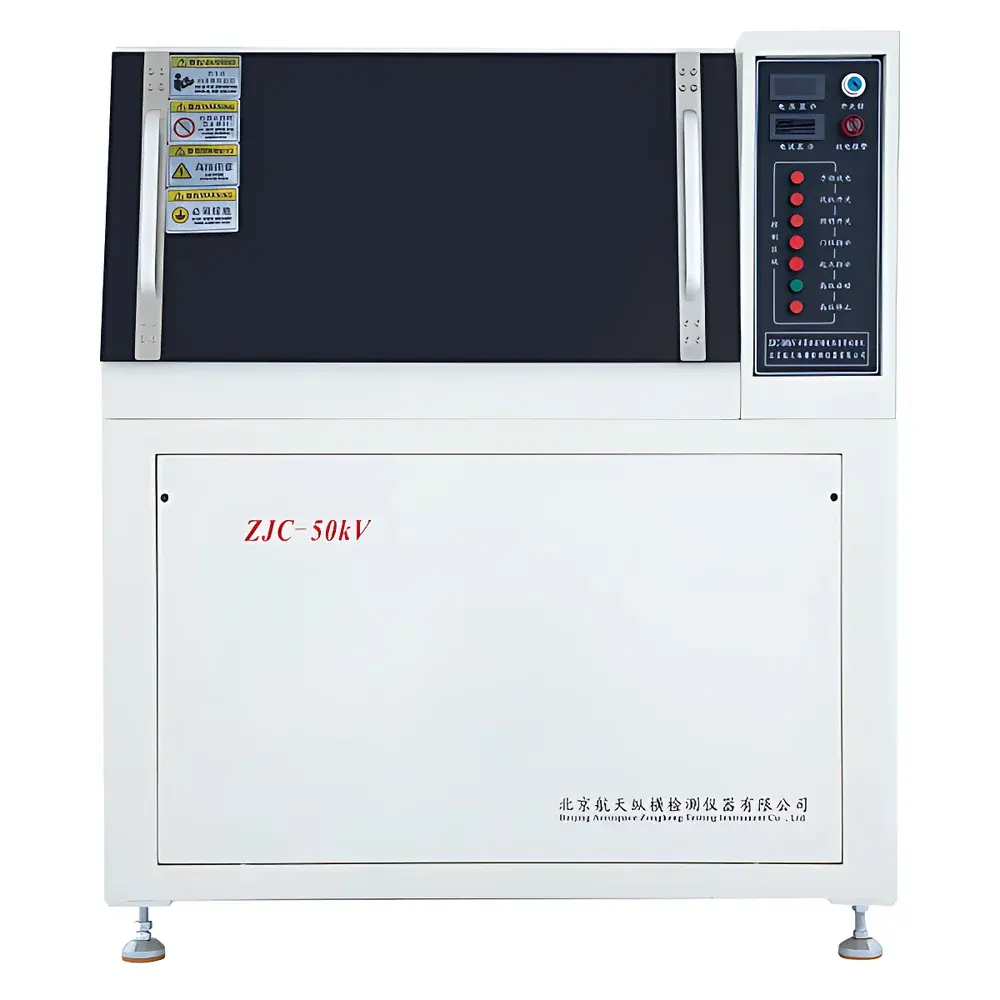
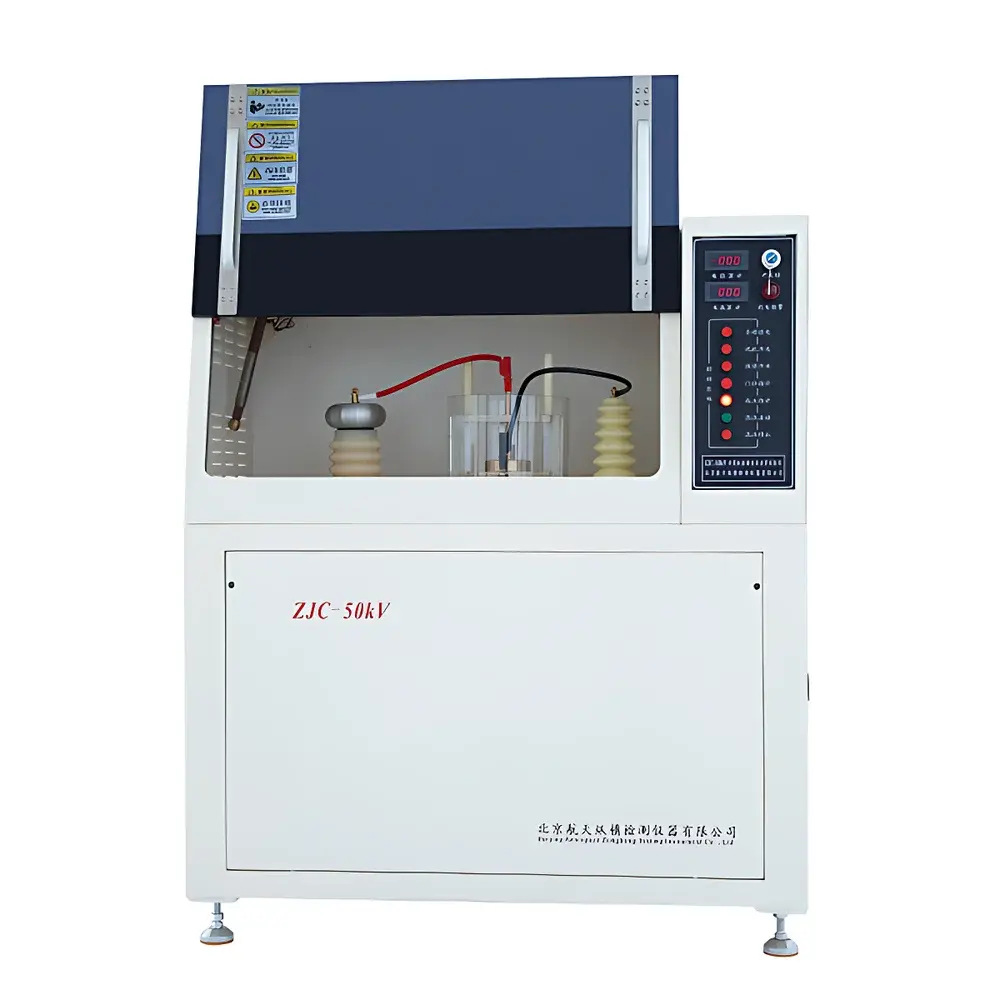
Aerospace ZJC-150KV AC/DC Dielectric Breakdown Voltage Tester
| Brand | Aerospace |
|---|---|
| Origin | Beijing, China |
| Model | ZJC-150KV |
| Output Voltage | AC/DC 0–150 kV |
| Measurement Range | AC/DC 15–150 kV |
| Accuracy | ≤ ±2% |
| Ramp Rate | 1–5 kV/s |
| Hold Time | 0–4 h |
| Leakage Current Setting | 1–30 mA (software-controlled) |
| Input Power | AC 220 V ±10%, 50 Hz ±1% |
| Output Power | 15 kVA |
| Dimensions (L×W×H) | 1980 × 1220 × 1750 mm |
| Weight | 350 kg |
| Operating Environment | 15–30 °C, RH ≤ 85% |
| Grounding Requirement | Dedicated earth electrode ≥1.5 m depth |
| Compliance | GB 1408.1–2006, GB 1408.2–2006, GB/T 1695–2005, GB/T 3333, HG/T 3330, GB 12656, ASTM D149 |
Overview
The Aerospace ZJC-150KV AC/DC Dielectric Breakdown Voltage Tester is a precision high-voltage testing system engineered for the quantitative evaluation of dielectric strength and voltage withstand capability of solid insulating materials under standardized power-frequency (50 Hz) alternating current or steady-state direct current stress. It operates on the fundamental principle of controlled voltage ramping until electrical breakdown occurs—defined as the irreversible loss of insulating integrity resulting in a measurable conduction path across the specimen. The instrument delivers calibrated, traceable high-voltage outputs up to 150 kV in both AC and DC modes, enabling compliance-driven characterization of insulation performance in accordance with international electrotechnical standards including IEC 60243-1 (equivalent to ASTM D149), GB 1408 series, and related material-specific test protocols. Its architecture integrates a high-stability oil-immersed high-voltage transformer, digitally regulated step-up control, real-time leakage current monitoring, and fully isolated measurement circuits—all housed within an EMI-shielded, interlocked enclosure meeting Class I electrical safety requirements.
Key Features
- True dual-mode operation: Independent AC (50 Hz) and DC high-voltage generation with seamless mode switching via software interface.
- Precision programmable voltage ramp: Adjustable linear rise rate from 1 kV/s to 5 kV/s, with sub-second resolution timing and automatic hold-on-break functionality.
- Integrated safety-critical protection suite: Includes overcurrent cutoff (<0.1 s response), mechanical and electronic high-voltage limiters, zero-voltage startup enforcement, door-interlocked discharge inhibition, and automatic post-test grounding via built-in discharge circuitry.
- Dedicated oil-immersed test chamber: Equipped with standardized brass or stainless-steel electrodes (e.g., spherical, cylindrical, or needle-plane per ASTM D149 Annex A1), adjustable electrode spacing, and temperature-stable dielectric oil bath (optional).
- Real-time data acquisition: Simultaneous sampling of applied voltage, leakage current, time-to-breakdown, and duration at preset test voltage—with 16-bit A/D conversion and noise-immune signal conditioning.
- Robust grounding architecture: Compliant with IEC 61000-4-5 and GB/T 16895.3, featuring dedicated 1.5 m deep earth rod connection point and low-impedance chassis bonding.
Sample Compatibility & Compliance
The ZJC-150KV supports standardized testing of rigid and semi-rigid dielectric solids—including polymer films, laminated composites, ceramic substrates, vulcanized rubber sheets, impregnated fiberboards, mica tapes, and insulating varnish-coated substrates. Specimen thickness must fall within 0.1–10 mm per GB 1408.1 and ASTM D149 guidelines to ensure valid field uniformity. All test configurations adhere to electrode geometry and environmental controls specified in referenced standards. The system meets essential regulatory requirements for laboratory accreditation: full traceability of calibration certificates (voltage divider, current shunt), documented uncertainty budgets (<±2% at full scale), and hardware/software design aligned with ISO/IEC 17025 clause 5.5.1 for electrical safety testing equipment. Optional audit-ready configuration includes GLP-compliant electronic signatures, 21 CFR Part 11–enabled user access logs, and immutable test record archiving.
Software & Data Management
The proprietary Windows-based control software provides ISO 17025–aligned test workflow management. Users define test parameters—including voltage mode, ramp rate, hold voltage, pass/fail thresholds, and leakage current limits—via intuitive dialog boxes. During execution, the software plots real-time voltage vs. time and current vs. time curves with auto-scaling, multi-curve overlay, and region-specific zoom. Post-test, raw data (timestamped, with metadata: operator ID, sample ID, ambient T/RH, electrode type) are stored in encrypted binary format (.zjc) and exportable to CSV, Excel, or Word without loss of precision. Built-in report templates comply with internal QA formats and external certification submissions (e.g., UL, CE, CCC). Role-based access control allows administrator-defined permissions for parameter editing, result modification, and system configuration—ensuring separation of duties and preventing unauthorized overrides.
Applications
This tester serves critical quality assurance and R&D functions across multiple sectors: validation of insulating components in high-voltage cable manufacturing (per GB/T 3333); qualification of capacitor dielectrics (GB 12656); assessment of coating integrity on motor windings (HG/T 3330); comparative screening of epoxy resin formulations for aerospace encapsulation; and accelerated aging studies of polymeric insulators under combined thermal-electrical stress. It is routinely deployed in third-party testing laboratories accredited to CNAS (China National Accreditation Service) and in OEM QC labs supporting IATF 16949 and ISO 9001 certified production lines. The 150 kV ceiling enables evaluation of next-generation wide-bandgap semiconductor packaging materials and high-dielectric-constant ceramics used in pulsed-power systems.
FAQ
What standards does the ZJC-150KV explicitly support?
It natively implements GB 1408.1–2006, GB 1408.2–2006, GB/T 1695–2005, GB/T 3333, HG/T 3330, GB 12656, and ASTM D149—covering both AC and DC dielectric breakdown testing methodologies.
Is the system suitable for continuous unattended operation?
Yes. Designed for industrial lab environments, it features thermal management (transformer ventilation port), overload recovery logic, and fault-tolerant firmware permitting extended duty cycles without mandatory cooldown intervals.
How is measurement traceability ensured?
Voltage output is calibrated against NIST-traceable high-voltage dividers; current sensing uses certified shunts. Full calibration documentation—including uncertainty statements and as-found/as-left reports—is provided with each unit and annually recommended.
Can test sequences be automated for batch processing?
Yes. The software supports script-based test sequencing, automatic electrode cleaning prompts, pass/fail flagging based on user-defined criteria, and scheduled report generation for multi-sample campaigns.
What safety certifications apply to the mechanical enclosure?
The cabinet conforms to IP2X finger-protection rating per GB 4208 and incorporates dual-redundant door interlocks, illuminated HV status indicators, and emergency stop circuitry compliant with IEC 60204-1.
Related Products



