
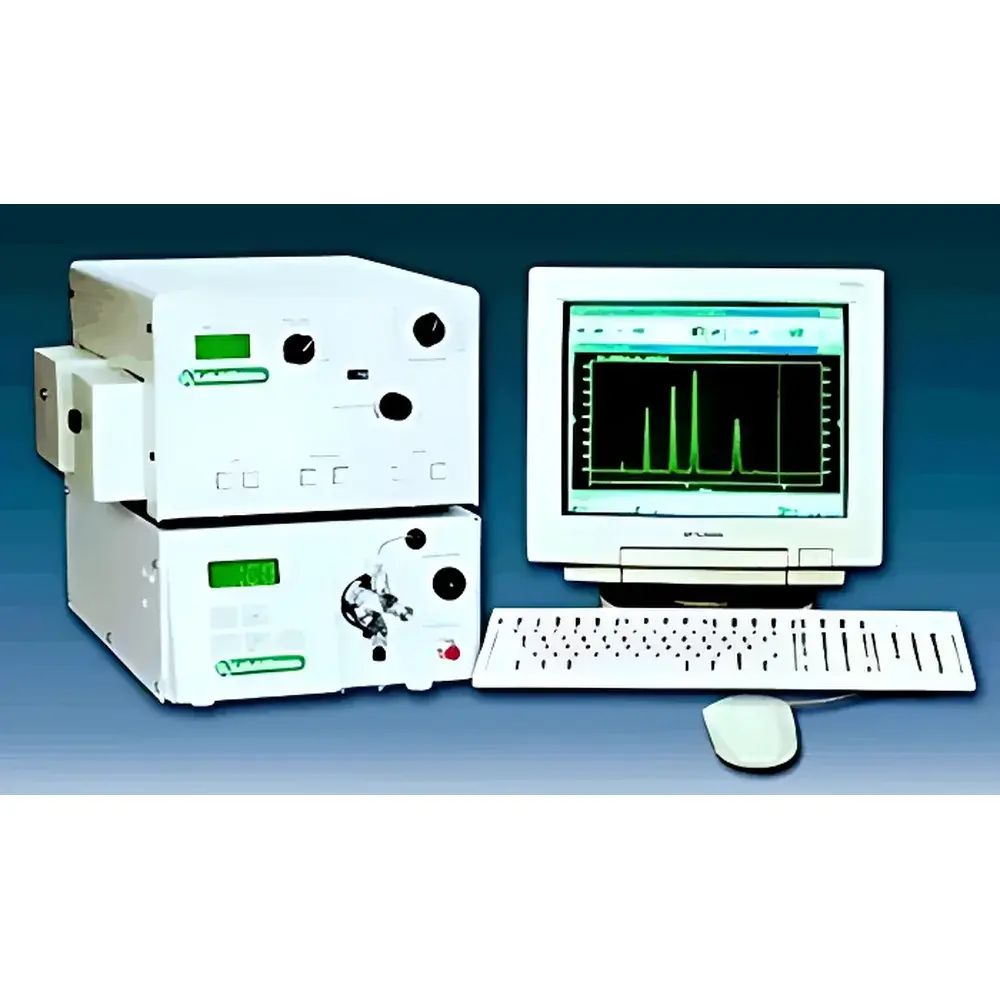
LabAlliance PC-2000 Isocratic High-Performance Liquid Chromatography System
| Origin | USA |
|---|---|
| Manufacturer Type | Authorized Distributor |
| Origin Category | Imported |
| Model | PC-2000 |
| Pricing | Available Upon Request |
| Maximum Pressure | 6000 psi |
| Flow Rate Range | 0.01–9.99 mL/min |
| Flow Accuracy | ±0.1% |
| Baseline Noise (UV-VIS) | 0.2 × 10⁻⁵ AU |
| Baseline Drift (UV-VIS) | 2 × 10⁻⁴ AU/hr |
| Pump Technology | SSI III Dual-Piston Positive Displacement with Patented Online Self-Cleaning Mechanism |
| Upgrade Path | Compatible with Second Pump for Binary Gradient Configuration |
| Detector Standard | Model 500 UV-Vis Variable Wavelength Detector (190–700 nm) |
| Software | LabAlliance Chromatography Data System (CDS) with Audit Trail & Electronic Signature Support per FDA 21 CFR Part 11 |
Overview
The LabAlliance PC-2000 Isocratic High-Performance Liquid Chromatography (HPLC) System is an engineered solution for laboratories requiring robust, reproducible, and compliant isocratic separations in routine quality control (QC), method validation, and applied research environments. Built upon four decades of HPLC system design expertise, the PC-2000 implements classical reversed-phase, normal-phase, and ion-exchange chromatographic principles using a single high-pressure solvent delivery module, fixed-composition mobile phase, and a precision UV-Vis detection platform. Its architecture adheres to fundamental chromatographic theory—ensuring consistent retention time stability, peak symmetry, and quantitative linearity across diverse analyte classes including pharmaceutical actives, organic impurities, polymers, and small-molecule metabolites. The system operates within ISO/IEC 17025-aligned workflows and supports GLP/GMP documentation requirements through traceable instrument control and data integrity features.
Key Features
- SSI III High-Pressure Solvent Delivery Pump featuring patented online self-cleaning mechanism—eliminates solvent residue buildup at check valves and pistons, extending mean time between maintenance (MTBM) to >10 years under typical QC usage conditions
- High-precision flow control over 0.01–9.99 mL/min range with ±0.1% accuracy and <0.05% RSD, enabled by sapphire-plated plungers and ceramic ball valves for chemical inertness and wear resistance
- Model 500 UV-Vis variable wavelength detector with spectral range 190–700 nm, baseline noise ≤0.2 × 10⁻⁵ AU (254 nm, 1 sec time constant), and drift ≤2 × 10⁻⁴ AU/hr—optimized for low-concentration quantitation in regulated environments
- Modular detector interface supporting seamless integration of optional detectors: fluorescence (FLD), refractive index (RID), evaporative light scattering (ELSD), and conductivity (CD) without hardware modification
- Scalable architecture: single-pump configuration supports immediate isocratic deployment; addition of a second SSI III pump enables binary gradient operation without controller replacement or software reconfiguration
- Pre-configured system package includes injection valve with 20 µL fixed loop, stainless-steel analytical column (C18, 150 × 4.6 mm, 5 µm), complete installation kit, and validated CDS software suite
Sample Compatibility & Compliance
The PC-2000 accommodates a broad spectrum of sample matrices—including aqueous buffers, organic solvents (acetonitrile, methanol), and mildly corrosive mobile phases—due to its wetted-path materials (316L stainless steel, PEEK, sapphire, and ceramic). It complies with ASTM E2656 (Standard Guide for HPLC System Verification), USP Chromatography, and ISO 17025 clause 5.9 on equipment verification. All electronic records generated via the LabAlliance CDS maintain ALCOA+ attributes (Attributable, Legible, Contemporaneous, Original, Accurate, Complete, Consistent, Enduring, Available) and support audit-ready reporting for FDA, EMA, and PMDA inspections. System suitability testing (SST) templates are preloaded per ICH Q2(R2) guidelines.
Software & Data Management
The LabAlliance Chromatography Data System (CDS) provides full lifecycle data handling—from method creation and sequence definition to real-time chromatogram acquisition, peak integration, calibration curve generation, and report export (PDF, CSV, XML). The software incorporates role-based user access control, electronic signatures compliant with FDA 21 CFR Part 11, and immutable audit trails logging all method edits, data processing actions, and instrument events. Raw data files (.lcd) are stored in vendor-neutral format with embedded metadata (instrument ID, date/time stamp, operator ID, method version), ensuring long-term readability independent of software upgrades. Backup and restore protocols align with NIST SP 800-53 Rev. 5 requirements for data integrity preservation.
Applications
- Pharmaceutical QC release testing of APIs and finished dosage forms per USP monographs
- Food safety analysis: pesticide residue screening, mycotoxin quantification, and preservative profiling
- Environmental monitoring: PAHs, phenols, and chlorinated hydrocarbons in water and soil extracts
- Polymer additive characterization (e.g., antioxidants, UV stabilizers) in petrochemical and plastics manufacturing
- Academic and contract research labs performing method development, stability-indicating assays, and forced degradation studies
FAQ
Is the PC-2000 compatible with UHPLC columns?
Yes—the system’s maximum pressure rating of 6000 psi supports 2.7 µm and 3 µm particle-packed columns commonly used in high-efficiency isocratic applications, though it is not rated for sub-2 µm UHPLC pressures (≥15,000 psi).
Can the Model 500 detector be configured for dual-wavelength analysis?
Yes—simultaneous dual-channel acquisition at user-defined wavelengths is supported, enabling ratio-based quantitation and peak purity assessment.
Does the system include validation documentation?
A comprehensive IQ/OQ protocol package is provided, including factory test reports, as-installed verification data, and blank templates for PQ execution in accordance with GAMP 5 principles.
What maintenance intervals are recommended for the SSI III pump?
Under standard operating conditions (aqueous/organic mobile phases, filtered solvents), scheduled maintenance is recommended every 24 months; however, the online self-cleaning function typically extends piston seal life beyond 5000 hours of cumulative operation.
Is third-party software integration supported?
The CDS exports standardized .cdf and .csv files and supports OpenLab CDS import protocols, facilitating interoperability with LIMS and enterprise analytics platforms via secure API endpoints.



