
Aerospace ZJC-150KV Dielectric Strength Tester for Vulcanized Rubber and Solid Insulating Materials
| Brand | Aerospace |
|---|---|
| Origin | Beijing, China |
| Model | ZJC-150KV |
| Maximum Output Voltage | 150 kV AC/DC |
| Voltage Accuracy | ≤ ±3–5% |
| Adjustable Ramp Rates | 0.1–5 kV/s (7 preset steps) |
| Test Modes | AC/DC — Uniform Ramp, Stepwise Ramp, Hold-at-Voltage (Dielectric Withstand) |
| Compliance | GB 1408.1–2006, GB/T 1695–2005, GB/T 3333–2008, HG/T 3330–2003, GB 12656–1990, ASTM D149–2022 |
| Electrode Configurations | Ø25 mm & Ø75 mm stainless steel disk electrodes |
| Test Medium | Air or insulating oil |
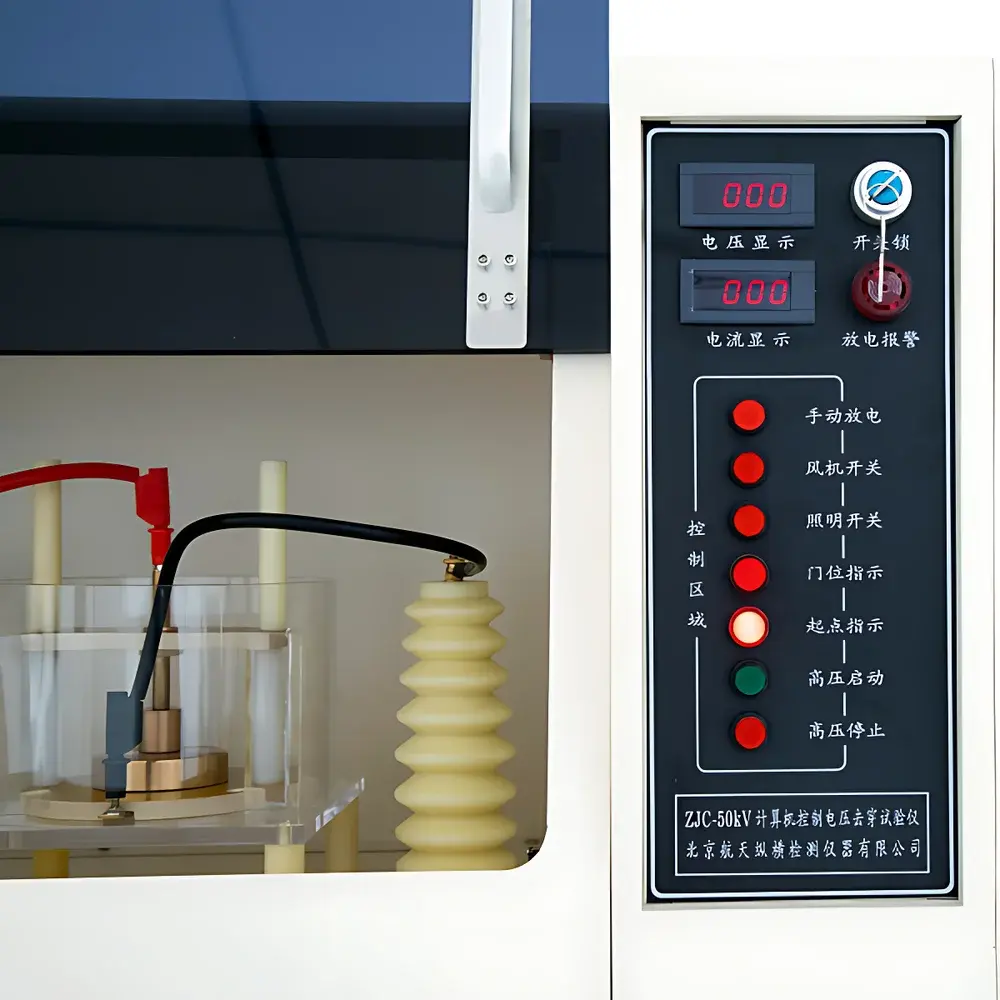
| Safety Interlocks | 6-level hardware-enforced shutdown (door switch, key-controlled HV disconnect, zero-position lockout, overcurrent cutoff <100 ms, ground fault detection, DC discharge alarm) |
| Software Platform | Windows XP/7/8 native application with real-time curve plotting, multi-curve overlay, region zoom, manual data validation, Excel export, user role management, and audit-trail-capable test logging |
Overview
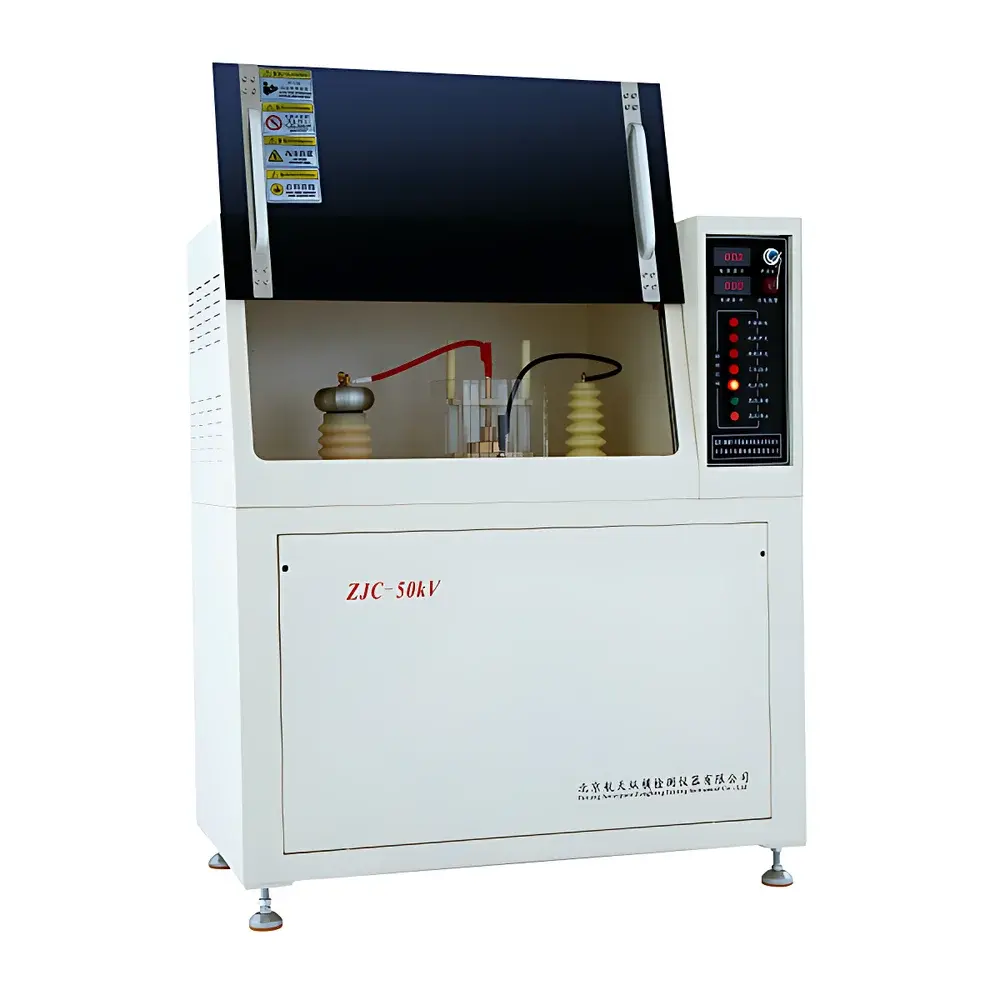
The Aerospace ZJC-150KV Dielectric Strength Tester is a precision high-voltage testing system engineered for the quantitative evaluation of electrical breakdown behavior in solid dielectric materials under standardized AC and DC stress conditions. It operates on the principle of controlled voltage ramping across a defined electrode geometry until catastrophic dielectric failure—manifested as a conductive path through the specimen—is detected via current surge monitoring. This instrument implements the fundamental methodology described in IEC 60243-1, ASTM D149, and GB 1408.1, where dielectric strength (kV/mm) is calculated as the peak applied voltage at breakdown divided by the thickness of the conditioned test specimen. Designed for laboratory-based quality control, R&D validation, and regulatory compliance testing, the system delivers repeatable, traceable, and standards-aligned results for vulcanized rubber, thermoplastics, elastomeric films, epoxy resins, ceramic substrates, glass laminates, and insulating varnishes.
Key Features
- True dual-mode operation: fully independent AC (50/60 Hz) and DC output channels, each capable of continuous voltage regulation from 0 to 150 kV with digital setpoint resolution of 10 V
- Seven programmable voltage ramp rates (0.1, 0.2, 0.3, 0.5, 1.0, 2.0, and 3.0 kV/s), selectable per test sequence to match material response kinetics and standard requirements
- Hardware-enforced six-tier safety architecture: interlocked test chamber door, keyed HV isolation switch, auto-resetting autotransformer zero-position sensor, instantaneous overcurrent cutoff (<100 ms), ground-fault circuit interrupter (GFCI), and mandatory DC discharge verification prior to access
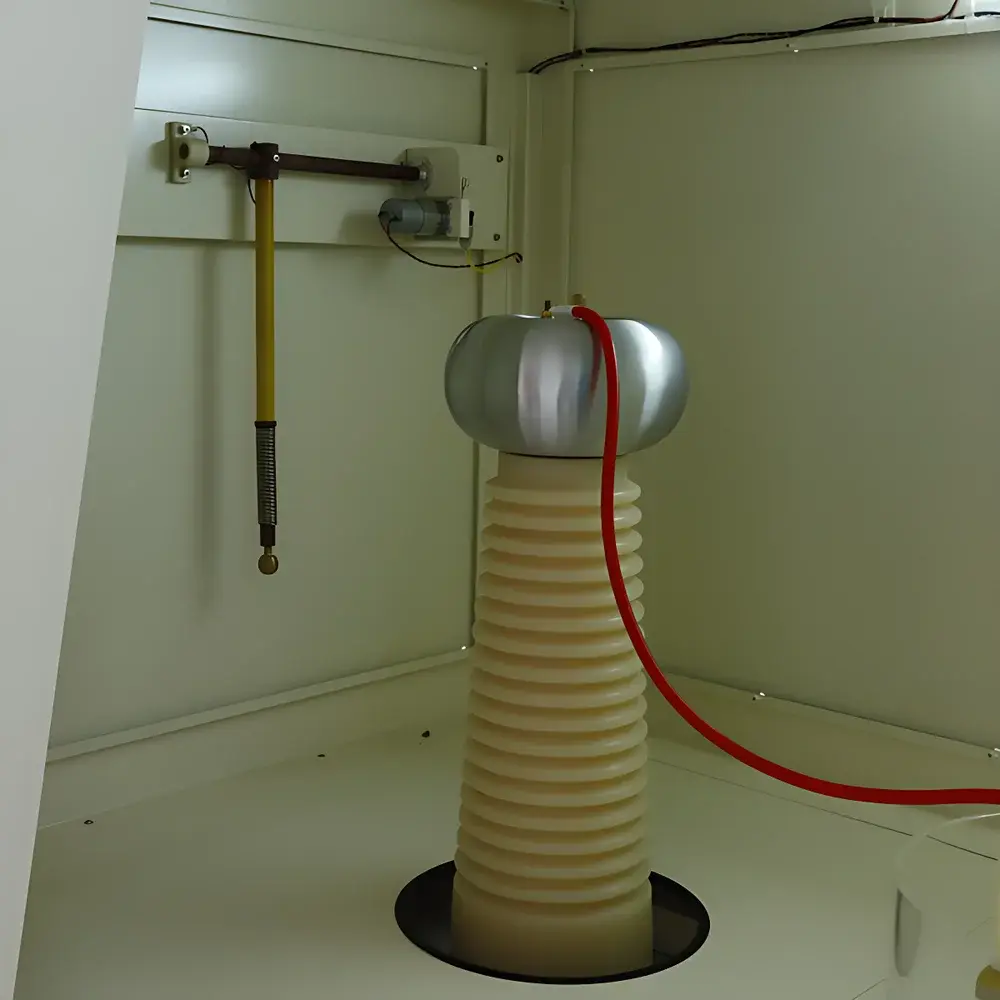
- Integrated discharge management: built-in electrostatic discharge (ESD) probe with visual/audible confirmation; eliminates reliance on external grounding rods and enforces procedural compliance before specimen handling
- Real-time data acquisition at ≥1 kHz sampling rate, synchronized with voltage ramp profile; enables precise identification of pre-breakdown leakage current onset, partial discharge thresholds, and post-breakdown arcing duration
- Self-contained test environment: sealed oil bath option (ASTM D149 Annex A) and ambient air configuration, both compliant with electrode spacing requirements per GB/T 1695–2005 (≥250 mm for 50 kV, ≥370 mm for 100+ kV systems)
Sample Compatibility & Compliance
The ZJC-150KV accommodates flat, homogeneous specimens ranging from 0.1 mm to 12 mm in thickness, including vulcanized rubber sheets (per GB/T 1695–2005), polymeric films (GB/T 3333–2008), capacitor paper (GB 12656–1990), mica tapes, silicone elastomers, and cured resin composites. Electrode configurations conform to ASTM D149 Figure 1 (disk electrodes) and support parallel-plate geometry per IEC 60243-1. All operational parameters—including voltage calibration traceability, ramp linearity, and current threshold sensitivity—are validated against national metrological standards. The system satisfies full technical alignment with ISO/IEC 17025–2017 requirements for testing laboratories, supporting GLP documentation workflows and enabling direct integration into FDA 21 CFR Part 11–compliant environments when paired with optional electronic signature modules and audit-log-enabled software licenses.
Software & Data Management
Control and analysis are executed via a dedicated Windows-native application featuring deterministic real-time plotting, multi-test curve overlay with color-coded legends, and lossless vector-based export (SVG/PDF). Each test session automatically logs timestamped metadata: operator ID, environmental conditions (optional external sensor integration), electrode type, specimen ID, voltage waveform, current response, breakdown event coordinates, and pass/fail status per selected acceptance criteria. Data files adhere to HDF5 format for long-term archival integrity and interoperability with MATLAB, Python (h5py), and LIMS platforms. The software implements role-based access control (RBAC): administrators configure test templates and calibration intervals; technicians execute predefined protocols; QA reviewers validate raw data and approve reports. All modifications to test parameters or result annotations are immutably recorded with user ID and timestamp—fully satisfying ALCOA+ principles (Attributable, Legible, Contemporaneous, Original, Accurate, Complete, Consistent, Enduring, Available).
Applications
- Quality assurance of automotive EPDM and NBR rubber components for high-voltage cable insulation and bushing applications
- Development-stage screening of nanocomposite dielectrics for power electronics encapsulation
- Regulatory submission testing of medical device polymer housings per IEC 60601-1 Clause 8.8.3
- Failure analysis of aged transformer winding papers and pressboard spacers
- Comparative evaluation of surface-modified polyimide films for aerospace flex circuits
- Validation of conformal coating integrity on PCB assemblies subjected to humidity conditioning (per IPC-CC-830B)
FAQ
What standards does this instrument fully support out-of-the-box?
The ZJC-150KV is preconfigured to execute test sequences compliant with GB 1408.1–2006, GB/T 1695–2005, ASTM D149–2022, and IEC 60243-1. Optional firmware modules extend coverage to UL 746A (tracking resistance correlation) and IEC 60587 (electrical tracking resistance).
Is the system suitable for testing curved or irregularly shaped samples?
No. Per ASTM D149 Section 6.2 and GB/T 1695–2005 Section 5.1, only flat, parallel-surface specimens of uniform thickness may be tested. Curved geometries introduce field distortion and invalidate dielectric strength calculations.
How is measurement uncertainty quantified for calibration verification?
Voltage output uncertainty is ±(0.5% of reading + 0.2% of full scale) at 23 °C ±2 °C, verified annually using NIST-traceable high-voltage dividers (e.g., Tettex 4200 series) and calibrated current shunts (Fluke 9100-100A).
Can test data be exported directly to LIMS or ERP systems?
Yes. The software supports automated CSV and XML exports via scheduled tasks, and includes a documented REST API for programmatic ingestion into enterprise data infrastructure. Audit trails and electronic signatures meet 21 CFR Part 11 Subpart B requirements when configured with time-stamped digital certificates.
What maintenance intervals are recommended for sustained accuracy?
Preventive maintenance—focused on HV transformer insulation resistance, contactor contact resistance, and grounding continuity—is required every 12 months or after 500 test cycles, whichever occurs first. Calibration certificate renewal must align with ISO/IEC 17025–2017 Clause 7.7.1 requirements.



