
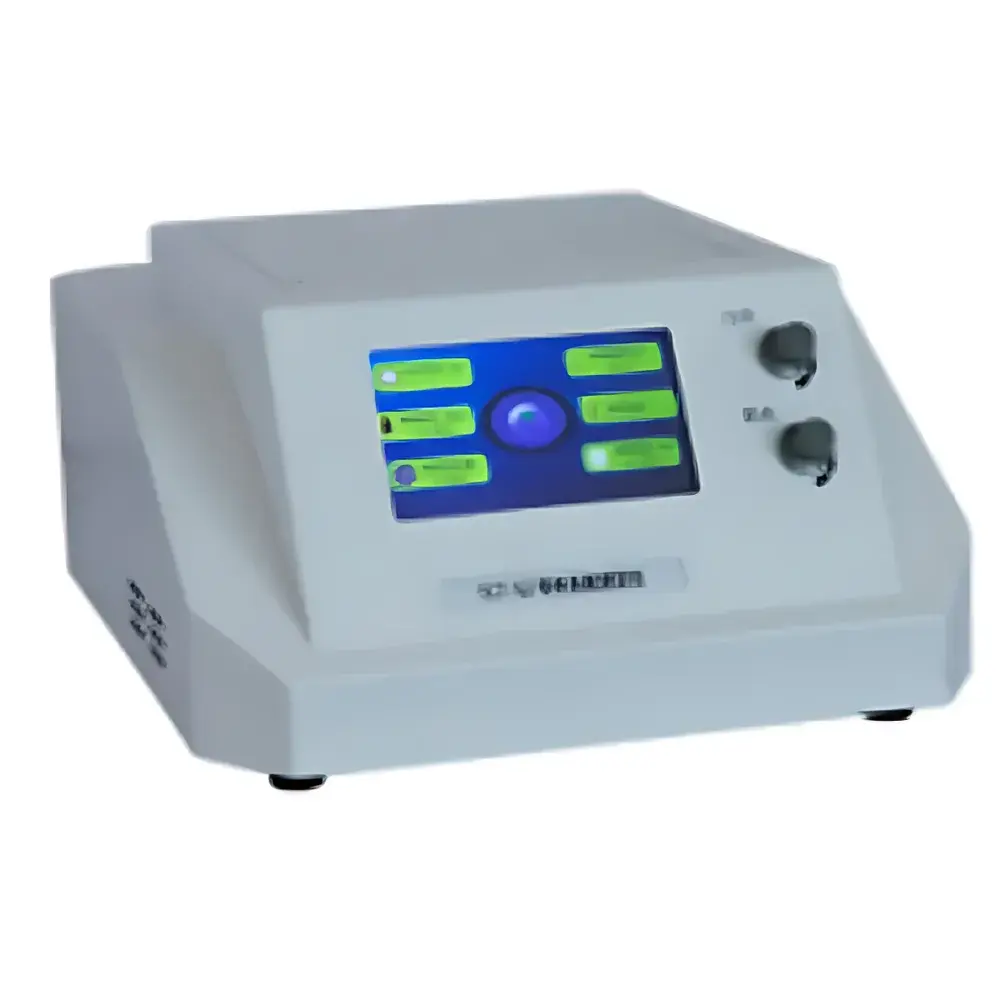
Aerospace TCA-3030 Dual-Sided Guarded Hot Plate Thermal Conductivity Analyzer
| Brand | Aerospace |
|---|---|
| Origin | Beijing, China |
| Model | TCA-3030 |
| Measurement Principle | Guarded Hot Plate Method (ASTM C177 / ISO 8302 / GB/T 10294-2008) |
| Thermal Conductivity Range | 0.01–1 W/(m·K) |
| Accuracy | ≤1% |
| Repeatability | ≤1% |
| Temperature Range (Cold Plate) | 5–90 °C |
| Max. Hot Plate Temperature | 120 °C |
| Sample Dimensions | 300 mm × 300 mm, Thickness ≤37.5 mm |
| Sample Form | Solid, Homogeneous Flat Panels |
| Test Environment | Ambient (Controlled Room: 8–35 °C, RH <80%) |
| Power Supply | 3 kW, 220 V AC |
| Overall Dimensions (L×W×H) | 1120 × 830 × 1600 mm |
| Automation | Microprocessor-Controlled with Real-Time Data Acquisition & Reporting |
| Compliance | Fully aligned with GB/T 10294-2008, ASTM C177, ISO 8302, and EN 12664 for steady-state thermal resistance measurement |
Overview
The Aerospace TCA-3030 Dual-Sided Guarded Hot Plate Thermal Conductivity Analyzer is a precision-engineered instrument designed for the standardized determination of thermal conductivity (λ) and thermal resistance (R-value) of low-to-moderate conductivity solid materials under steady-state conditions. It implements the guarded hot plate method—recognized as the primary reference technique for absolute thermal property measurement per international standards including ASTM C177, ISO 8302, EN 12664, and China’s national standard GB/T 10294-2008. Unlike transient or comparative methods, the guarded hot plate approach establishes a one-dimensional, steady heat flux across a uniformly thick, flat specimen sandwiched between two precisely controlled temperature plates. A concentric guard ring surrounding the central heater actively maintains identical temperatures on both sides of the gap between the metering and guard zones, thereby eliminating lateral heat loss and ensuring metrological traceability. This architecture delivers high reproducibility and minimal systematic error—critical for certification labs, building material R&D centers, and quality control departments requiring compliance-grade data for regulatory submissions or product labeling.
Key Features
- Dual-sided guarded hot plate configuration with independently regulated hot and cold plates, enabling precise ΔT control from 5 °C to 120 °C (hot side) and 5–90 °C (cold side)
- High-stability aluminum heating panels with low thermal inertia and uniform surface temperature distribution (±0.1 °C over active area)
- Integrated refrigerated cooling system using antifreeze solution, permitting sub-ambient average sample temperature measurements and expanded operational flexibility
- Pneumatic sample clamping mechanism ensuring consistent, operator-independent contact pressure—eliminating variability introduced by manual tightening
- Redundant temperature monitoring via calibrated digital platinum RTD sensors (traceable to NIST-equivalent references) at multiple critical locations: metering plate surface, guard zone, cold plate, and ambient enclosure
- High-resolution DC power measurement for heater input (±0.05% full scale), directly linked to heat flux calculation
- Real-time acquisition of thermal equilibrium parameters—including temperature gradients, power consumption, and time-based convergence metrics—with automated pass/fail assessment against ASTM-defined stability criteria (e.g., <0.1 °C/h drift over 30 min)
Sample Compatibility & Compliance
The TCA-3030 is optimized for rigid, homogeneous, flat-sheet specimens measuring 300 mm × 300 mm with thickness up to 37.5 mm. It accommodates insulating materials such as mineral wool, rigid polyurethane foam, phenolic boards, calcium silicate, aerogel composites, and ceramic fiber boards. Samples must exhibit negligible internal convection and isotropic thermal behavior within the test plane. The system supports GLP-compliant operation through audit-trail-enabled software logging (user actions, calibration events, environmental parameters, and raw sensor outputs). All measurement protocols adhere strictly to the uncertainty budgeting requirements outlined in ISO/IEC 17025:2017 for testing laboratories. Data output conforms to ASTM E691 interlaboratory precision guidelines and supports traceable reporting for LEED documentation, CE marking, and CCC certification workflows.
Software & Data Management
The embedded Windows-based control software provides full lifecycle test management—from parameter configuration and real-time visualization to automated report generation in PDF and CSV formats. Graphical interfaces display live temperature profiles (including spatial gradient maps across the metering zone), dynamic power curves, and convergence diagnostics. Each test session records metadata including operator ID, calibration certificate numbers, ambient lab conditions, and equipment uptime logs. Audit trails are immutable and timestamped; electronic signatures comply with FDA 21 CFR Part 11 requirements when configured with appropriate access controls and digital certificate integration. Raw data files retain native sensor resolution (0.001 °C, 0.01 W) and support third-party post-processing in MATLAB, Python (NumPy/Pandas), or commercial statistical packages. Firmware updates are delivered via secure HTTPS and validated with SHA-256 checksums.
Applications
- Validation of thermal performance claims for construction insulation products submitted to national building codes (e.g., China’s JGJ 144, U.S. IECC, EU EPBD)
- R&D characterization of next-generation aerogel composites, vacuum insulation panels (VIPs), and bio-based foams
- Quality assurance testing in ISO 9001-certified manufacturing facilities producing fire-rated boards or acoustic insulation
- Third-party certification testing accredited to CNAS (China National Accreditation Service) or UKAS standards
- Academic research on phonon transport mechanisms in porous solids and phase-change composite materials
- Calibration reference for secondary methods such as heat flow meters (ASTM C518) and transient plane source (TPS) instruments
FAQ
What standards does the TCA-3030 comply with?
It fully implements GB/T 10294-2008, ASTM C177, ISO 8302, EN 12664, and supports verification against ISO 8301 (heat flow meter method) for cross-validation.
Can it measure materials with anisotropic thermal properties?
No—the guarded hot plate method assumes isotropy and homogeneity; anisotropic samples require directional testing via alternative techniques such as laser flash analysis (ASTM E1461).
Is external chiller required for sub-ambient operation?
No—the integrated refrigeration unit with antifreeze circulation enables cold plate temperatures down to 5 °C without auxiliary chillers.
How is thermal contact resistance minimized during testing?
Through pneumatic clamping (adjustable 0.2–0.8 MPa), graphite-based thermal interface paste application guidance, and real-time contact uniformity monitoring via distributed thermocouple arrays.
Does the system support multi-specimen sequential testing?
Yes—automated workflow allows batch loading of up to six pre-conditioned specimens; software queues tests and applies individual stabilization criteria per run.
What maintenance intervals are recommended for long-term accuracy?
Quarterly verification of RTD calibration against NIST-traceable references, biannual power sensor recalibration, and annual full-system performance validation per ISO/IEC 17025 Annex A.3.



