
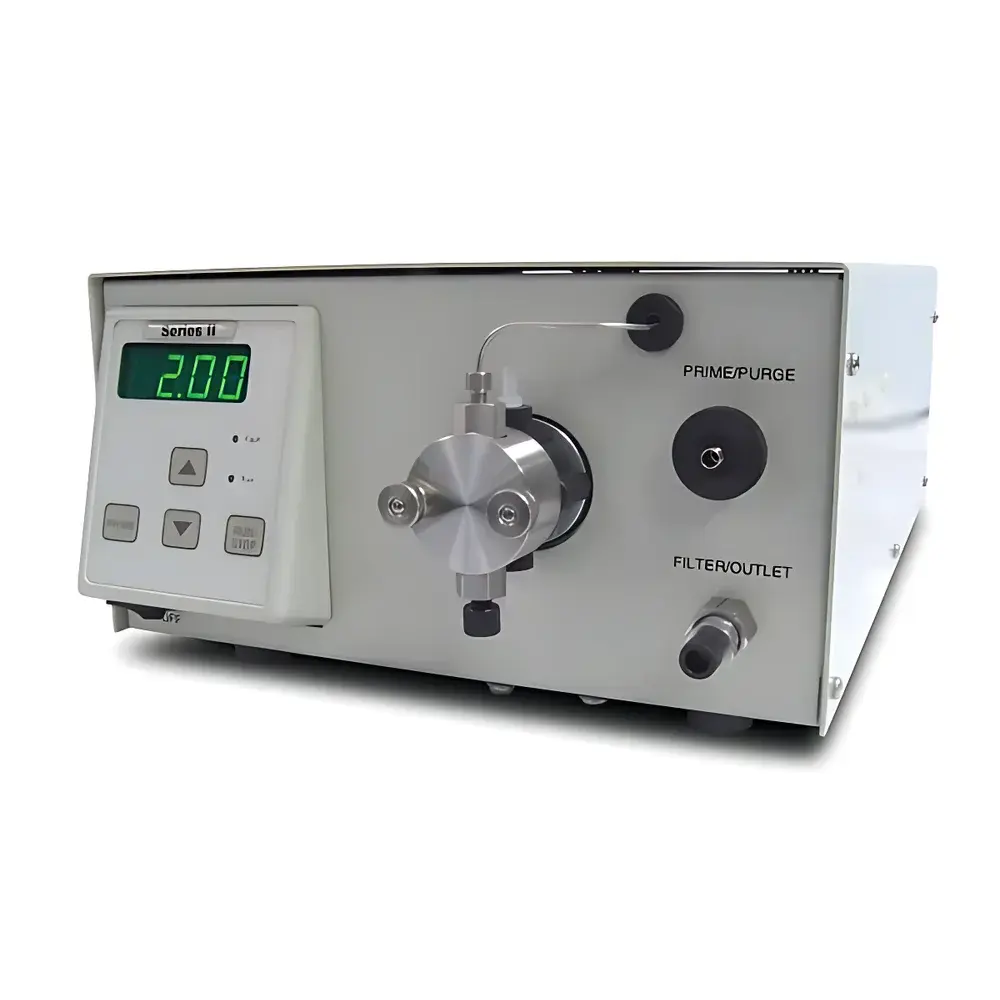
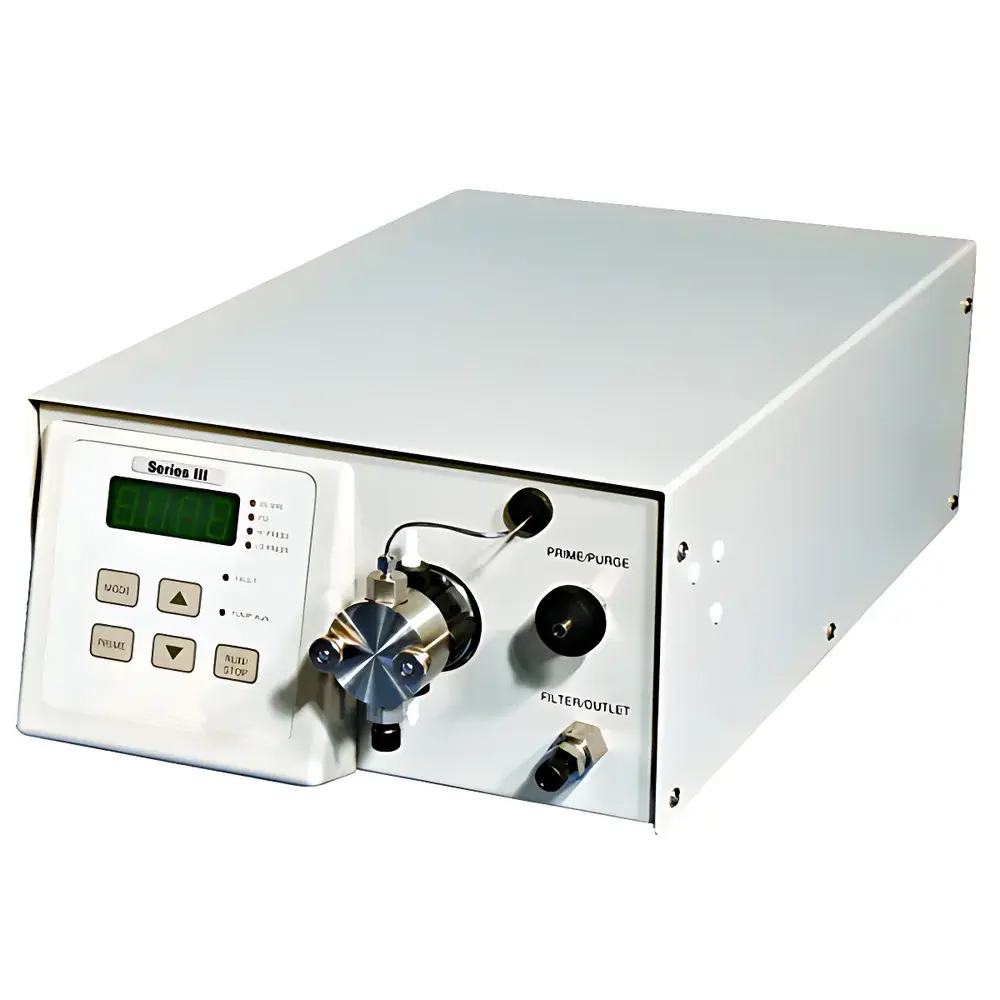
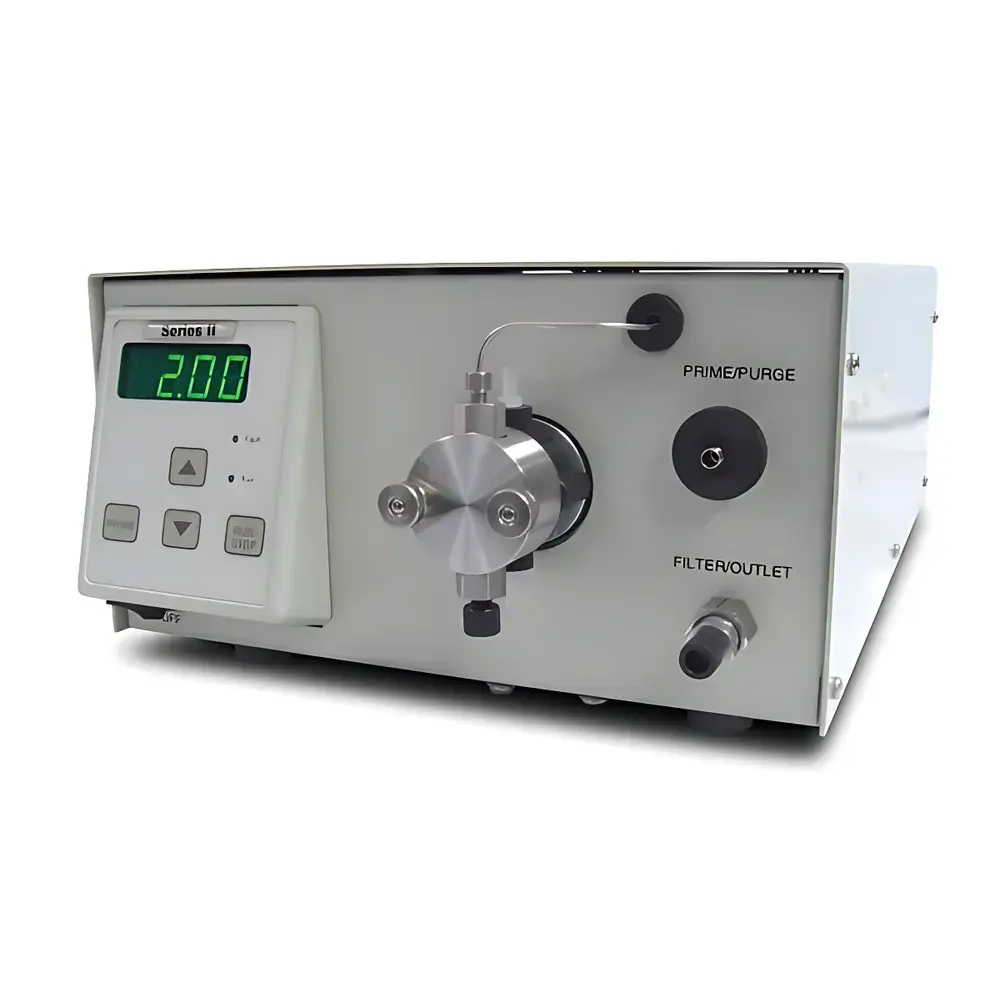
LABA Series III Constant Flow Pump
| Brand | LABA (Tianjin Lanbo) |
|---|---|
| Model | Pump II |
| Origin | USA |
| Type | High-Pressure, Precision Constant Flow Pump |
| Construction | Stainless Steel Fluid Path (PEEK fittings optional) |
| Control Interface | RS-232 |
| Remote Operation | Yes |
| Dual Check Valve Design | Yes |
| Automatic Pressure Protection | High/Low Pressure Cut-off |
| Self-Cleaning Pump Head | Yes |
| Quick-Drain Valve | Yes |
| LED Display | Yes |
| Seal Replacement | Tool-Free, Modular |
| Continuous Duty Rating | Yes |
| Chromatography-Compatible Flow Stability | Yes |
Overview
The LABA Series III Constant Flow Pump is an engineered solution for precise, uninterrupted liquid delivery in analytical and preparative laboratory workflows—particularly in high-performance liquid chromatography (HPLC), flow chemistry reactors, catalyst screening systems, and continuous-process reaction monitoring. Based on positive displacement peristaltic or dual-piston architecture (configurable per application), the pump delivers stable volumetric flow across a defined pressure range, minimizing pulsation and ensuring reproducible residence time control in chemical synthesis setups. Its design prioritizes compatibility with aggressive solvents, moderate temperatures (up to 60 °C), and extended unattended operation—critical for multi-hour catalytic reaction studies or gradient elution sequences. Unlike variable-speed peristaltic pumps, the Series III employs closed-loop flow feedback and real-time pressure sensing to maintain setpoint accuracy within ±0.5% of full scale under dynamic backpressure conditions typical of packed-bed reactors or microfluidic manifolds.
Key Features
- Stainless steel fluid path with chemically resistant wetted surfaces; PEEK tubing and fittings available as field-replaceable options for enhanced compatibility with halogenated solvents and strong acids/bases.
- Dual integrated check valves prevent reverse flow during pressure transients or system shutdown—essential for maintaining reagent integrity in sequential injection or multi-stream mixing applications.
- Onboard pressure monitoring circuitry continuously samples line pressure; automatic shutdown occurs if readings exceed user-defined upper thresholds (e.g., >400 bar) or fall below minimum operational limits (e.g., <1 bar), safeguarding both pump integrity and downstream instrumentation.
- Self-cleaning pump head mechanism activates during idle intervals or after flow cessation, flushing residual analyte from internal chambers using a brief reverse-flow pulse—reducing cross-contamination between runs without manual disassembly.
- Quick-drain valve enables rapid system depressurization and solvent exchange—minimizing downtime during method development or column regeneration procedures.
- Front-panel LED display provides real-time readouts of flow rate (mL/min), pressure (bar), operating status, and fault codes; intuitive membrane keypad supports parameter entry without external software dependency.
- RS-232 serial interface allows integration into automated lab environments via SCPI-compliant command sets; compatible with LabVIEW, Python (pySerial), and third-party LIMS platforms for scheduled run execution and audit-trail logging.
Sample Compatibility & Compliance
The Series III accommodates aqueous, organic, and mixed-phase solutions—including acetonitrile, THF, DMF, and dilute mineral acids—within its validated operating envelope. All elastomeric seals meet USP Class VI biocompatibility standards; stainless steel components conform to ASTM A276 for corrosion resistance. The pump supports GLP/GMP-aligned workflows through configurable event logging (start/stop timestamps, pressure excursions, maintenance alerts) and optional 21 CFR Part 11–compliant electronic signatures when paired with certified host software. It is routinely deployed in laboratories adhering to ISO/IEC 17025 accreditation requirements for method validation and equipment qualification.
Software & Data Management
Native firmware supports ASCII-based command protocols over RS-232, enabling direct scripting of flow profiles (ramps, steps, holds) and synchronization with detector triggers. Optional LABA Control Suite (v3.2+) provides GUI-based method building, real-time graphing of flow/pressure trends, and CSV export of time-stamped operational logs. Audit trails record all parameter changes, user logins, and hardware events—retained locally on non-volatile memory with tamper-evident hashing. Data exports comply with FAIR principles (Findable, Accessible, Interoperable, Reusable) and integrate natively with ELN systems via RESTful API extensions.
Applications
- HPLC and UHPLC mobile phase delivery with low pulsation (<1.5% ripple) and pressure stability (<±0.2 bar drift over 8 h).
- Continuous-flow hydrogenation, oxidation, and photoredox reactions requiring stoichiometric reagent dosing at 0.01–50 mL/min.
- Automated catalyst testing rigs where precise residence time control directly impacts turnover frequency (TOF) calculations.
- Calibration standard delivery in ICP-MS and IC systems demanding sub-microliter precision and zero carryover.
- Microreactor feed systems interfaced with Coriolis mass flow controllers for closed-loop concentration modulation.
FAQ
What is the maximum operating pressure rating for the Series III Pump II?
The pump is rated for continuous operation up to 400 bar (5800 psi), with short-term peak tolerance to 450 bar under controlled thermal conditions.
Can the pump handle viscous solutions such as polymer melts or ionic liquids?
It is optimized for Newtonian fluids with viscosities ≤ 500 cP at 25 °C; non-Newtonian or particulate-laden streams require upstream filtration and reduced flow rates to maintain seal longevity.
Is firmware update capability supported in-field?
Yes—updates are delivered via RS-232 using signed HEX packages; version history and checksum verification are logged automatically.
Does the pump include documentation compliant with ISO 9001 calibration requirements?
Factory calibration certificates (traceable to NIST standards) and IQ/OQ templates are provided with each unit; PQ protocol support is available upon request.
How often must the pump seals be replaced under typical HPLC usage?
With proper solvent compatibility and daily use at 1 mL/min, PTFE-coated seals demonstrate ≥6 months service life; replacement kits include torque-spec drivers and alignment jigs to ensure repeatable installation.



