
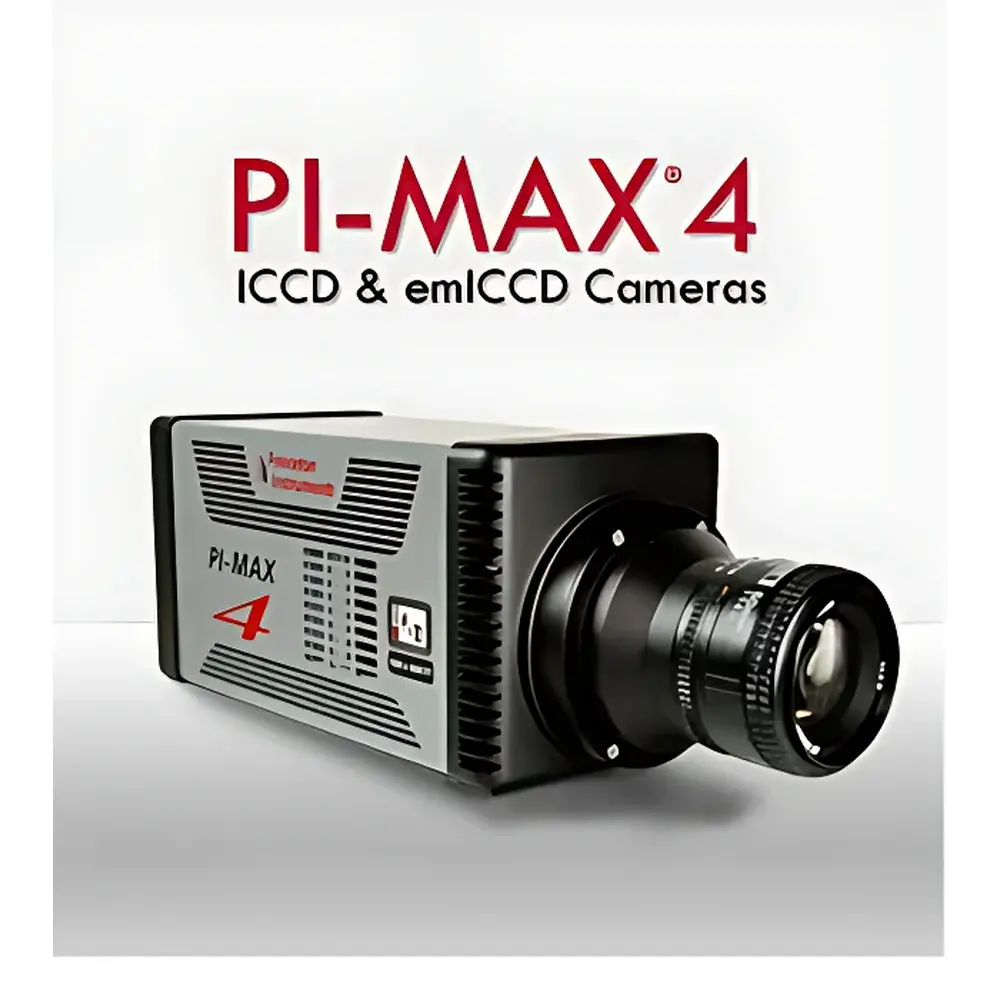
Princeton Instruments PI-MAX4 ICCD & emICCD Camera
| Brand | Princeton Instruments (Teledyne) |
|---|---|
| Origin | USA |
| Model Variants | 512/1024EMB, 1024i, 1024f, 1024i-RF, 2048f |
| Pixel Sizes | 13×13 µm, 12.8×12.8 µm, 16×16 µm, 26×26 µm, 13.5×13.5 µm |
| Gating Speed | up to 1 MHz |
| Minimum Gating Width | <500 ps |
| Timing Precision | ±10 ps |
| Readout Speeds | 2–10 MHz |
| Data Depth | 16-bit |
| Interface | GigE (up to 50 m cable length) |
| QE Peak | >50% (Gen III filmless photocathode, 200–900 nm) |
| Dual-Image Acquisition Interval | 2 µs |
| Spectral Acquisition Rate | up to 10,000 spectra/s |
| Software Platform | LightField v6.x (64-bit, LabVIEW/MATLAB/EPICS compatible) |
Overview
The Princeton Instruments PI-MAX4 ICCD and emICCD camera represents the state-of-the-art in time-resolved optical imaging and spectroscopy. Engineered for ultrafast gated detection, it integrates a high-performance image intensifier—compatible with Gen II or filmless Gen III photocathodes—with either back-illuminated EMCCD or scientific-grade CCD sensor architectures. Its core measurement principle relies on precise temporal gating of incident photons via voltage-controlled microchannel plate (MCP) intensification, enabling sub-nanosecond time-domain discrimination without compromising spatial resolution. Unlike conventional ICCDs that employ metal-mesh photocathodes—introducing diffraction-limited modulation transfer function (MTF) degradation—the PI-MAX4 utilizes mesh-free, high-quantum-efficiency photocathodes, preserving full optical resolution across the 200–900 nm spectral range. The system achieves true single-photon sensitivity in emICCD configurations, where electron multiplication gain precedes intensifier gating, delivering exceptional signal-to-noise ratio (SNR) in low-light, time-critical applications such as laser-induced breakdown spectroscopy (LIBS), combustion diagnostics, and fluorescence lifetime imaging microscopy (FLIM).
Key Features
- Sub-500 ps optical gating width with ±10 ps timing precision, enabled by SuperHV gate driver technology and integrated SuperSynchro timing engine
- 1 MHz maximum gating repetition rate—20× faster than prior-generation ICCDs—supporting high-duty-cycle pulsed experiments
- Dual-image acquisition mode (DIF) with ≤2 µs inter-frame interval on 1024i models, facilitating background-subtracted kinetic imaging
- Modular sensor compatibility: supports 512×512 and 1024×1024 EMCCDs; 1024×256, 1024×1024, and 2048×2048 CCDs; all optimized for intensified operation
- Gigabit Ethernet interface with deterministic latency and full remote control over distances up to 50 meters—no fiber converters required
- True 16-bit digitization at readout speeds up to 10 MHz, ensuring dynamic range preservation during rapid spectral acquisition
- LightField software platform with oscilloscope-style real-time parameter control, embedded mathematical processing, and hardware-synchronized triggering
Sample Compatibility & Compliance
The PI-MAX4 is designed for integration into regulated and research-grade optical laboratories requiring traceable, repeatable time-gated measurements. It complies with standard optical safety classifications (IEC 60825-1 Class 1 when properly configured) and meets electromagnetic compatibility requirements per FCC Part 15 Subpart B and CE EN 61326-1. While not inherently FDA 21 CFR Part 11 compliant as a standalone device, its LightField software supports audit-trail-enabled acquisition protocols when deployed in GLP/GMP environments—particularly relevant for LIBS-based elemental analysis in pharmaceutical raw material screening or combustion emission monitoring. All sensor variants operate within ISO 11146-defined beam profiling constraints and support NIST-traceable wavelength calibration via IntelliCal, fulfilling ASTM E275 and ISO/IEC 17025 documentation prerequisites for accredited spectral labs.
Software & Data Management
LightField v6.x serves as the unified control and analysis environment for the PI-MAX4, offering native 64-bit architecture, real-time data streaming, and deterministic hardware synchronization. Its intuitive interface replicates oscilloscope logic for gate delay, width, and repetition configuration—critical for optimizing time-resolved signal capture in pump-probe or time-correlated single-photon counting (TCSPC) workflows. Built-in mathematical functions enable on-the-fly spectral deconvolution, lifetime decay fitting (biexponential, stretched exponential), and pixel-wise intensity normalization. The PICAM API provides full programmatic access to all hardware parameters through C/C++, Python, MATLAB, LabVIEW, and EPICS IOC bindings. Data export conforms to HDF5 and FITS standards, ensuring interoperability with third-party analysis pipelines used in plasma physics (e.g., CRONOS), combustion modeling (e.g., Chemkin), and synchrotron beamline control systems.
Applications
- Laser-Induced Breakdown Spectroscopy (LIBS): Enables shot-to-shot spectral acquisition at ≥10 kHz, supporting quantitative elemental mapping in geological samples, nuclear fuel debris, and Martian regolith simulants—consistent with Curiosity rover operational constraints.
- Combustion Diagnostics: Captures OH*, CH*, and NO* chemiluminescence with picosecond temporal isolation, permitting flame front velocity reconstruction and equivalence ratio profiling in turbulent premixed flames.
- Fluorescence Lifetime Imaging Microscopy (FLIM): Delivers time-domain FLIM with <1 ns resolution in widefield or confocal configurations, supporting FRET-based protein interaction studies and metabolic redox state mapping in live-cell assays.
- Dynamic Neutron Radiography: Synchronized with pulsed neutron sources (e.g., spallation targets), the PI-MAX4 resolves transient phase changes in hydrogenous materials—including water ingress in composites or lithium dendrite growth in battery cells—complementing X-ray attenuation contrast.
- Plasma Physics & Ultrafast Phenomena: Resolves streamer propagation, dielectric barrier discharge dynamics, and laser-plasma coupling with sub-ns shuttering—essential for validating particle-in-cell (PIC) simulations.
FAQ
What distinguishes the PI-MAX4 emICCD from conventional ICCDs?
The emICCD variant integrates electron multiplication pre-amplification with intensified detection, achieving single-photon sensitivity while maintaining linearity across six orders of magnitude—unattainable with analog-gain-only ICCDs.
Can the PI-MAX4 be synchronized with external laser systems?
Yes. The SuperSynchro timing engine provides programmable TTL/CMOS trigger outputs and inputs with jitter <20 ps, enabling deterministic lock-in to femtosecond oscillator pulses or Q-switched Nd:YAG systems.
Is LightField software validated for use in regulated environments?
LightField supports configurable audit trails, user-access controls, and electronic signature workflows. When deployed with documented SOPs, it satisfies ALCOA+ data integrity principles under FDA and EMA guidance for non-clinical analytical instrumentation.
Does the PI-MAX4 support spectral deconvolution of overlapping emission bands?
Yes. LightField includes constrained least-squares spectral unmixing and iterative reweighted minimization algorithms, validated against NIST SRM 2068 for multi-component plasma emission analysis.
What cooling options are available for extended exposure stability?
All PI-MAX4 models feature thermoelectric (TE) cooling to –25 °C below ambient, with optional liquid recirculation for sustained deep-cooling (< –40 °C) during long-duration FLIM or LIBS mapping sequences.




