
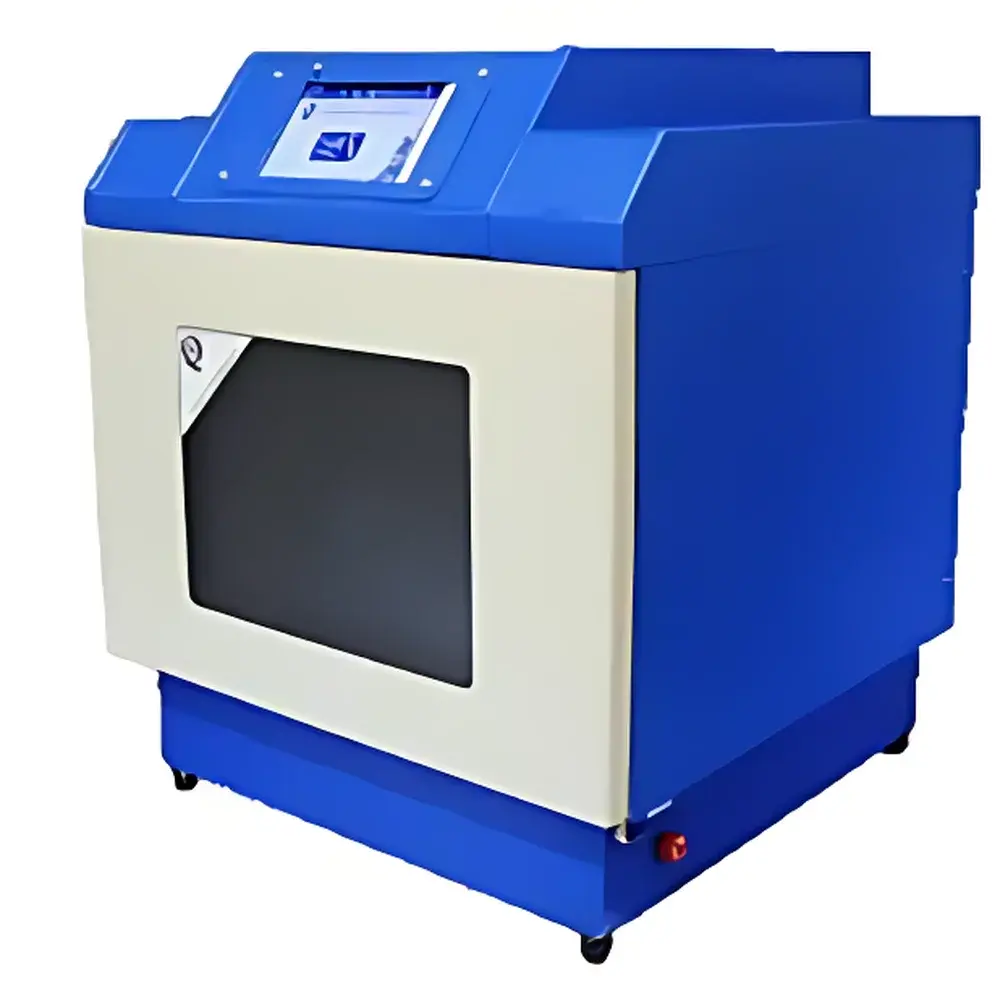
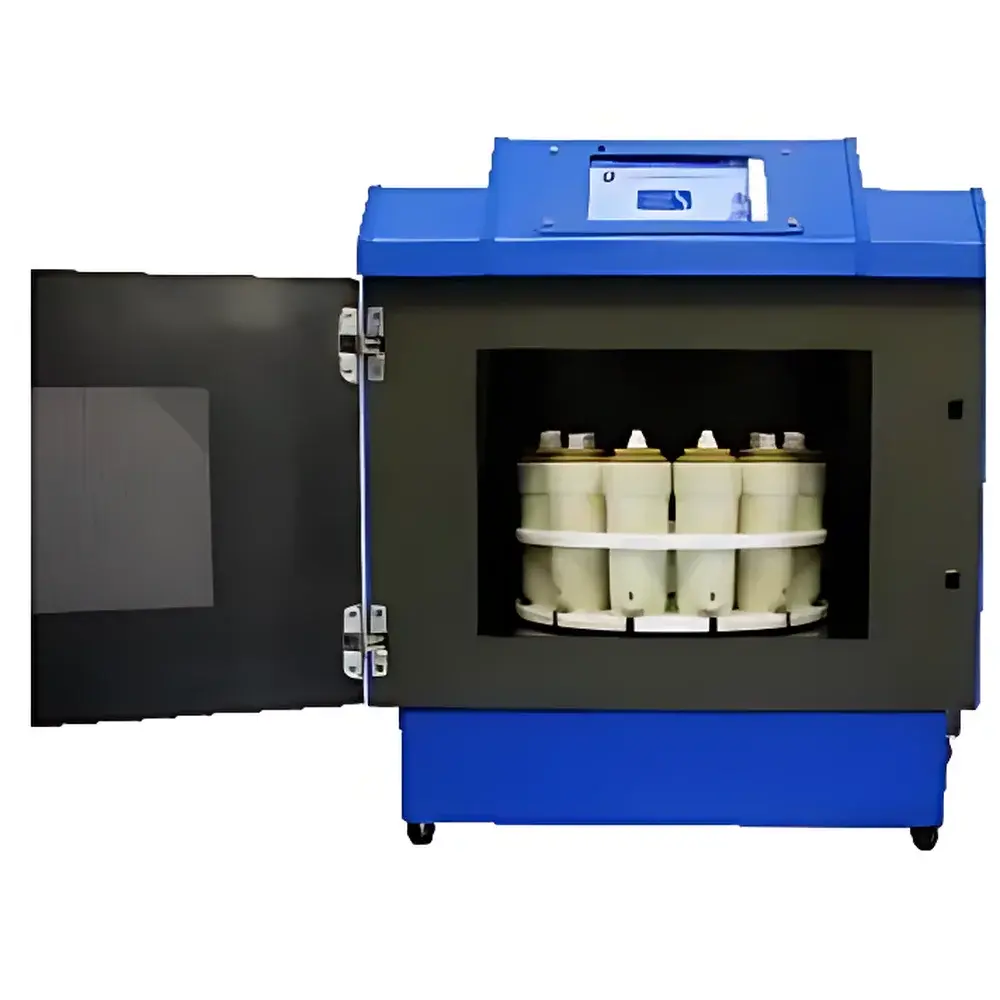
Labo QLABPro Microwave Digestion System
| Brand | Labo (Tianjin Labo / LABA) |
|---|---|
| Origin | USA |
| Manufacturer Type | Authorized Distributor |
| Origin Category | Imported |
| Model | QLABPro |
| Price Range | USD $26,000–$39,000 (FOB) |
| Cavity Class | Industrial-Grade |
| Sample Capacity | 12 or 20 vessels |
| Microwave Source | Magnetron |
| Max Temperature | 230 °C (standard mode) / 400 °C (high-temp mode) |
| Max Pressure | 500 psi |
| Exhaust Flow Rate | 150 CFM |
| Output Power | Up to 1200 W |
| Safety Features | Spring-loaded interlocked door, overpressure venting, real-time per-vessel T/P monitoring, thermal runaway detection, PTFE-coated cavity |
Overview
The Labo QLABPro Microwave Digestion System is an industrial-grade, closed-vessel microwave-assisted sample preparation platform engineered for high-throughput, reproducible, and trace-metal-clean digestion of solid and semi-solid matrices. It operates on the principle of controlled microwave energy absorption by polar molecules (e.g., HNO₃, HCl, HF) within sealed quartz or high-purity PFA/TFM digestion vessels—enabling rapid, uniform heating under inert, pressurized conditions. Designed for compliance with EPA Methods 3050B, 3051A, 3052, and ASTM D5511/D5512, the QLABPro supports quantitative elemental analysis workflows in environmental, geological, pharmaceutical, and regulatory testing laboratories. Its dual-mode temperature/pressure control architecture ensures precise thermal management across heterogeneous sample loads, while its robust cavity design—lined with corrosion-resistant PTFE coating—maintains long-term integrity when processing aggressive acid mixtures (e.g., aqua regia, HF-containing reagents).
Key Features
- Real-time, independent temperature and pressure monitoring for each digestion vessel—enabling per-vial process validation and deviation detection
- Industrial-class magnetron source with dynamic 0–1200 W power modulation; fine-grained power ramping (±5 W increments) ensures stable thermal profiles and minimizes overshoot during ramp phases
- 360° synchronous rotation of both turntable and microwave feed system—eliminating hot/cold spots and ensuring field homogeneity across full 12- or 20-position rotor configurations
- Spring-loaded, multi-point latched safety door with redundant mechanical and electronic interlocks—meets IEC 61000-4-3 and UL 61010-1 requirements for Class II microwave equipment
- Active overpressure release mechanism with directional venting path—prevents cross-contamination between vessels and maintains containment integrity up to 500 psi burst threshold
- PTFE-coated stainless-steel cavity interior—resistant to nitric, hydrochloric, hydrofluoric, and perchloric acid vapors; validated for >10,000 cycles without coating degradation
- Integrated 150 CFM forced-air exhaust system with acid-resistant ducting—supports rapid post-digestion cooling and removal of corrosive fumes in accordance with ANSI Z9.5 laboratory ventilation standards
Sample Compatibility & Compliance
The QLABPro accommodates standard 55 mL and 100 mL digestion vessels fabricated from high-purity TFM-PTFE, PFA, or quartz—compatible with organic-rich soils, biological tissues, polymers, catalysts, and metallurgical slags. Vessel geometry is optimized for efficient microwave coupling and minimal standing-wave interference. All operational protocols—including method recall, parameter logging, and alarm history—are timestamped and stored with user ID attribution, supporting audit readiness for ISO/IEC 17025, GLP, and FDA 21 CFR Part 11 environments. The system includes preloaded EPA, ISO 11885, and USP digestion templates, with editable parameters for ramp time, hold duration, maximum pressure, and cooling delay.
Software & Data Management
Control is executed via a dedicated embedded Linux-based interface with 7″ capacitive touchscreen and optional Ethernet/Wi-Fi connectivity. Software logs all critical process variables (vessel ID, T/P/time traces, power output, door status, fault codes) in encrypted CSV and XML formats. Audit trail functionality records operator actions, method modifications, and calibration events with immutable timestamps. Data export supports direct integration into LIMS platforms via OPC UA or secure SFTP. Remote diagnostics and firmware updates are supported through authenticated cloud portal access—subject to customer-configured firewall policies.
Applications
- Environmental: Total recoverable metals (As, Cd, Cr, Pb, Hg, Ni) in wastewater sludge, sediments, and airborne particulates per EPA 6010D/6020B
- Geochemical: Rare earth element (REE) quantification in silicate rocks using HF-HNO₃-HClO₄ fusion
- Pharmaceutical: Residual catalyst (Pd, Pt, Rh) determination in active pharmaceutical ingredients (APIs)
- Food & Agriculture: Lead and cadmium screening in cereals, spices, and infant formula per EU Commission Regulation (EU) No 2023/915
- Materials Science: Dissolution of battery cathode materials (NMC, LFP) for Li/Ni/Co/Mn stoichiometry verification
FAQ
What safety certifications does the QLABPro hold?
It complies with IEC 61000-4-3 (EMC immunity), UL 61010-1 (electrical safety), and EN 62496-1 (microwave leakage ≤5 mW/cm² at 5 cm distance). Full certification documentation is provided with shipment.
Can the system be integrated into a fully automated sample prep line?
Yes—via RS-232, Modbus TCP, or dry-contact I/O signals for handshake with robotic arms, autosamplers, or post-digestion dilution stations.
Is HF digestion supported without cavity damage?
Yes—provided vessels are TFM-PTFE or quartz and acid concentrations remain within manufacturer-specified limits (≤2 mL HF per 55 mL vessel); the PTFE cavity liner has been tested for 500+ consecutive HF cycles.
How is method validation performed for regulatory submissions?
Each run generates a digital certificate of performance—including raw T/P curves, vessel-specific variance reports, and pass/fail flags against predefined acceptance criteria (e.g., ±2 °C temperature stability, ≤10 psi pressure drift during hold phase).
What maintenance intervals are recommended?
Cavity cleaning after every 50 runs; magnetron output verification annually or after 2,000 operating hours; door gasket replacement every 2 years or 5,000 cycles—per documented preventive maintenance schedule (PMS-QLABPro-Rev.4).



