
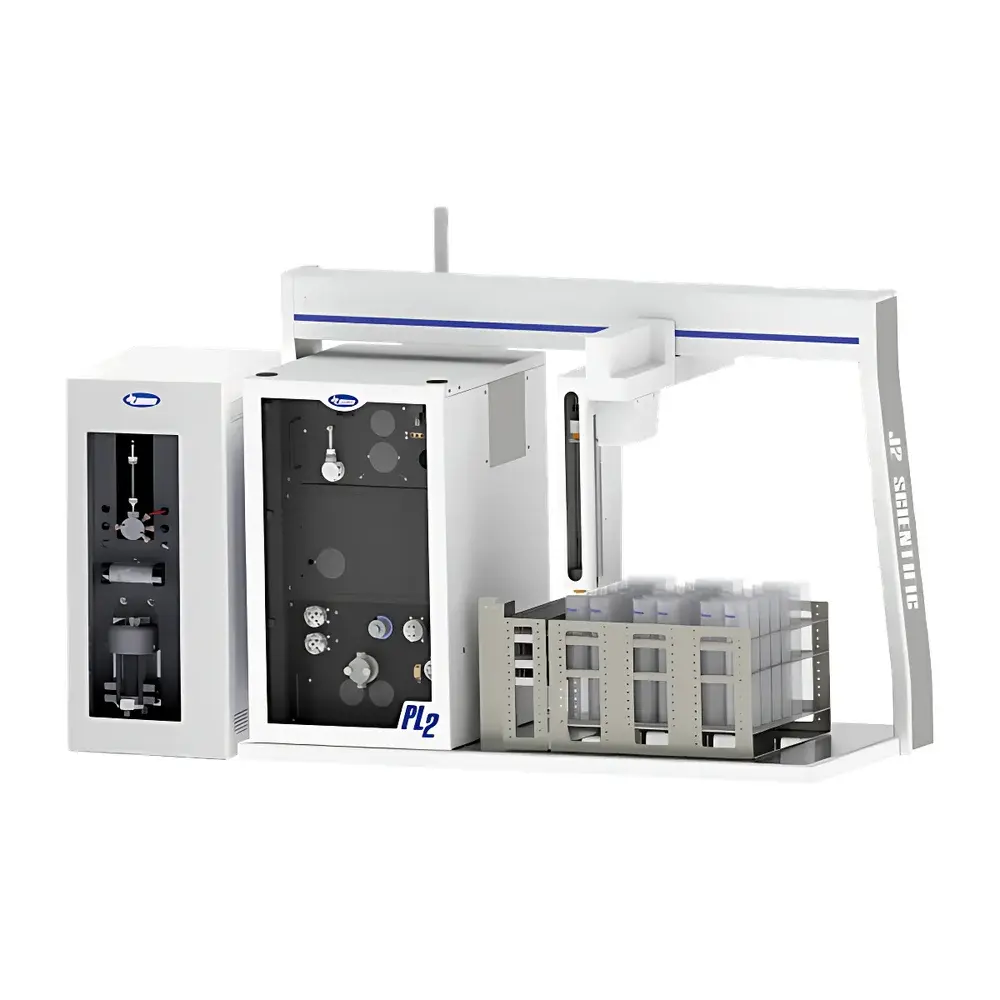
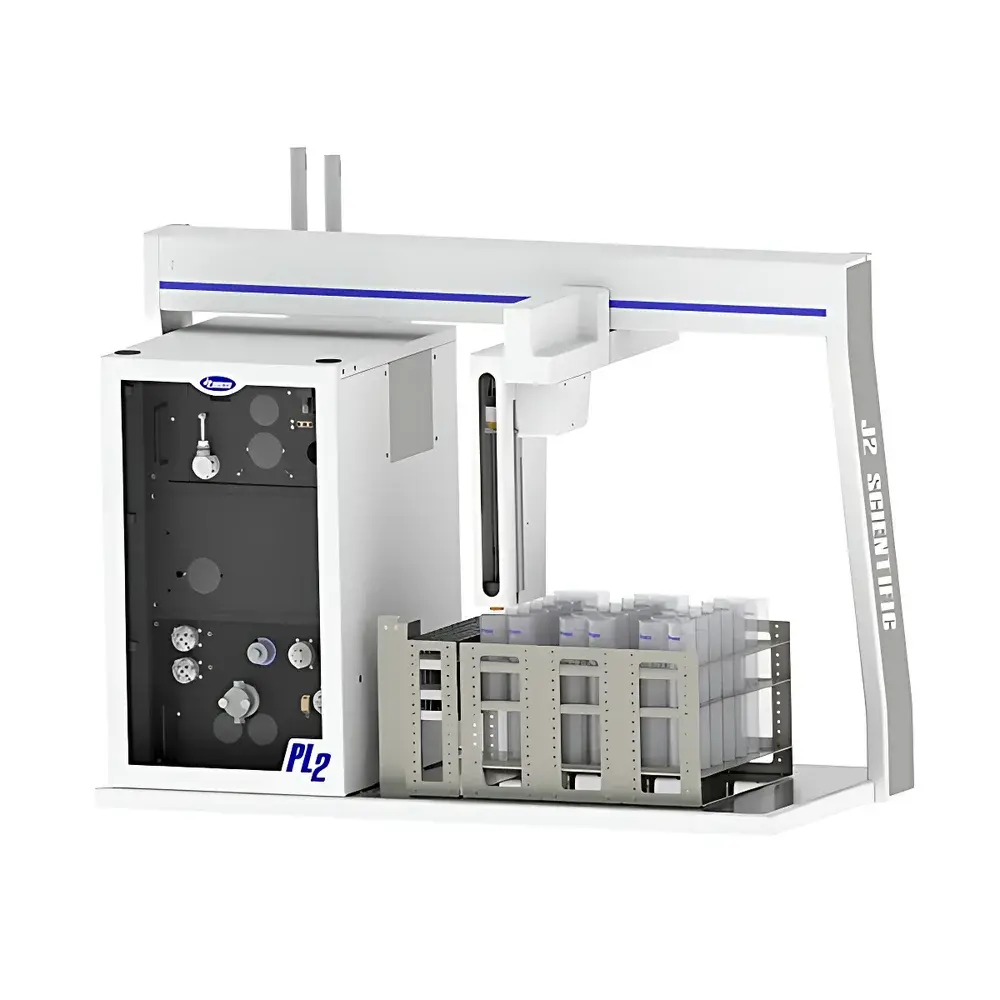
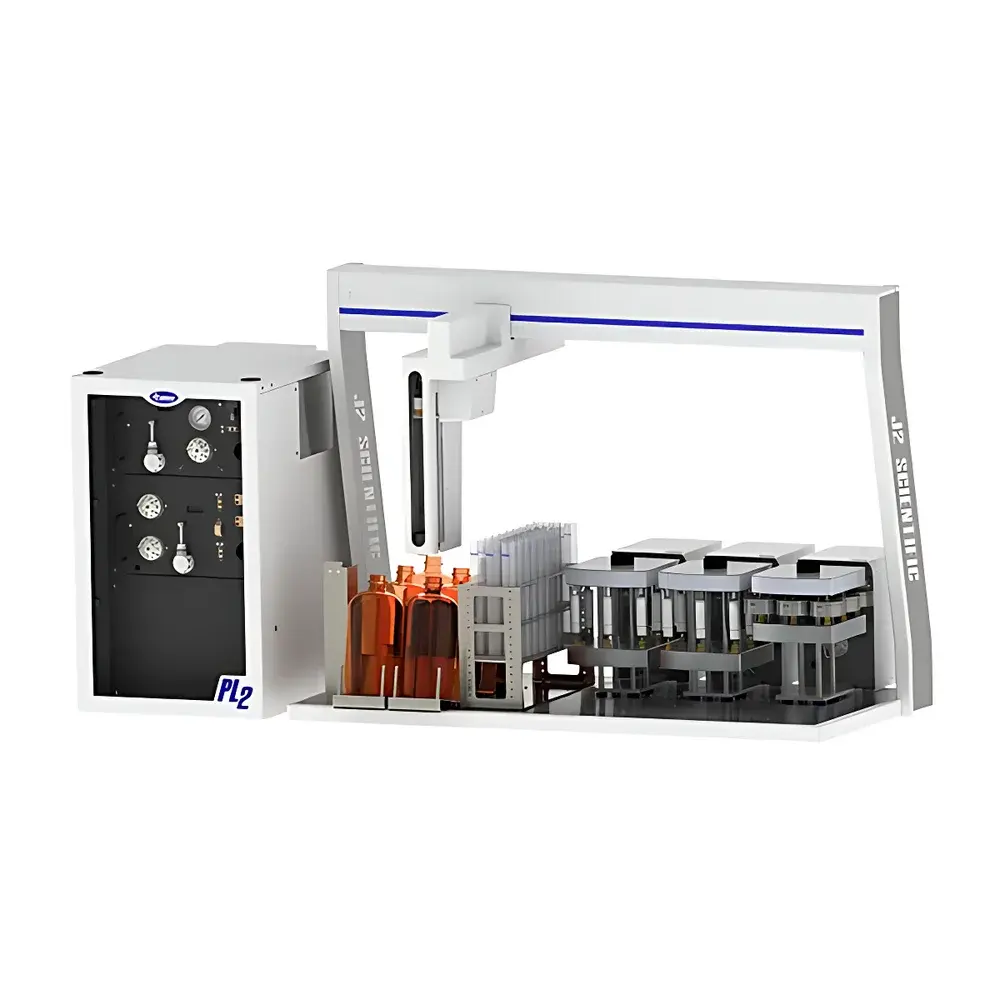
J2 Scientific PrepLinc2 GPC-Online Concentration Coupling System
| Brand | J2 Scientific |
|---|---|
| Origin | USA |
| Model | PrepLinc2 |
| Flow Rate | 0.01–10.00 mL/min |
| Maximum Pressure | 2500 psi |
| Flow Stability | ±0.5% RSD |
| Autosampler Volume Range | 100 µL–1000 mL |
| Autosampler Capacity | 36 positions |
| Pump Type | Integrated Dual-Plunger HPLC Pump |
| UV Detection | Built-in 254/280 nm Dual-Wavelength Detector |
| System Architecture | Fully Integrated GPC Purification + Online Solvent Evaporation Platform |
Overview
The J2 Scientific PrepLinc2 GPC-Online Concentration Coupling System is an engineered solution for automated, high-integrity sample cleanup and concentration in trace-level residue analysis workflows. It integrates gel permeation chromatography (GPC) — a size-exclusion separation technique widely accepted for macromolecule removal from complex biological and environmental matrices — with real-time, programmable solvent evaporation via AccuVap™ technology. Unlike offline or sequential approaches, the PrepLinc2 performs purification and concentration *in a single, uninterrupted fluidic path*, minimizing analyte loss, adsorption, and cross-contamination risks. This architecture ensures reproducible recovery of labile, semi-volatile, and thermally sensitive compounds — including organophosphorus pesticides, organochlorines, synthetic antioxidants, and veterinary drug residues — prior to GC, GC-MS, LC-MS/MS, or HPLC analysis. Designed for compliance-critical environments, the system operates under defined flow dynamics and pressure control (up to 2500 psi), supporting method transfer across laboratories and regulatory validation requirements.
Key Features
- Integrated dual-plunger HPLC pump and dual-wavelength (254/280 nm) UV detector housed within the GPC module — eliminating external tubing connections and reducing system dead volume to < 50 µL.
- AS4mini autosampler with 36-position capacity and precision syringe-driven injection — enabling unattended processing of up to 36 samples per run, with full volumetric accuracy across 100 µL–1000 mL ranges.
- Patented loop-based online concentration interface: purified eluent passes directly into a heated, nitrogen-assisted evaporation loop; no fraction collection, manual transfer, or reconstitution required.
- Column protection bypass valve — automatically engages during idle or shutdown cycles to maintain column hydration and prevent stationary phase drying or cracking.
- Direct injection port with positive-displacement syringe: guarantees 100% transfer of loaded sample volume (100 µL–10 mL) into the GPC column, eliminating carryover and calibration drift from partial injections.
- Modular firmware architecture compliant with FDA 21 CFR Part 11-ready data integrity protocols when paired with J2’s optional LIMS integration package.
Sample Compatibility & Compliance
The PrepLinc2 supports a broad range of sample types, including animal tissues (muscle, liver, fat), dairy products, fruits, vegetables, soil extracts, and water concentrates — all following standard extraction protocols (e.g., QuEChERS, ASE, or liquid–liquid partitioning). Its GPC fractionation window (typically 100–10,000 Da exclusion limit) effectively removes lipids, proteins, pigments, and polymeric interferences while retaining target analytes. The system is validated for use in methods aligned with GB/T 5009.x, GB 5009.32-2016, SN/T 2430–2459 series, and internationally harmonized standards including ISO 17025-accredited laboratories. All hardware and software components meet IEC 61000-4 electromagnetic compatibility requirements and UL/CSA safety certifications for Class I, Division 2 laboratory environments.
Software & Data Management
Controlled via J2’s proprietary PrepLinc Control Suite (v4.2+), the system provides method-driven automation with audit-trail logging, user-access levels (admin/operator/observer), and electronic signature support. Method templates include pre-configured GPC gradient profiles (e.g., THF at 0.5–2.0 mL/min), UV threshold-triggered fraction switching, and AccuVap temperature/flow ramping logic. Raw data (UV chromatograms, pressure logs, evaporation status flags) are stored in vendor-neutral .csv and .xml formats. Optional integration with Empower™, Chromeleon™, or OpenLab CDS enables seamless downstream reporting. All system events — including pump priming, valve actuation, and autosampler needle wash cycles — are timestamped and exportable for GLP/GMP inspection readiness.
Applications
- Routine pesticide multiresidue analysis in food safety testing laboratories (e.g., 380-analyte screening per GB/T 20772-2006).
- Cleanup of lipid-rich tissue extracts prior to GC-MS quantification of persistent organic pollutants (POPs) per GB/T 5009.19-2008 and GB/T 5009.161-2003.
- Concentration and desalting of aqueous environmental samples (e.g., wastewater, surface water) for LC-MS/MS detection of emerging contaminants.
- Preparative-scale isolation of low-abundance metabolites from fermentation broths or plant extracts where thermal degradation must be avoided.
- Automated method development for GPC column selection, mobile phase optimization, and evaporation efficiency profiling under controlled RH and ambient conditions.
FAQ
What GPC columns are compatible with the PrepLinc2?
Standard 10–25 µm particle-size styrene-divinylbenzene (SDB) columns (e.g., Bio-Beads SX-3, PLgel Mixed-D) with 10–300 mm length and 7.5–20 mm ID are supported. Column oven temperature is user-adjustable from ambient to 60°C.
Can the system handle viscous or particulate-laden extracts?
Yes — inline 0.45 µm PTFE filter cartridges (optional) and programmable pulse-dampened flow delivery mitigate clogging. Sample filtration prior to autosampler loading is recommended for >1% suspended solids.
Is method validation documentation available?
J2 provides IQ/OQ documentation packages, system suitability test protocols, and a complete traceability matrix linking hardware IDs, firmware versions, and calibration certificates — all compliant with ISO/IEC 17025 clause 5.5.2.
How is solvent consumption minimized during online concentration?
AccuVap employs closed-loop nitrogen recirculation with dew-point monitoring and variable gas-flow modulation, reducing solvent vapor emissions by >70% versus traditional rotary evaporation — verified per EPA Method 8270D Annex A.
Does the PrepLinc2 support remote monitoring?
Via Ethernet-connected operation and optional VNC-enabled secure gateway, allowing real-time status viewing and emergency pause/resume from authorized network endpoints — subject to local IT security policy approval.



