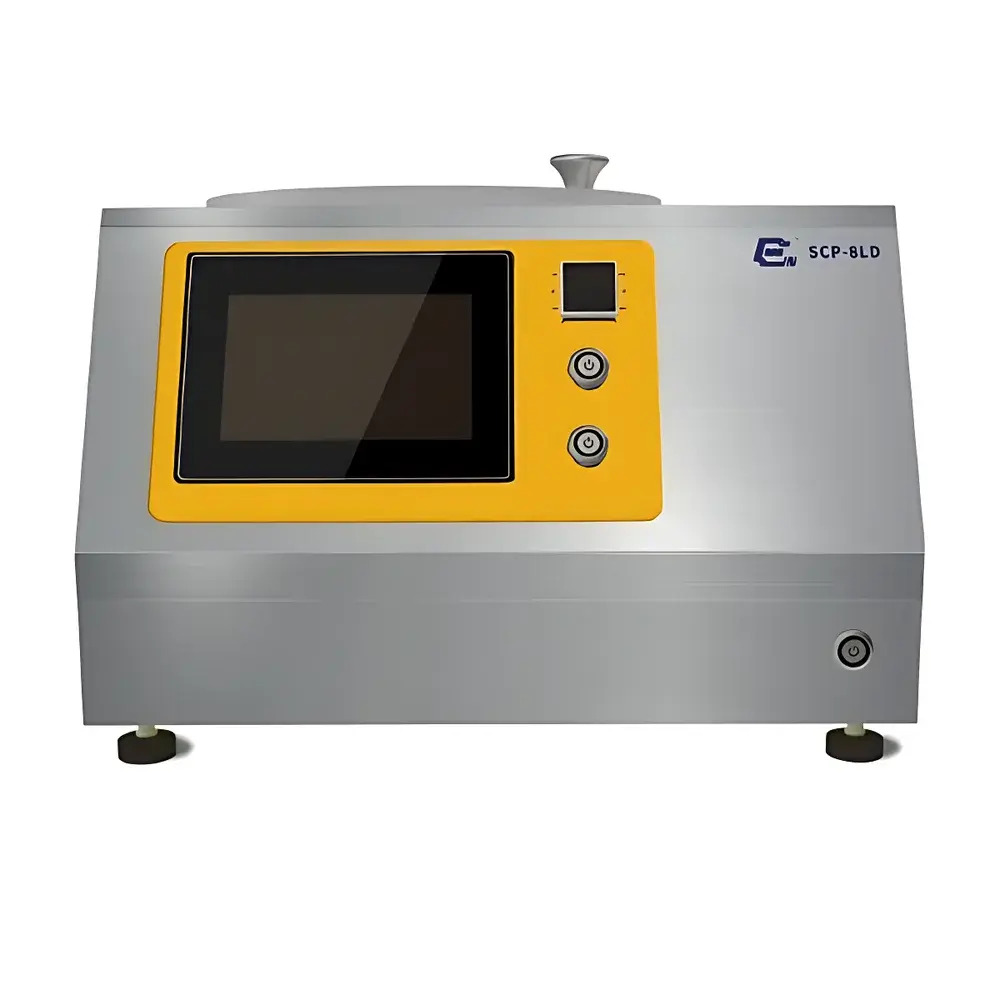
Laurell WS-650-8B Spin Coater
| Brand | Laurell |
|---|---|
| Origin | USA |
| Model | WS-650-8B |
| Maximum Substrate Size | 200 mm wafer or 178 mm × 178 mm square substrate |
| Max Speed | 12,000 rpm (at 100 mm Si wafer) |
| Controller | 650 Series Microprocessor-Based Process Controller |
| Software | Spin3000 PC Control & Simulation Suite (free, optional but fully compatible) |
| Housing Material | Chemically resistant solid copolymer blend (standard) or PTFE Hostaflon® TFM-1600 / Teflon® AF (optional, high-temp/ultra-clean) |
| Sealing | Proprietary labyrinth seal with N₂ purge capability |
| Compliance | Designed for ISO Class 5–4 cleanroom integration |
Overview
The Laurell WS-650-8B Spin Coater is an engineered solution for precision photoresist, polymer, and functional thin-film deposition in semiconductor fabrication, MEMS development, and advanced materials research. Operating on the principle of centrifugal force-driven fluid thinning and solvent evaporation, the system delivers repeatable, uniform coatings across substrates up to 200 mm in diameter or 178 mm × 178 mm square formats. Its core architecture integrates a high-inertia, brushless DC motor with closed-loop speed regulation, enabling stable rotational control from 100 to 12,000 rpm (calibrated at 100 mm Si wafers), with acceleration/deceleration profiles programmable to ±0.5% repeatability. The system’s vacuum chuck design ensures mechanical stability during high-speed spin cycles, while its sealed bowl geometry minimizes airborne particle generation and eliminates splash-back—critical for sub-100 nm lithographic processes.
Key Features
- Compact, benchtop footprint optimized for Class 5–4 cleanroom environments and tool clustering in fab-lite or R&D labs.
- Proprietary labyrinth seal with integrated nitrogen purge pathway—validated to maintain <0.1 particles/ft³ (≥0.1 µm) during operation per ISO 21501-4 and JIS B 9921 protocols.
- Chemically inert housing options: standard Laurell-engineered copolymer (resistant to acetone, PGMEA, sulfuric acid, KOH, and piranha solutions) or optional PTFE Hostaflon® TFM-1600 for elevated-temperature (>150 °C) and ultra-low-particulate applications.
- No-splash bowl design with internal fluid drainage grooves and rear-mounted removable solvent trap—eliminates need for external splash rings and reduces maintenance downtime.
- Modular controller architecture: 650 Series microprocessor-based unit supports on-the-fly process interruption, step-wise resume, and real-time parameter adjustment without firmware reload.
- Field-upgradable via plug-in modules—no return-to-factory required for hardware expansion (e.g., vacuum assist, temperature-controlled chuck, or multi-nozzle dispense).
Sample Compatibility & Compliance
The WS-650-8B accommodates rigid, flat substrates including silicon, glass, quartz, sapphire, GaAs, and flexible polyimide films—provided surface flatness remains within ≤10 µm total indicator reading (TIR). It complies with SEMI S2-0215 safety guidelines and meets CE marking requirements for electromagnetic compatibility (EN 61326-1) and low-voltage directive (2014/35/EU). When operated with Spin3000 software under validated configurations, the system supports 21 CFR Part 11-compliant electronic records and signatures—including full audit trail capture of operator ID, timestamped process steps, parameter deviations, and system event logs. All wetted surfaces are ECTFE-coated 316 stainless steel or fluoropolymer-lined, ensuring trace metal contamination <1E9 atoms/cm² per ASTM F1911 surface analysis protocol.
Software & Data Management
Spin3000 is a Windows-based application developed in C# and certified for Windows 10/11 (64-bit). It provides three operational modes: standalone local control, LAN-distributed multi-unit management, and secure remote access via TLS-encrypted HTTP(S) tunneling. Key capabilities include virtual process simulation—allowing operators to validate recipes offline against actual hardware timing models—and automated report generation compliant with ISO/IEC 17025 documentation standards. Data export supports CSV, XML, and HDF5 formats for integration with LIMS, MES, or statistical process control (SPC) platforms. Firmware updates are delivered as signed .bin packages with SHA-256 checksum verification; installation requires no controller power cycle.
Applications
- Photolithography: Uniform spin-on application of g-line, i-line, KrF, ArF, and EUV resists (e.g., AZ® series, Shipley® UVIII, JSR® ARF-100).
- Functional coatings: PEDOT:PSS, perovskite precursors, sol-gel metal oxides (TiO₂, SiO₂), and conductive polymers for OPVs and flexible electronics.
- MEMS & packaging: BCB, polyimide passivation layers, and underfill dispensing pre-cure profiling.
- Academic research: Nanoparticle suspension coating, 2D material transfer support layers, and biomolecular film formation (e.g., DNA, protein monolayers).
FAQ
Does the WS-650-8B support temperature-controlled spinning?
Yes—via optional heated chuck module (up to 200 °C) with ±0.3 °C stability and integrated thermocouple feedback loop.
Can the system be integrated into a factory automation environment?
Yes—it features RS-232, Ethernet (TCP/IP), and optional SECS/GEM interface for host-level recipe download, status reporting, and fault signaling per SEMI E30/E37 standards.
Is validation documentation available for GMP-regulated facilities?
Laurell provides IQ/OQ templates aligned with ASTM E2500 and ISO 13485; PQ support is performed on-site by certified field engineers.
What solvent resistance certifications apply to the standard housing material?
The copolymer blend is tested per ASTM D543 immersion protocol for 72 h exposure to 98% H₂SO₄, 40% KOH, acetone, IPA, and PGMEA—with dimensional change <0.5% and tensile strength retention >92%.
How is particle contamination mitigated during lid closure and spin initiation?
The dual-seal mechanism—comprising a primary O-ring compression seal and secondary labyrinth barrier with continuous N₂ flow—prevents ambient particulates from entering the process chamber during lid actuation and ramp-up phases.