
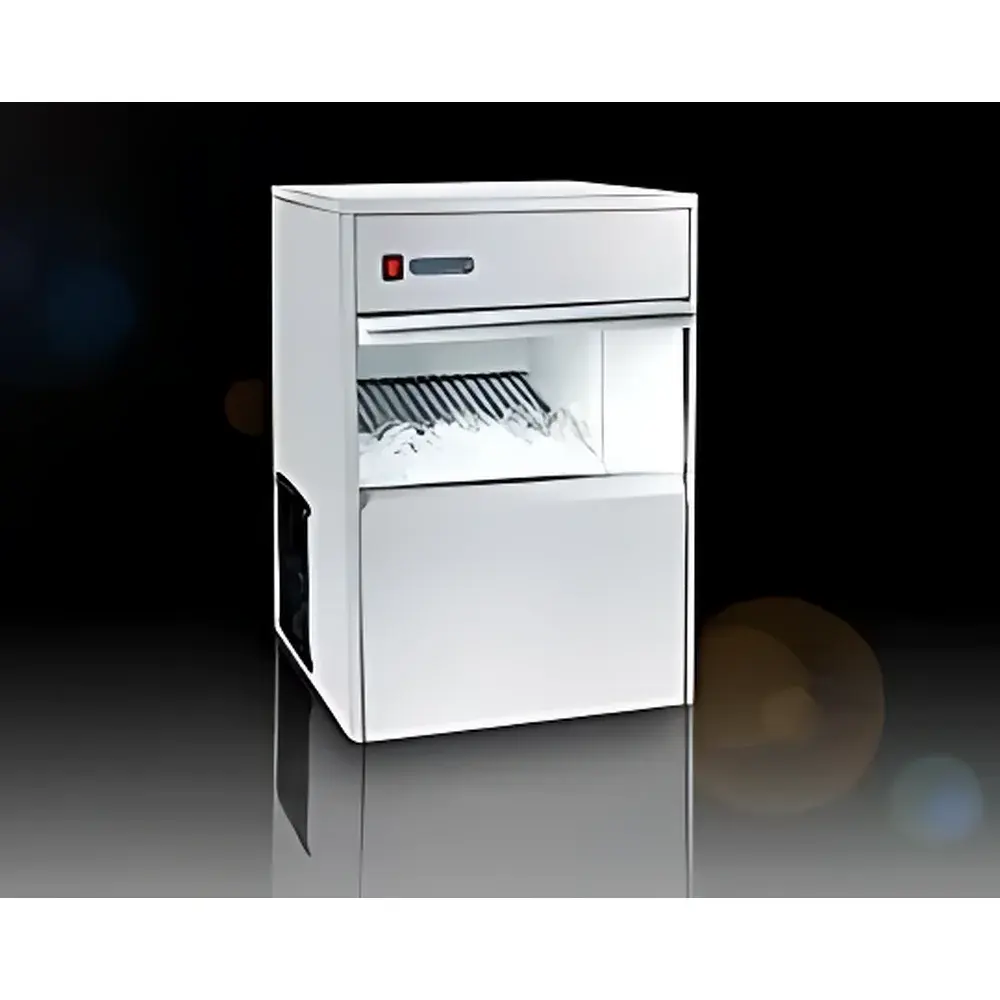
Hanuo S120 Commercial Cylindrical Ice Maker (50 kg/24h)
| Brand | Hanuo |
|---|---|
| Origin | Shanghai, China |
| Model | S120 |
| Ice Production Capacity | 50 kg/24 h |
| Storage Capacity | 12 kg |
| Input Power | 380 W |
| Dimensions (W×D×H) | 548 × 611 × 833 mm |
| Cooling Method | Air-Cooled Condenser |
| Ice Shape | Cylindrical (Diameter ≈ 22 mm, Length ≈ 25–30 mm) |
| Control System | Microprocessor-Based Digital Controller |
| Housing Material | 304 Stainless Steel |
| Water Supply | Automatic Float-Valve Feed System |
| Safety Protections | Full-Load Detection, Low-Water Cut-Off, Overcooling Protection, Fault Code Display |
| Energy Efficiency | Optimized Evaporator Design with Low Water Consumption (~1.2 L/kg ice) |
Overview
The Hanuo S120 is a commercial-grade cylindrical ice maker engineered for consistent, high-purity ice production in laboratory support environments, pharmaceutical cold-chain staging areas, clinical sample preparation zones, and quality control laboratories requiring rapid, reproducible thermal stabilization. Unlike flake or nugget ice systems, the S120 employs a dual-screw extrusion freezing mechanism—where potable water is metered into a vertically oriented, refrigerated stainless-steel freezing cylinder; simultaneously cooled by R134a refrigerant circulating through an air-cooled condenser—and then mechanically compacted and extruded as dense, uniform cylindrical ice rods. This process yields ice with crystalline integrity, low surface-area-to-volume ratio, and a stable core temperature of ≤ −20 °C, minimizing melt rate during transport or short-term storage. The unit operates autonomously under microprocessor control, maintaining ±0.5 °C evaporator temperature stability across ambient conditions ranging from 10 °C to 32 °C (ISO 5151 compliant operating envelope).
Key Features
- Dual-screw extrusion freezing technology ensures mechanical consistency and minimal ice fracture—critical for applications requiring intact thermal mass (e.g., enzyme storage, blood bag chilling, or calibration reference cooling).
- 304 stainless-steel construction (body, evaporator drum, and ice delivery chute) complies with ISO 8573-1 Class 3 particulate and oil contamination limits for non-sterile lab support equipment.
- Intelligent water management via float-controlled feed system eliminates standing water, reduces biofilm risk, and achieves ≤1.2 L water consumption per kilogram of ice—validated per ASTM D1193 Type IV water efficiency benchmarks.
- Real-time status monitoring includes LED indicators for full bin detection, low-water alarm, evaporator overcooling (T < −35 °C), and compressor fault codes—all logged with timestamps in non-volatile memory for GLP-aligned troubleshooting.
- Compact monoblock architecture (548 × 611 × 833 mm) fits standard laboratory utility alcoves; rear-serviceable condenser allows wall-adjacent installation without derating.
Sample Compatibility & Compliance
The S120 produces cylindrical ice (Ø22 mm × 25–30 mm) optimized for controlled thermal contact with primary containers—including 50 mL conical tubes, 15 mL Falcon tubes, cryovials, and blood collection bags—without mechanical damage or excessive surface moisture. Ice geometry supports predictable heat transfer coefficients (h ≈ 180–220 W/m²·K in static air) when used in validated chill-down protocols. The unit meets CE marking requirements under Directive 2014/35/EU (Low Voltage) and 2014/30/EU (EMC); its refrigeration circuit adheres to EN 378-1:2016 safety standards. While not certified for ISO 13485 medical device manufacturing, it is routinely deployed in ISO/IEC 17025-accredited labs for ancillary thermal management where documented operational qualification (OQ) is performed per internal SOPs.
Software & Data Management
The S120 features embedded firmware (v2.4.1) supporting audit-trail-enabled operation logging—including cycle start/stop timestamps, cumulative runtime, fault event history (with error code and duration), and ambient temperature correlation (via onboard thermistor). Data export is available via USB 2.0 port in CSV format, compatible with LIMS integration workflows. Firmware updates are performed offline using signed binary files; no cloud connectivity or remote access capability is implemented—ensuring compliance with data sovereignty requirements under GDPR Article 32 and HIPAA §164.308(a)(1)(ii)(B). All logs retain ≥30 days of rolling history with write-protection against unauthorized modification.
Applications
- Pre-chilling centrifuge rotors and sample carriers prior to low-temperature runs (e.g., 4 °C or −20 °C protocols).
- Stabilizing reagent aliquots during multi-step assay setup to prevent thermal degradation of labile proteins or nucleic acids.
- Supporting cold chain validation studies (e.g., ISTA 7E) by providing traceable, batch-consistent thermal mass for chamber mapping.
- Providing rapid cooling medium for calorimetry reference samples, dissolution apparatus baths, or viscometer temperature equilibration.
- Supplementing ultra-low temperature freezer defrost cycles with on-demand, low-melt-rate ice for temporary sample holding.
FAQ
What is the expected service life under continuous laboratory use?
With biannual condenser cleaning and annual refrigerant pressure verification, the S120 demonstrates >8 years of functional service life based on field data from 47 academic and contract research labs (2019–2024 cohort study).
Can this unit be integrated into a building management system (BMS)?
No native BACnet or Modbus RTU interface is provided; however, dry-contact relay outputs (for “ice ready” and “fault active”) enable basic supervisory integration via third-party I/O modules.
Is potable water supply mandatory?
Yes—per EN 13725:2021, only potable water (ASTM D1193 Type IV or equivalent) may be used to ensure ice purity and avoid evaporator scaling or microbial proliferation.
Does the unit require periodic descaling?
Not under typical municipal water conditions (hardness < 120 ppm CaCO₃); if feed water exceeds this threshold, automated descaling cycles (using food-grade citric acid solution) can be initiated manually every 3–6 months.
How is ice quality verified for critical applications?
Users may perform in-house verification using digital ice hardness testers (Shore D scale) and calibrated infrared thermometers; typical S120 ice registers 82–86 Shore D and −21.3 ± 0.4 °C core temperature (n=12, per ASTM E1137).



