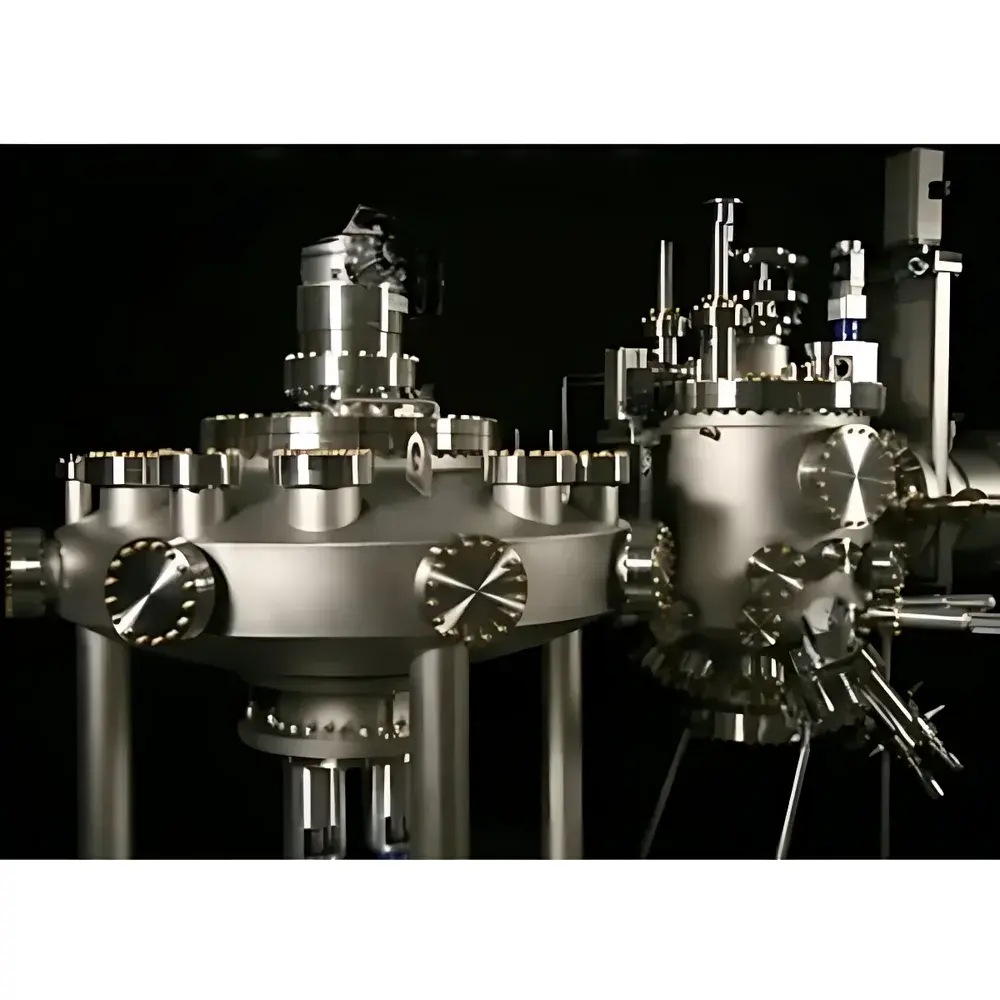
Veeco GEN10 Molecular Beam Epitaxy System
| Brand | Veeco |
|---|---|
| Origin | USA |
| Model | GEN10 |
| Configuration | Cluster-tool architecture with up to three material-specific growth chambers |
| Vacuum Integration | Ultra-high vacuum (UHV) integrated chamber system |
| Automation | Robotic wafer transfer for unattended operation |
| Application Scope | Research-grade III–V, II–VI, and elemental semiconductor epitaxy |
| Compliance Framework | Designed for GLP-compliant process documentation and ASTM F1529-22 compatible thin-film metrology workflows |
Overview
The Veeco GEN10 Molecular Beam Epitaxy (MBE) System is a research-grade, ultra-high vacuum (UHV) cluster-tool platform engineered for atomic-layer precision in the epitaxial growth of compound semiconductors. Operating on the fundamental principle of thermal effusion—where elemental or compound sources are heated in Knudsen cells to generate collimated molecular beams that impinge onto a heated crystalline substrate under UHV conditions—the GEN10 enables stoichiometrically controlled, layer-by-layer deposition with sub-monolayer resolution. Its modular architecture integrates up to three independent, material-optimized growth chambers (e.g., GaAs/AlGaAs, InP-based, or Si/Ge configurations) within a single interconnected UHV manifold, eliminating cross-contamination between incompatible material systems such as arsenides and phosphides. This design supports simultaneous multi-user access, extended unattended runs (up to 72 h), and seamless transition from R&D to pilot-scale process development—making it a foundational tool for university cleanrooms, national labs, and corporate advanced materials groups engaged in optoelectronics, quantum devices, and high-electron-mobility transistor (HEMT) fabrication.
Key Features
- Cluster-tool configuration with up to three independently controlled, material-specific growth chambers—enabling co-deposition, sequential heterostructure growth, and cross-material compatibility without venting.
- Integrated UHV infrastructure (<1×10⁻¹⁰ Torr base pressure) with ion pumps, cryopanels, and turbomolecular pumping stages optimized for long-term stability and low hydrocarbon background.
- Automated robotic wafer handling system supporting 2″, 3″, and 4″ substrates with pre-alignment, in-situ reflection high-energy electron diffraction (RHEED) monitoring, and real-time growth rate calibration via quartz crystal microbalances (QCMs).
- Modular source assembly with water-cooled Knudsen cells, effusion cell temperature control (±0.1°C), and programmable shutter sequencing synchronized to substrate heater ramp profiles.
- Substrate heating system with radiative and resistive options (up to 850°C for GaAs, 950°C for Si), integrated thermocouple feedback, and uniformity <±1.5°C across 4″ wafers.
- Front-end interface compliant with SECS/GEM protocol for integration into fab-wide MES and equipment automation frameworks.
Sample Compatibility & Compliance
The GEN10 accommodates a broad spectrum of substrate materials—including Si(100), GaAs(100), InP(100), sapphire, and graphene-on-SiC—with native support for oxide desorption, annealing, and surface reconstruction protocols. Growth processes adhere to ASTM F1529-22 (Standard Guide for MBE Process Characterization) and are traceable under GLP-aligned operational logs. All vacuum interlocks, pressure interlocks, and beam shutter fail-safes conform to IEC 61508 SIL-2 functional safety requirements. While not FDA-certified per se, its audit-ready data structure—including timestamped RHEED intensity logs, QCM deposition curves, and heater power profiles—supports 21 CFR Part 11 compliance when deployed with validated third-party electronic lab notebook (ELN) software.
Software & Data Management
Control is executed via Veeco’s proprietary MBE Command Center™ software—a Windows-based, role-secured application offering recipe-driven growth sequencing, real-time parameter visualization (beam flux, substrate temperature, chamber pressure), and automated calibration routines (e.g., As₂/As₄ flux ratio mapping, dopant incorporation yield modeling). All process data are stored in vendor-neutral HDF5 format with embedded metadata (user ID, timestamp, hardware configuration hash), enabling direct import into MATLAB, Python (h5py), or commercial statistical process control (SPC) platforms. Audit trails record every parameter change, user login/logout event, and emergency stop activation—fully reconstructible for internal QA reviews or external ISO 9001 surveillance audits.
Applications
- Growth of lattice-matched and strained-layer superlattices for quantum cascade lasers (QCLs) and terahertz emitters.
- Epitaxial development of GaN-on-Si templates for power electronics and RF HEMTs.
- Low-dimensional heterostructures including InSb nanowires, Bi₂Se₃ topological insulator films, and MoS₂/WS₂ van der Waals heterobilayers.
- Fabrication of reference standards for scanning tunneling microscopy (STM) and angle-resolved photoemission spectroscopy (ARPES).
- Process transfer studies targeting migration from GEN10 to production-scale Veeco EPIK® or TurboDisc® platforms under identical thermal and flux boundary conditions.
FAQ
What vacuum level does the GEN10 achieve, and how is it maintained during extended growth runs?
The system achieves a base pressure of ≤1×10⁻¹⁰ Torr using a combination of ion pumps, cryopanels, and turbo-molecular pumps; pressure stability is actively monitored and corrected via feedback-controlled pump speed modulation during multi-day depositions.
Can the GEN10 grow both III–V and II–VI materials without cross-contamination?
Yes—its physically isolated, UHV-integrated chamber architecture prevents gas-phase mixing; each growth module operates under independent pressure and effusion control, validated by residual gas analysis (RGA) before and after material switching.
Is remote operation supported for unattended overnight growth?
Fully supported via secure TLS-encrypted VNC interface; all critical alarms (pressure excursion, shutter failure, heater drift) trigger email/SMS alerts and auto-pause execution per user-defined safety thresholds.
What substrate sizes and orientations are compatible?
Standard configurations support 2″, 3″, and 4″ wafers with orientation options including (100), (111)A/B, and vicinal off-cut substrates; custom holders available for non-planar or patterned templates.
How does Veeco ensure long-term reproducibility across different GEN10 installations?
Through factory calibration of all Knudsen cell flux profiles, standardized RHEED geometry alignment procedures, and inclusion of NIST-traceable temperature calibration certificates with each system shipment.