
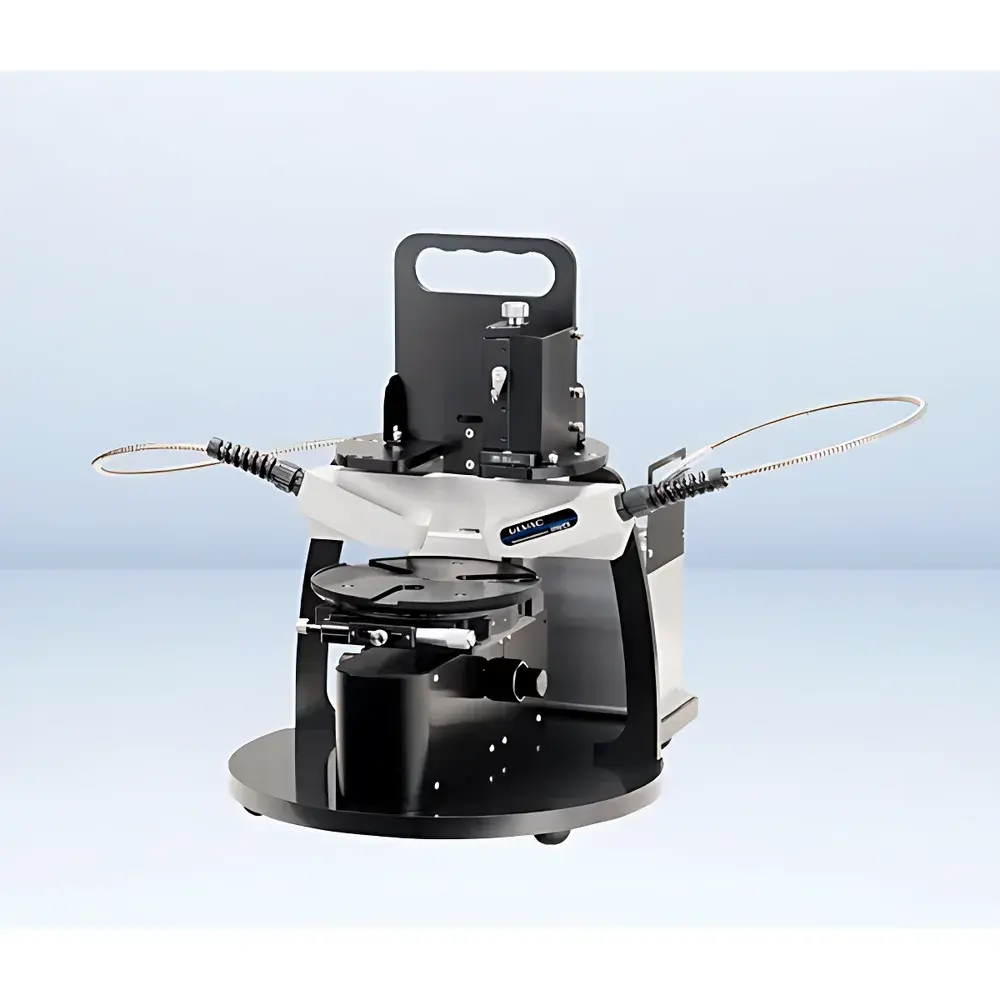
ULVAC KIKO UNECS Series Spectroscopic Ellipsometer
| Brand | ULVAC KIKO |
|---|---|
| Origin | Japan |
| Model | UNECS Series |
| Measurement Principle | Spectroscopic Ellipsometry (SE) |
| Wavelength Range Options | Standard: 530–750 nm |
| Visible-Extended | 380–760 nm |
| Minimum Acquisition Time | 20 ms per spectrum |
| Sensor Architecture | Fixed-optics, no rotating elements |
| Environmental Configurations | Ambient-air, vacuum-integrated, and in-situ chamber-mounted variants |
| Sample Stage Options | Manual, motorized XY, large-substrate (up to 300 mm), portable benchtop, and OEM-integrated modules |
| Compliance | Designed for ISO/IEC 17025-aligned calibration traceability |
Overview
The ULVAC KIKO UNECS Series Spectroscopic Ellipsometer is an engineered solution for non-destructive, contactless characterization of thin film optical constants—including thickness (d), complex refractive index (ñ = n + ik), and extinction coefficient (k)—across semiconductor, display, photovoltaic, and advanced coating R&D and production environments. Operating on the fundamental principles of spectroscopic ellipsometry, the system measures the change in polarization state (Δ and Ψ) of monochromatic or broadband light after reflection from a sample surface. By fitting measured spectra to physically grounded optical models—such as layered Cauchy, Tauc-Lorentz, or B-Spline dispersion functions—the instrument delivers quantitative metrology with high repeatability and sub-nanometer thickness resolution for films ranging from <0.5 nm to >5 µm. Its fixed-optics design eliminates mechanical moving parts in the sensor head, directly contributing to long-term stability, vibration insensitivity, and minimal drift—critical attributes for inline process monitoring and lab-based reference measurements.
Key Features
- Snapshot Acquisition Architecture: Utilizes a static, multi-channel spectrometer coupled with polarizer/analyzer optics—no rotating compensators or goniometers—enabling full-spectrum acquisition in ≤20 ms. This supports real-time monitoring of dynamic processes such as ALD, PVD, or spin-coating.
- Configurable Spectral Coverage: Two standard optical path variants: (i) 530–750 nm for high signal-to-noise ratio in visible-transparent applications; (ii) extended 380–760 nm range for broader material dispersion analysis, including UV-active layers and wide-bandgap oxides.
- Modular Mechanical Design: Sensor unit weighs <1.2 kg and occupies <120 × 80 × 60 mm—enabling integration into vacuum chambers (CF flange options), gloveboxes, or portable metrology carts without recalibration.
- Multi-Platform Flexibility: Available with manual tilt-adjustment stages, motorized XYZ stages (±0.1 µm repeatability), large-area mapping systems (up to 300 mm wafers), and OEM-ready controller interfaces (Ethernet/IP, RS-232, TTL triggers).
- Maintenance-Free Optics: Solid-state detector array and polarization optics require no periodic alignment or recalibration under stable thermal conditions (<±0.5 °C), reducing total cost of ownership and operational downtime.
Sample Compatibility & Compliance
The UNECS platform accommodates rigid and planar substrates including silicon wafers, glass, sapphire, quartz, and polymer films (PET, PI). It supports transparent, semi-transparent, and weakly absorbing dielectric and semiconductor layers—e.g., SiO₂, SiNₓ, Al₂O₃, ITO, photoresists, organic EL layers, and perovskite precursors. Measurement accuracy adheres to ASTM E1939 (Standard Guide for Spectroscopic Ellipsometry) and ISO 15594 (Optics and photonics — Ellipsometry — Vocabulary and symbols). System configuration and software validation packages are available to support 21 CFR Part 11 compliance, including electronic signatures, audit trails, and user-access-controlled parameter locking—essential for regulated QC laboratories operating under GMP/GLP frameworks.
Software & Data Management
Control and analysis are performed via UNECS-Analyzer™ software, a Windows-based application supporting model-driven fitting (Levenberg-Marquardt and Nelder-Mead algorithms), multi-sample batch processing, and scriptable automation (Python API). Raw Δ/Ψ spectra, fitted parameters, confidence intervals, and residual maps are exportable in CSV, HDF5, and industry-standard JPK formats. The software includes built-in libraries of optical constants for >120 materials and supports custom dispersion model definition. Optional network licensing enables concurrent access across shared lab environments, while encrypted project files ensure data integrity and version control aligned with ISO/IEC 17025 documentation requirements.
Applications
- Thickness and optical dispersion mapping of gate oxides (SiO₂, HfO₂) and high-k stacks in CMOS process development
- In-line monitoring of anti-reflective and hard-coating layers on display cover glass (Gorilla Glass®, sapphire)
- Quantification of photoresist swelling and developer-induced profile changes during lithography optimization
- Characterization of transparent conductive oxides (ITO, AZO, FTO) for touch sensors and solar cell front electrodes
- Real-time kinetic analysis of self-assembled monolayers (SAMs) and polymer brush growth in liquid environments (with optional liquid cell)
- Quality assurance of optical filters, AR coatings, and Bragg reflectors in precision optics manufacturing
FAQ
What vacuum compatibility options are available for the UNECS sensor head?
Standard configurations include DN40 CF and DN63 CF vacuum feedthroughs with all-metal seals; optical transmission loss at 1×10⁻⁶ Pa is <0.3% across the specified wavelength range.
Can the system measure rough or patterned surfaces?
Yes—when combined with effective medium approximation (EMA) modeling and appropriate spot size selection (standard: Ø300 µm; optional: Ø100 µm or Ø500 µm), it quantifies average film properties over topographically heterogeneous areas.
Is calibration traceable to national standards?
Yes—factory calibration uses NIST-traceable Si/SiO₂ reference wafers; certificate of calibration includes uncertainty budget per ISO/IEC 17025 Annex A.
Does the software support automated pass/fail criteria for production QA?
Yes—user-defined tolerance windows for thickness, n, and k can trigger visual alerts, log events, and export XML reports compatible with MES/SPC systems.
What training and technical support is provided?
ULVAC KIKO offers on-site installation verification, 2-day operator training, and remote application engineering support—with SLA options for 24/7 critical-system response.




