
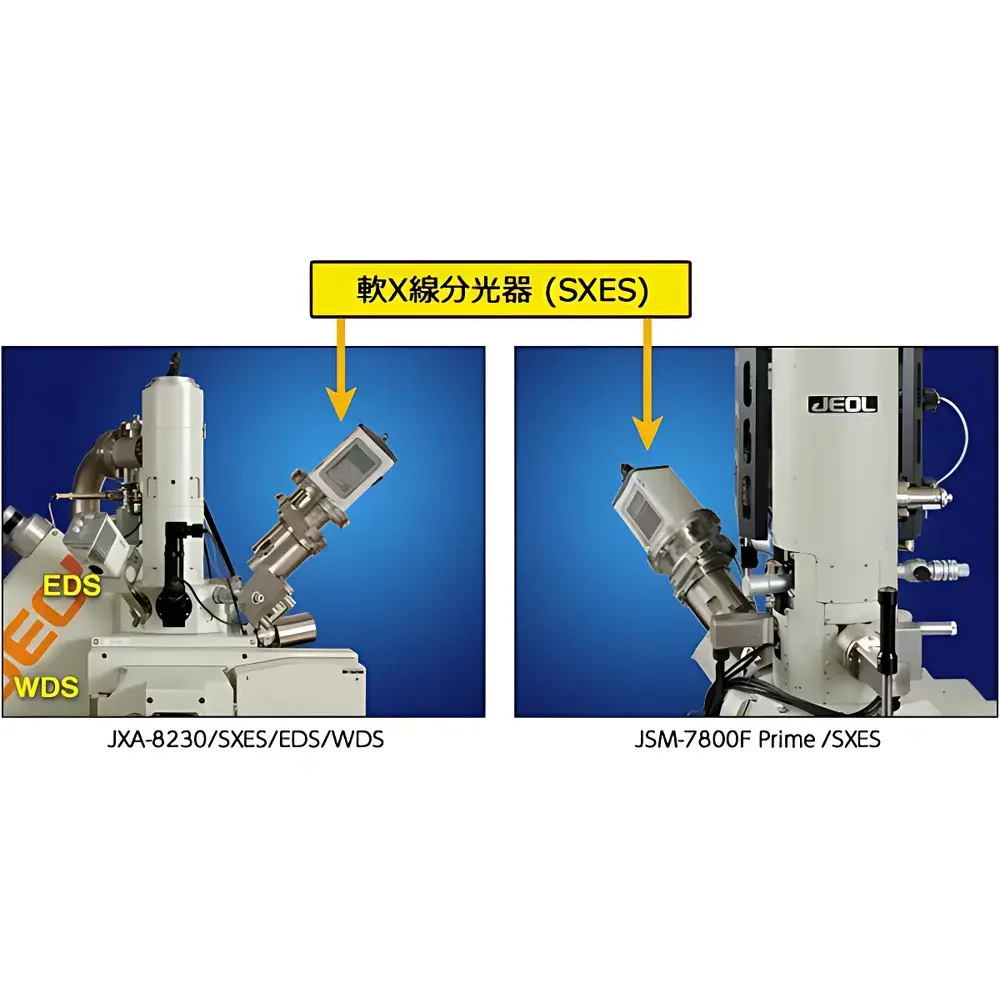
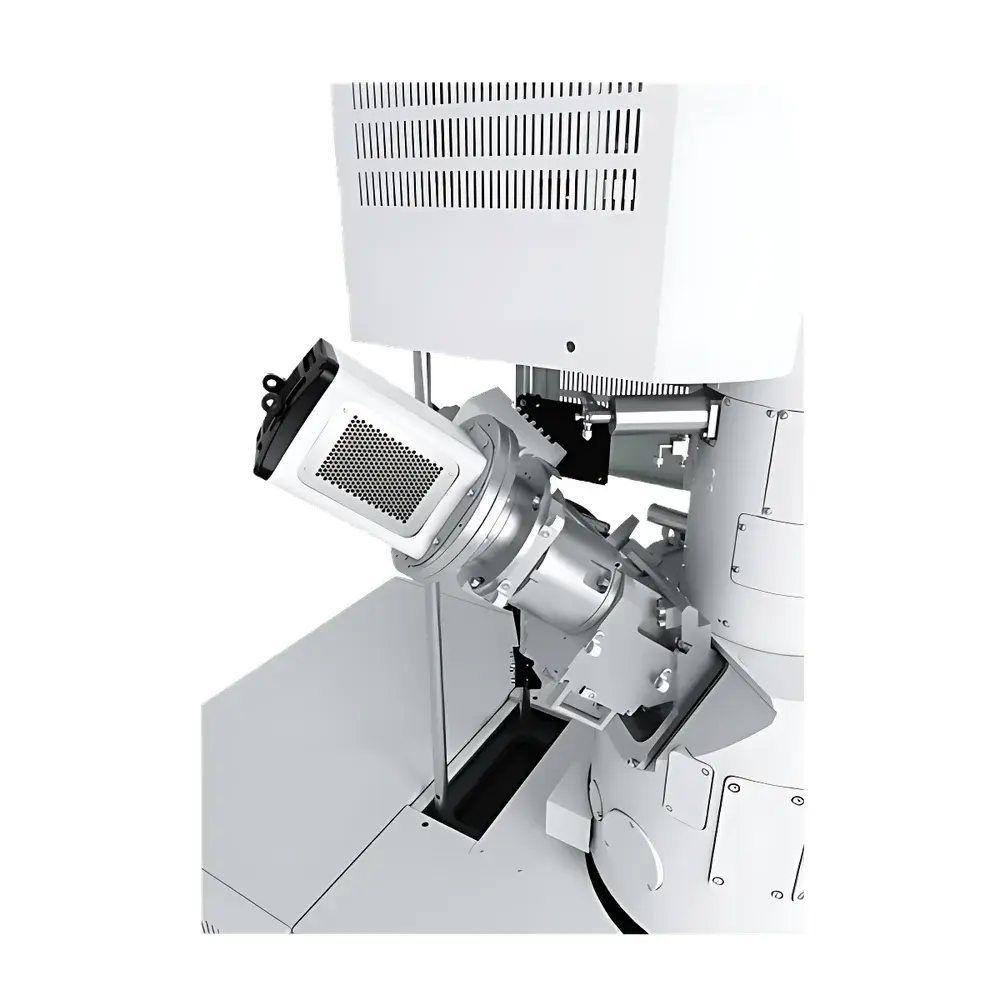
JEOL SXES Soft X-ray Emission Spectrometer
| Brand | JEOL |
|---|---|
| Origin | Japan |
| Manufacturer Type | Authorized Distributor |
| Origin Category | Imported |
| Model | SXES |
| Price | USD 700,000 |
Overview
The JEOL SXES Soft X-ray Emission Spectrometer is a high-resolution spectroscopic attachment engineered for integration with scanning electron microscopes (SEM) and electron probe microanalyzers (EPMA). It operates on the principle of soft X-ray emission spectroscopy (SXES), which detects characteristic X-ray photons emitted in the energy range of ~40–2000 eV following inner-shell ionization by a focused electron beam. Unlike energy-dispersive X-ray spectroscopy (EDS) or wavelength-dispersive X-ray spectroscopy (WDS), SXES leverages crystal diffraction—typically using spherically bent crystals such as LiF, PET, or ADP—to achieve intrinsic energy resolution down to 0.3 eV. This enables precise separation of spectral features arising from subtle electronic structure differences, including chemical shifts associated with oxidation state, coordination environment, and bonding configuration. As a result, the SXES transforms conventional electron-beam instruments into multimodal analytical platforms capable of simultaneous high-spatial-resolution imaging, quantitative elemental mapping, and chemically sensitive spectroscopic analysis.
Key Features
- Sub-0.3 eV intrinsic energy resolution at the C Kα line (277 eV), enabling discrimination of fine spectral structures unresolvable by EDS or WDS
- Dedicated soft X-ray optical path with ultra-high-vacuum-compatible monochromator chamber and position-sensitive detector
- Automated crystal selection mechanism supporting multiple analyzing crystals (e.g., LiF(200), PET(002), ADP(101)) for optimized coverage across light-element ranges (B to F, Na to Cl, K to Ca)
- Integrated beam alignment and spectrometer calibration routines compatible with JEOL SEM/EPMA control architecture
- Robust mechanical design with thermal stabilization and vibration isolation to maintain long-term spectral fidelity during extended acquisition
- Native support for point, line, and area spectral acquisition modes synchronized with stage motion and beam scanning
Sample Compatibility & Compliance
The SXES is designed for use with solid, conductive, or carbon-coated insulating samples under standard high-vacuum conditions (≤1×10⁻⁴ Pa) typical of JEOL SEM and EPMA systems. It complies with IEC 61000-6-3 (EMC emission standards) and meets mechanical safety requirements per ISO 13857. While not a standalone medical or industrial process instrument, its data output supports compliance-driven workflows: spectral libraries and acquisition metadata are structured to align with GLP audit-trail requirements; raw spectrum files include timestamped instrument parameters, detector gain settings, and crystal orientation data—facilitating traceability under FDA 21 CFR Part 11 when deployed in regulated laboratories. The system adheres to JEOL’s internal quality management system certified to ISO 9001:2015.
Software & Data Management
Control and analysis are performed via JEOL’s proprietary SXES Analysis Suite, running on Windows-based host PCs interfaced through optical fiber-linked digital I/O modules. The software provides real-time spectrum preview, background subtraction using iterative polynomial fitting, peak deconvolution with Voigt profile modeling, and integrated elemental quantification based on fundamental parameter (FP) algorithms validated against NIST SRM reference materials. All spectra are stored in vendor-neutral .SPC format compliant with the ASTM E1348 standard for spectral data exchange. Batch processing scripts support automated generation of valence-state maps (e.g., Fe²⁺/Fe³⁺ ratio distributions), and export options include CSV, HDF5, and MSA-compatible formats for third-party tools such as DM3, HyperSpy, or MATLAB-based spectral modeling pipelines.
Applications
- Quantitative light-element analysis in ceramics, battery cathode materials (e.g., Ni, Co, Mn L-edge shifts in NMC oxides), and catalysts where EDS sensitivity and resolution are insufficient
- Oxidation state mapping of transition metals (e.g., Ti²⁺/Ti³⁺/Ti⁴⁺ in titanates; Cr³⁺/Cr⁶⁺ in stainless steel corrosion layers)
- Chemical bonding analysis in nitrides, carbides, and borides—particularly for B K-edge and N K-edge fine structure interpretation
- Valence band structure probing in correlated electron systems, including rare-earth compounds and high-Tc superconductors
- Interfacial chemistry characterization at buried heterojunctions in semiconductor devices, enabled by depth-resolved SXES using variable incident beam energy
FAQ
What vacuum level is required for optimal SXES operation?
The SXES monochromator chamber must be maintained at ≤5×10⁻⁵ Pa, independent of the main SEM column vacuum. A dedicated turbomolecular pumping station with cold trap is integrated into the system.
Can SXES be retrofitted onto non-JEOL electron microscopes?
Retrofitting is technically feasible but requires custom mechanical interface design, electron-optical alignment validation, and firmware-level synchronization—JEOL only guarantees full functionality and calibration on JEOL-branded SEM and EPMA platforms.
How does SXES compare to electron energy-loss spectroscopy (EELS)?
While EELS offers superior energy resolution (<0.1 eV) in TEM mode, SXES provides higher collection efficiency for soft X-rays, better signal-to-noise for low-Z elements in SEM geometry, and direct compatibility with bulk, thick, or rough samples unsuitable for thin-foil TEM preparation.
Is spectral library matching supported for unknown phase identification?
Yes—the SXES Analysis Suite includes a curated reference database of >1200 experimentally acquired spectra for pure elements, binary compounds, and common oxides, with optional expansion via user-contributed libraries.



