
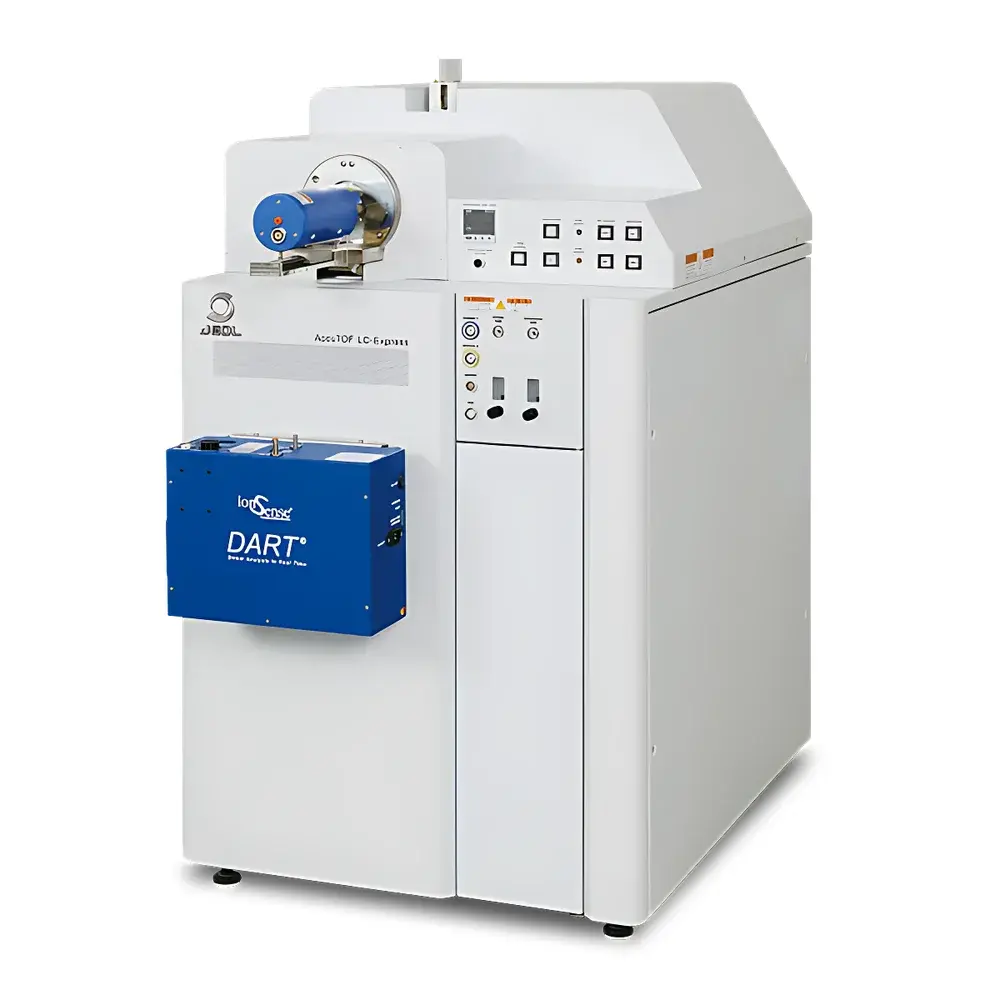
JEOL JMS-T100LP Atmospheric Pressure Ionization Time-of-Flight Mass Spectrometer
| Brand | JEOL |
|---|---|
| Origin | Japan |
| Instrument Type | Time-of-Flight (TOF) Mass Spectrometer |
| Configuration | Liquid Chromatography–Mass Spectrometry (LC-MS) Platform |
| Ionization Modes | Electrospray Ionization (ESI), Direct Analysis in Real Time (DART™), Cold Spray Ionization (CSI) |
| Intended Use | General-purpose high-resolution mass analysis in research, quality control, and regulatory-compliant laboratories |
| Compliance Context | Designed to support GLP/GMP workflows and data integrity requirements per FDA 21 CFR Part 11 and ISO/IEC 17025 guidelines |
Overview
The JEOL JMS-T100LP is a high-performance atmospheric pressure ionization time-of-flight mass spectrometer engineered for robust, reproducible molecular mass measurement across diverse analytical workflows. As the latest generation in JEOL’s TOF-MS platform, it integrates orthogonal acceleration time-of-flight (oa-TOF) architecture with vacuum-stable ion optics and digital signal acquisition to deliver high mass accuracy, excellent mass resolution, and wide dynamic range—without requiring magnetic sector or quadrupole pre-filtration. Its design centers on atmospheric pressure ion sources, enabling seamless coupling with liquid chromatography systems for comprehensive separation and detection of small molecules, peptides, metabolites, and synthetic compounds. The instrument operates on fundamental TOF principles: ions generated at atmospheric pressure are accelerated into a field-free flight tube under precisely timed voltage pulses; their time-of-flight to the microchannel plate detector is directly proportional to the square root of their mass-to-charge ratio (m/z), allowing simultaneous detection of all ions within each acquisition cycle.
Key Features
- Orthogonal acceleration TOF geometry for enhanced mass resolution and sensitivity without sacrificing duty cycle
- Dual-mode atmospheric pressure ion source compatibility: standard electrospray ionization (ESI) plus optional JEOL-exclusive DART™ (Direct Analysis in Real Time) and Cold Spray Ionization (CSI) sources
- High-vacuum system with turbomolecular pumping stages optimized for stable ion transmission and low background noise
- Digital time-to-digital converter (TDC) with picosecond-level timing resolution for precise m/z determination
- Modular front-end design supporting integration with HPLC, UHPLC, and nano-LC systems via standardized ESI interfaces
- Thermally stabilized flight tube and detector assembly to minimize thermal drift during extended acquisition sequences
Sample Compatibility & Compliance
The JMS-T100LP accommodates a broad spectrum of sample types—including polar and non-polar small molecules, labile biomolecules, polymers, and environmental extracts—without derivatization or extensive cleanup. Its ESI interface supports flow rates from 1 µL/min to 1 mL/min, making it compatible with capillary, microbore, and conventional bore LC configurations. DART™ enables rapid ambient surface analysis of solids, liquids, and gases with minimal sample preparation, while Cold Spray extends sensitivity for thermally fragile analytes such as glycopeptides and oligonucleotides. From a regulatory standpoint, the system’s firmware architecture supports audit-trail-enabled operation, electronic signatures, and secure user access controls aligned with FDA 21 CFR Part 11 and ISO/IEC 17025 requirements. Data files conform to open mzML format, ensuring interoperability with third-party processing tools used in metabolomics, proteomics, and pharmaceutical impurity profiling.
Software & Data Management
Acquisition and processing are managed through JEOL’s MassCenter™ software suite, which provides real-time spectral visualization, centroiding, deconvolution, and isotopic pattern simulation. The software includes built-in calibration routines using internal or external standards (e.g., sodium formate clusters), automated peak detection with signal-to-noise thresholding, and batch-processing workflows for high-throughput screening. All raw data files are stored with embedded metadata—including instrument parameters, calibration history, and operator credentials—to satisfy GLP documentation standards. Export options include CSV, TXT, and mzXML formats; spectral libraries can be curated and searched against NIST, METLIN, and HMDB databases via integrated plug-ins. Remote monitoring and method sharing are supported via secure HTTPS-based client-server architecture.
Applications
- Pharmaceutical development: Impurity identification, degradation product characterization, and forced degradation studies per ICH Q3 guidelines
- Clinical and translational research: Targeted and untargeted metabolite profiling in biofluids (plasma, urine, CSF)
- Environmental analysis: Detection and structural elucidation of emerging contaminants (PFAS, pesticides, microplastic additives)
- Food safety: Residue screening, adulterant detection, and authenticity verification of botanicals and dietary supplements
- Materials science: Polymer end-group analysis, additive identification, and reaction monitoring in synthetic chemistry
FAQ
What ionization methods does the JMS-T100LP support?
It natively supports electrospray ionization (ESI) and offers optional integration of JEOL’s proprietary DART™ and Cold Spray Ionization (CSI) sources.
Is the system compatible with UHPLC separations?
Yes—the ESI interface is rated for pressures up to 15,000 psi and flow rates down to 200 nL/min, enabling direct coupling with modern UHPLC platforms.
Does the instrument meet regulatory data integrity requirements?
Yes—MassCenter™ software implements role-based access control, electronic signatures, and full audit trails compliant with FDA 21 CFR Part 11 and ISO/IEC 17025.
Can the JMS-T100LP perform accurate mass measurements?
Yes—its oa-TOF design, combined with internal calibration and temperature-controlled optics, enables sub-5 ppm mass accuracy over a wide m/z range under routine operating conditions.
What data formats are supported for export and third-party analysis?
Raw and processed data can be exported in mzML, mzXML, CSV, and vendor-neutral text formats, facilitating integration with tools such as XCMS, MZmine, and Skyline.
Related Products





