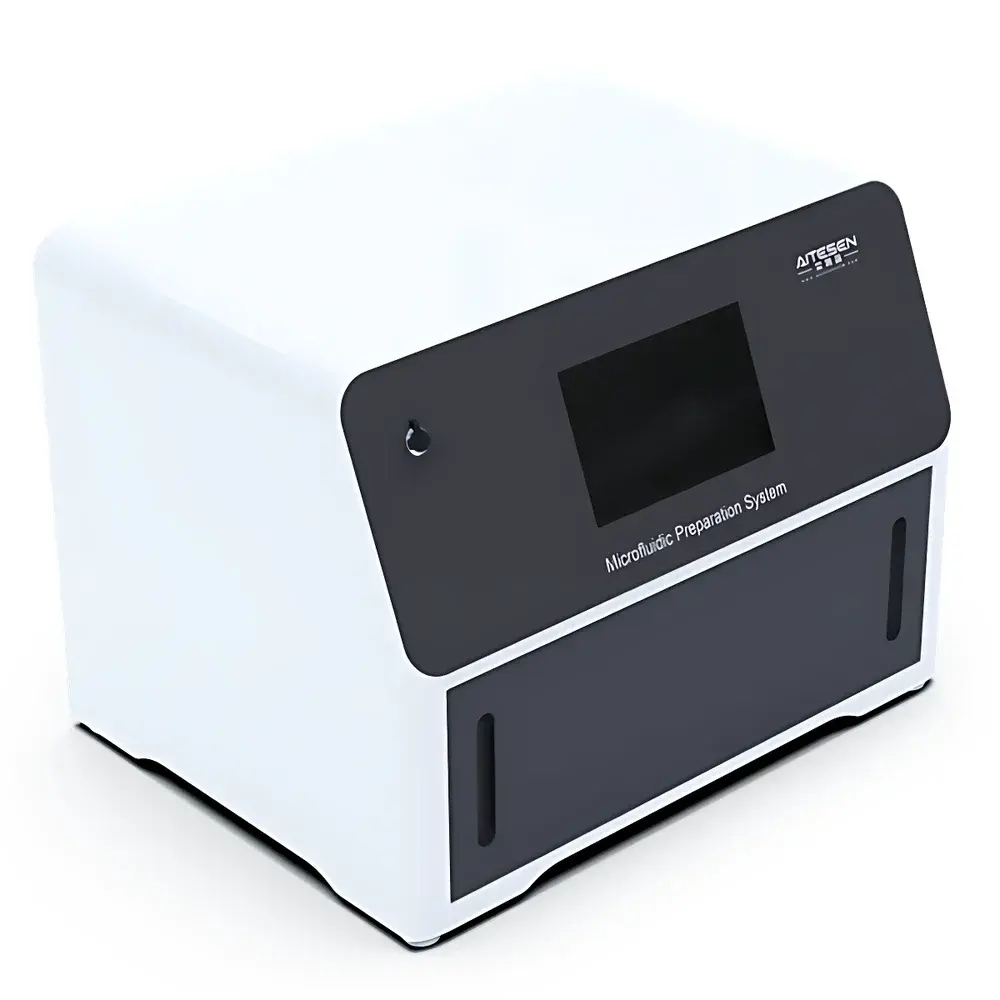
Aitesen MPE-P1 GMP-Compliant Microfluidic Nanoparticle Manufacturing System
| Brand | Aitesen |
|---|---|
| Origin | Jiangsu, China |
| Manufacturer Type | Authorized Distributor |
| Product Category | Domestic |
| Model | MPE-P1 |
| Carrier Type | Lipid Nanoparticle (LNP) |
| Pricing | Upon Request |
| Key Features | Integrated touchscreen HMI, batch record logging, exportable process data, high-flow/high-concentration LNP & liposome preparation, PDI < 0.1, particle size down to <100 nm |
| Compliance | Designed for GMP-aligned process development per ICH Q5A/Q5B, ISO 22442, and USP <1043> guidance |
| Software | Embedded control firmware with audit-trail-capable event logging (21 CFR Part 11–ready configuration available) |
Overview
The Aitesen MPE-P1 is a pilot-scale, GMP-aligned microfluidic nanoparticle manufacturing system engineered for the robust, reproducible, and scalable preparation of lipid-based and polymeric nanocarriers. It operates on the principle of hydrodynamic flow focusing and controlled turbulent mixing within precision-machined microchannels—leveraging laminar-to-turbulent transition regimes to achieve rapid, homogeneous mixing of immiscible phases (e.g., ethanolic lipid solution and aqueous nucleic acid buffer). This enables precise control over nucleation kinetics, vesicle self-assembly, and subsequent particle growth—critical parameters governing encapsulation efficiency, polydispersity index (PDI), and colloidal stability in therapeutic LNP formulations. Unlike batch-wise bulk mixing methods, the MPE-P1 implements continuous, single-pass processing under fully defined shear and residence time conditions—providing deterministic process outcomes essential for regulatory filing and tech transfer to commercial manufacturing.
Key Features
- GMP-oriented system architecture with stainless steel fluid-contact surfaces, pressure-rated microfluidic manifolds, and validated leak integrity
- Integrated 10.1-inch industrial touchscreen HMI with intuitive workflow navigation, real-time parameter monitoring, and configurable alarm thresholds
- Dual independent high-precision syringe pumps (A/B phase) with flow rate range 0.01–50 mL/min and CV ≤ 1.5% across operating range
- High-pressure delivery module (up to 200 MPa) coupled with interchangeable microfluidic chips for primary emulsification, secondary homogenization, and post-formation sizing control
- Onboard batch record generation compliant with ALCOA+ principles: timestamped operator ID, setpoint logs, actual flow/pressure traces, and manual intervention annotations
- Export functionality supporting CSV and PDF formats for raw process data, summary statistics, and QC release documentation
Sample Compatibility & Compliance
The MPE-P1 supports formulation development across multiple nanocarrier classes—including ionizable cationic LNPs (for mRNA, siRNA, saRNA), conventional and PEGylated liposomes (e.g., doxorubicin, irinotecan), PLGA and PEG-PLGA nanoparticles, oil-in-water emulsions (e.g., MF59-type adjuvants, parenteral fat emulsions), and inorganic colloids (e.g., gold nanoparticles). All wetted components comply with USP Class VI biocompatibility standards. The system’s design intent aligns with ICH Q5A(R2) for characterization of biological nanomaterials and supports execution of process validation activities per FDA Guidance for Industry: “Quality Considerations for Continuous Manufacturing of Drug Substances and Products” (2023). Optional IQ/OQ documentation packages are available for qualification under GMP environments.
Software & Data Management
The embedded firmware provides deterministic control logic with millisecond-level synchronization between pump actuation, pressure modulation, and chip temperature stabilization (ambient to 40 °C). Process data—including flow rates, backpressure, temperature, and elapsed time—is logged at 10 Hz with cryptographic hashing for integrity verification. Audit trail functionality meets 21 CFR Part 11 requirements when deployed with network-authenticated user accounts and electronic signature workflows. Exported datasets are structured for direct import into statistical process control (SPC) platforms or LIMS systems via standardized metadata headers (e.g., ISO/IEC 17025-compliant traceability tags).
Applications
- Process development and scale-down modeling for clinical-stage LNP-mRNA vaccine candidates
- DoE-driven optimization of liposome composition, hydration time, and extrusion alternatives
- Rapid screening of surfactant ratios and solvent quenching profiles for low-PDI (<0.1) nanoparticle batches
- Continuous manufacturing trials supporting FDA CMC section submissions
- Comparative assessment of microfluidic chip geometries (T-junction, herringbone, staggered herringbone) for specific payload–lipid interactions
- Preparation of reference standards for DLS, NTA, and SEC-MALS method qualification
FAQ
Is the MPE-P1 suitable for sterile manufacturing?
The system is designed for aseptic processing support; however, terminal sterilization of the microfluidic chip and tubing requires validation per ISO 13408-1. Sterile filtration of inlet streams and use of Grade A laminar flow hoods are recommended.
Can it interface with PAT tools such as in-line UV-Vis or dynamic light scattering?
Yes—the system includes analog/digital I/O ports and Modbus TCP support for synchronized integration with third-party analyzers for real-time concentration or size monitoring.
What chip materials are available for corrosive solvents like chloroform or THF?
Standard chips are fabricated from chemically resistant silicon carbide or fused silica; custom quartz or Hastelloy variants are available upon request for aggressive organic solvent compatibility.
Does the system support automated cleaning-in-place (CIP) protocols?
While not equipped with integrated CIP manifolds, the modular chip and pump head design allows for rapid disassembly and validated cleaning procedures per your facility’s SOPs.
How is process scalability demonstrated from MPE-P1 to production-scale systems?
The system employs dimensionless scaling parameters (Reynolds number, Capillary number, and Weber number) to maintain hydrodynamic similarity—enabling predictive translation to larger microfluidic reactors or jet-mixing platforms without empirical re-optimization.