
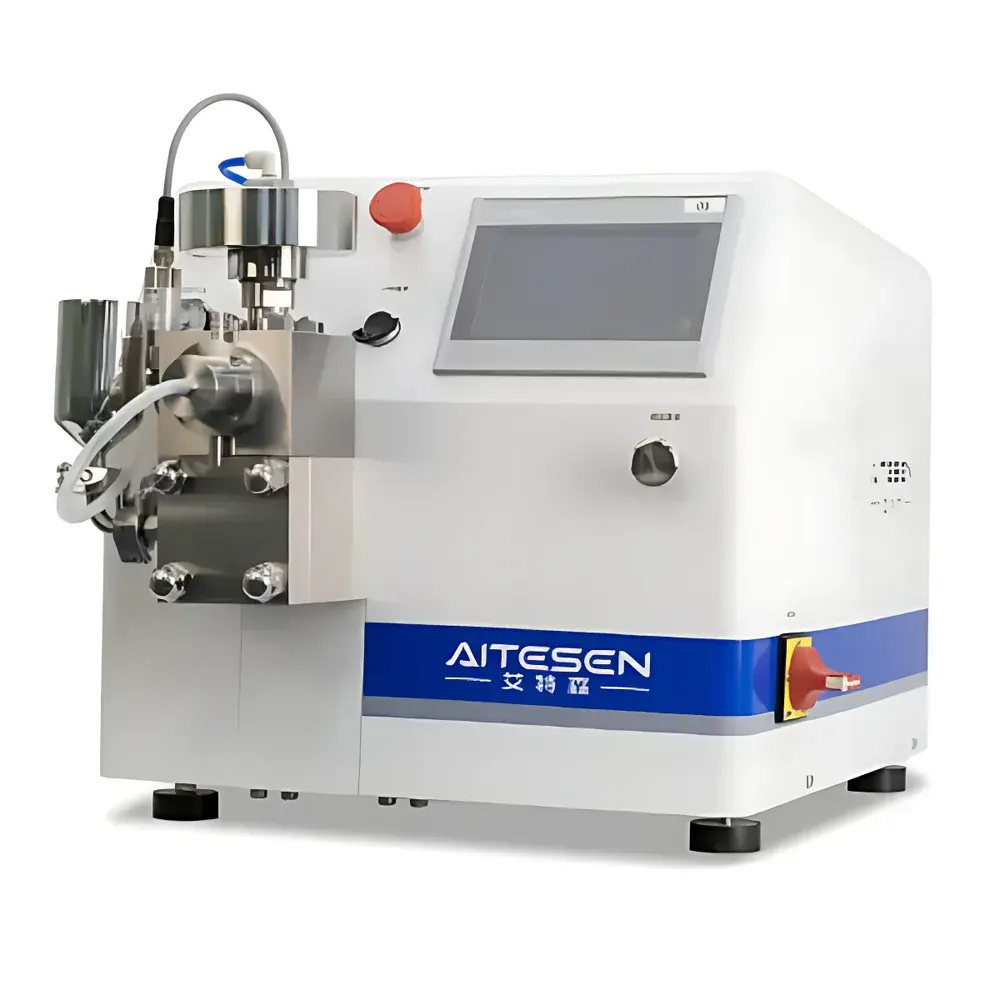
Aitesen HPH-L2 Laboratory-Scale High-Pressure Homogenizer
| Brand | Aitesen |
|---|---|
| Origin | Jiangsu, China |
| Model | HPH-L2 |
| Instrument Type | High-Pressure Homogenizer |
| Dimensions (W×D×H) | 545 × 755 × 494 mm |
| Maximum Pressure | 2000 bar |
| Maximum Feed Particle Size | 500 µm |
| Flow Rate | 5–15 L/h |
| Minimum Sample Volume | 15 mL |
| Noise Level | 65 dB(A) |
| Power Rating | 1.5 kW |
| Material of Wetted Parts | SAF2507 Super Duplex Stainless Steel |
| Compliance | Manufactured per EU Machinery Directive 98/37/EC (MD) |
Overview
The Aitesen HPH-L2 is a laboratory-scale high-pressure homogenizer engineered for reproducible, scalable cell disruption, nanoemulsion formation, and submicron particle size reduction under controlled, GMP-aligned conditions. It operates on the principle of high-shear cavitation and turbulent impact: pressurized sample slurry is forced through a precisely engineered homogenization valve—typically a fixed-geometry or adjustable geometry orifice—where rapid pressure drop induces intense hydrodynamic shear, microturbulence, and inertial cavitation. This physical mechanism enables consistent lysis of microbial cells (e.g., E. coli, yeast), uniform lipid nanoparticle (LNP) formation for mRNA delivery, and stable fat emulsification without thermal degradation or chemical additives. Designed for benchtop deployment in R&D laboratories and pilot-scale process development, the HPH-L2 bridges the gap between analytical-scale preparation and early-stage manufacturing, supporting technology transfer to industrial-grade homogenizers (e.g., HPH-L3 or production-scale units). Its modular architecture allows integration into closed-loop processing trains compliant with ISO 13485 and FDA 21 CFR Part 11 data integrity requirements when paired with optional PLC control and audit-trail-enabled software.
Key Features
- Robust wetted-path construction using SAF2507 super duplex stainless steel—resistant to chloride-induced stress corrosion cracking and compatible with aggressive biological buffers, organic solvents, and high-pH formulations.
- Modular, service-friendly pump head design with quick-release clamping—facilitates routine maintenance, sterilization validation, and material-of-construction verification per USP General Chapter <1058>.
- Manually adjustable homogenization valve with calibrated pressure handwheel—enabling precise, repeatable pressure setpoints from 500 to 2000 bar with ±5 bar repeatability across operational cycles.
- Integrated touchscreen HMI with real-time pressure logging, cycle counting, and timestamped event recording—data exportable via USB or Ethernet in CSV format for GLP-compliant documentation.
- Dual-mode pressure actuation: manual fine-tuning and optional pneumatic assist—ensuring stable pressure hold during extended homogenization runs (e.g., multi-pass LNP extrusion).
- Configurable safety interlocks including overpressure cut-off, temperature monitoring (optional), and door-open emergency shutdown—certified per EN ISO 13857 and EN 60204-1.
Sample Compatibility & Compliance
The HPH-L2 accommodates aqueous suspensions, oil-in-water emulsions, viscous biopolymer solutions (e.g., chitosan, hyaluronic acid), and low-to-medium viscosity organic phases used in LNP formulation. It accepts feed particles up to 500 µm—suitable for crude lysates, pre-filtered cell pastes, and micronized API dispersions. All fluid-contact components meet USP Class VI biocompatibility standards. The system supports steam-in-place (SIP) and clean-in-place (CIP) protocols when equipped with sanitary tri-clamp fittings and autoclavable valve assemblies. Manufacturing adheres to the EU Machinery Directive 98/37/EC (MD), with CE marking applied following risk assessment per EN ISO 12100. Optional IQ/OQ documentation packages are available for GxP environments requiring formal qualification against ASTM E2500 and ICH Q5A/Q5D.
Software & Data Management
The embedded controller logs pressure, runtime, and cycle count with millisecond-resolution timestamps. Exported datasets include raw pressure traces, cumulative energy input estimates (based on flow rate and pressure differential), and operator ID tags—supporting traceability in regulated workflows. When integrated with the optional PLC control module, the system generates electronic records compliant with FDA 21 CFR Part 11: digital signatures, audit trails, and role-based access control (RBAC) are implemented. Data files conform to ASTM E1462-22 (Standard Practice for Electronic Record Retention) and may be ingested directly into LIMS or ELN platforms via OPC UA or Modbus TCP interfaces.
Applications
- Biopharmaceutical development: bacterial and yeast cell disruption for recombinant protein recovery; LNP encapsulation of mRNA, siRNA, and CRISPR-Cas ribonucleoproteins.
- Parenteral formulation: production of sterile fat emulsions (e.g., propofol analogs), liposomal doxorubicin precursors, and nanosuspensions of BCS Class II/IV drugs.
- Functional food & nutraceuticals: nanoemulsification of omega-3 oils, curcumin, and polyphenols to enhance oral bioavailability.
- Advanced materials: exfoliation of graphene oxide, dispersion of carbon nanotubes in polymer matrices, and stabilization of cellulose nanocrystals.
- Process intensification: multi-pass homogenization for narrow PDI control (D90/D10 ≤ 1.8) in lipid nanoparticle batches intended for clinical trial supply.
FAQ
What is the minimum viable sample volume for method development studies?
The HPH-L2 supports reliable processing down to 15 mL total volume—ideal for screening formulation variables prior to scale-up. For ultra-low-volume optimization, an optional mini-adapter kit reduces dead volume to <8 mL.
Can the system be validated for use in GMP manufacturing environments?
Yes—when configured with PLC control, electronic batch records, and full audit trail functionality, the HPH-L2 meets baseline requirements for Phase I–II clinical manufacturing per ICH Q7 and Annex 15. Qualification support documentation (DQ/IQ/OQ) is available upon request.
Is the homogenization valve interchangeable with industrial-scale Aitesen models?
Valve geometries are platform-specific; however, the HPH-L2 uses the same core valve design principles and material specifications as the HPH-L3 and production series, enabling direct correlation of pressure–particle size relationships across scales.
How is temperature managed during extended homogenization cycles?
The base model relies on passive cooling via heat exchange through the stainless-steel housing. For thermally sensitive payloads (e.g., mRNA-LNPs), the optional jacketed inlet/outlet manifold and recirculating chiller interface maintain sample temperature within ±2°C over 30-minute continuous operation.



