
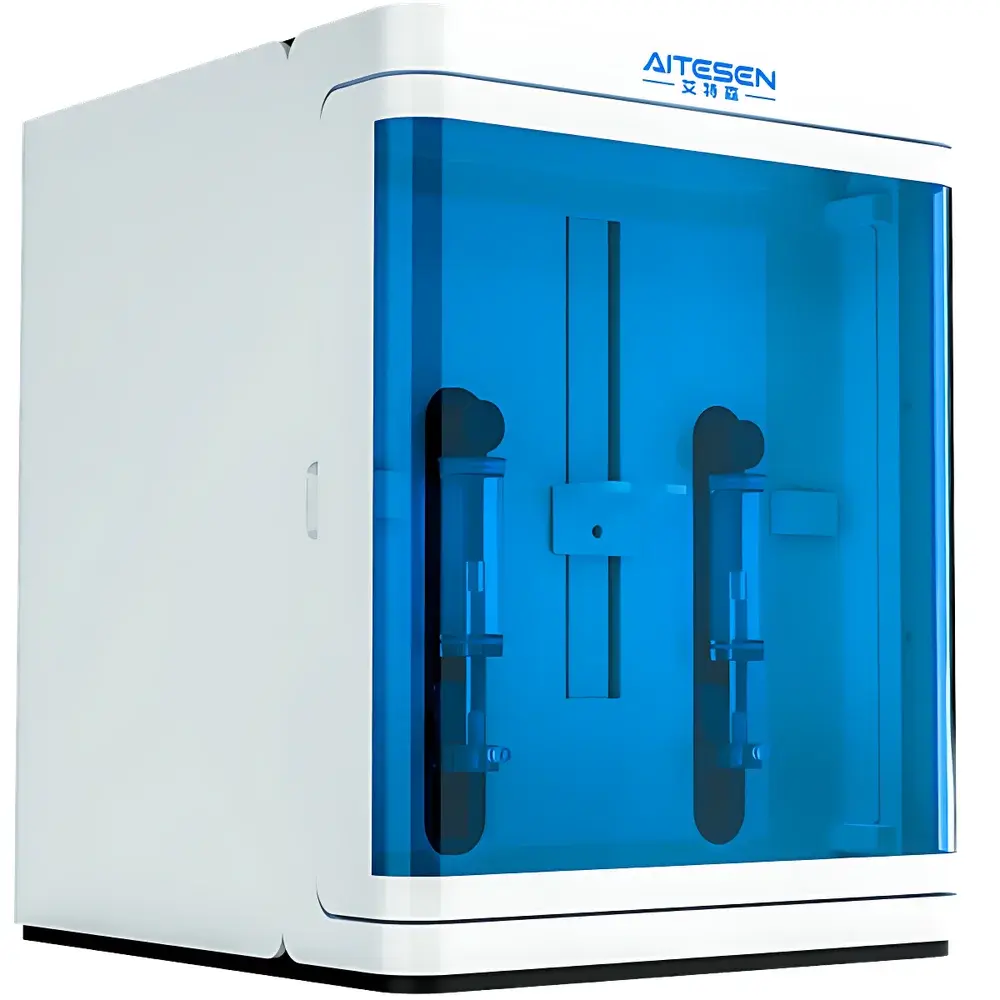
Aitesen MPE-L2 Microfluidic Nanomedicine Preparation System for Lipid Nanoparticle (LNP) Formulation
| Brand | Aitesen |
|---|---|
| Origin | Jiangsu, China |
| Manufacturer Type | Authorized Distributor |
| Product Category | Domestic |
| Model | MPE-L2 |
| Pricing | Available Upon Request |
| Payload Carrier Type | Lipid Nanoparticle (LNP) |
Overview
The Aitesen MPE-L2 Microfluidic Nanomedicine Preparation System is an engineered platform designed for precise, scalable, and reproducible formulation of lipid nanoparticles (LNPs) and other nanocarrier-based therapeutics. It operates on the principle of hydrodynamic focusing and controlled turbulent mixing within microstructured fluidic channels, enabling rapid, single-step nanoprecipitation or double-emulsion formation under fully defined laminar-to-turbulent transition regimes. Unlike conventional bulk mixing methods—such as probe sonication or thin-film hydration—the MPE-L2 implements continuous-flow microfluidics to decouple mixing kinetics from thermal and shear history, thereby minimizing batch-to-batch variability and supporting Quality-by-Design (QbD) workflows. The system is purpose-built for early-stage process development, formulation screening, and Phase I/II clinical material generation, with intrinsic compatibility for GMP-aligned scale-up pathways via chip-based process transfer.
Key Features
- Modular dual-syringe pump architecture delivering independent, programmable flow rates for phase A (aqueous nucleation solution) and phase B (organic lipid solution), with resolution down to 0.1 µL/min and long-term stability <±0.5% CV over 60 min.
- In-line high-pressure microfluidic chip integration (up to 20,000 psi operating pressure) enabling post-mixing homogenization via impingement jetting and controlled shear stress exposure for precise particle size modulation.
- Real-time operational flexibility: supports sequential multi-injection without chip disassembly—critical for iterative DoE studies and gradient-based formulation mapping.
- Chip-mounting interface compliant with ISO 80369-7 luer-lock standards; accommodates interchangeable, application-specific microfluidic chips fabricated in medical-grade cyclic olefin copolymer (COC) or fused silica.
- Integrated temperature stabilization module (±0.3 °C control range, 4–40 °C operating window) for thermosensitive payloads including mRNA, siRNA, and plasmid DNA.
- Compact benchtop footprint (W×D×H: 320 × 450 × 280 mm) with CE-marked electrical safety and IP20 enclosure rating.
Sample Compatibility & Compliance
The MPE-L2 is validated for use with standard LNP formulation components including ionizable lipids (e.g., DLin-MC3-DMA, SM-102), phospholipids (DSPC), cholesterol, and PEG-lipids across concentration ranges typical of preclinical development (0.5–10 mg/mL total lipid). It supports aqueous phases containing buffered saline, citrate, or Tris-HCl at pH 3.0–7.4, and organic phases comprising ethanol, isopropanol, or tert-butanol. All wetted materials comply with USP Class VI biocompatibility requirements. While not certified for GMP manufacturing, the system’s design aligns with FDA Guidance for Industry on Process Validation (2011) and ICH Q5A(R2) for viral vector and nucleic acid product development. Data logging capabilities support ALCOA+ principles when paired with validated third-party software.
Software & Data Management
The MPE-L2 operates via a Windows-based control interface featuring deterministic real-time scheduling of flow profiles, pressure ramping, and temperature setpoints. All operational parameters—including volumetric flow rates, backpressure readings, elapsed time, and chip temperature—are timestamped and exported in CSV format with millisecond-level resolution. Audit trails are enabled by default and meet the minimum technical requirements for 21 CFR Part 11 compliance when deployed with electronic signature-enabled enterprise software (e.g., LabArchives ELN or Thermo Fisher SampleManager LIMS). No cloud connectivity or remote telemetry is embedded; data residency remains fully local unless explicitly configured by the user.
Applications
- Rapid screening of LNP composition ratios (e.g., lipid:mRNA molar ratio, PEG density, cholesterol content) under constant mixing Reynolds number (Re = 50–500).
- Generation of uniform polyplexes and polymer-based nanoparticles (PLGA, PEI) requiring narrow PDI (<0.12) and sub-120 nm modal diameter.
- Process analytical technology (PAT)-enabled development: integration with inline DLS (e.g., Spectradyne nCS1) or UV-Vis spectrophotometry for real-time particle sizing and encapsulation efficiency estimation.
- Preparation of multilamellar or Janus-type nanoparticles via staged secondary emulsification using cascaded chip configurations.
- Supporting regulatory submissions: provides traceable, parameter-controlled documentation for IND-enabling CMC sections per ICH M4Q(R2).
FAQ
What is the minimum sample volume required per formulation run?
Typical operation uses 200–500 µL total volume (phase A + phase B), with full recovery achievable using low-dead-volume tubing and chip designs optimized for <10 µL residual hold-up.
Can the MPE-L2 be used for sterile processing?
The system itself is not aseptic; however, it supports integration with Grade A laminar flow hoods and sterilizable chip cartridges (autoclavable COC chips available upon request).
Is chip customization supported for non-standard formulations?
Yes—Aitesen offers collaborative chip design services based on client-defined mixing geometry, residence time targets, and shear rate specifications, with lead times of 4–6 weeks.
Does the system support automated cleaning-in-place (CIP)?
No dedicated CIP module is included, but the fluidic path is fully flushable with ethanol/water gradients and compatible with validated cleaning protocols per ASTM E3106-18.
How does the MPE-L2 compare to T-junction or staggered herringbone mixer platforms?
Unlike passive mixers relying solely on diffusion, the MPE-L2 employs active pressure-driven turbulence induction, achieving mixing times <5 ms and superior control over nucleation onset—critical for mRNA-LNP batch consistency.



