
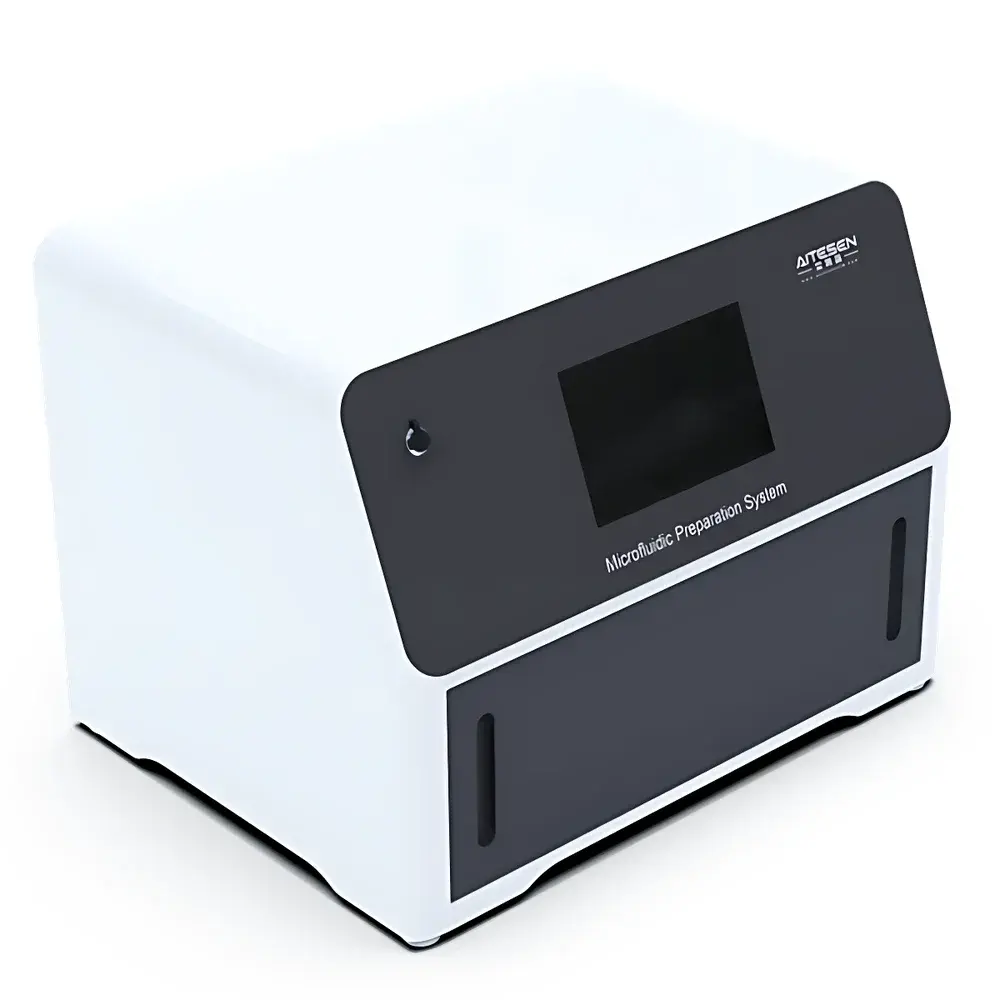
Aitesen MPE-P1 GMP-Compliant Microfluidic Nanomedicine Preparation System
| Brand | Aitesen |
|---|---|
| Origin | Jiangsu, China |
| Model | MPE-P1 |
| Application | Lipid Nanoparticle (LNP), Liposome, Polymeric Nanoparticle, Emulsion, and Inorganic Nanoparticle Preparation |
| Carrier Type | LNP |
| Regulatory Designation | GMP-Ready Process Development System |
| Control Interface | Integrated Touchscreen with Batch Record & Data Export Capability |
| Scalability | Pilot-Scale Continuous Manufacturing Platform |
| Particle Size Range | Down to <100 nm |
| Polydispersity Index (PDI) | <0.1 |
| Fluid Handling | Dual-Phase Precision Pumping (Phase A + Phase B) |
| Chip-Based Processing | Customizable Microchannel Architecture for Emulsification, Incubation, Size Control, and Secondary Processing |
| Compliance Framework | Engineered for alignment with FDA 21 CFR Part 11, ISO 13485, and ICH Q5A/Q5D principles |
Overview
The Aitesen MPE-P1 is a pilot-scale, GMP-aligned microfluidic preparation system engineered for the reproducible, continuous manufacturing of nanoscale drug delivery systems. It operates on the principle of controlled hydrodynamic focusing and interfacial shear within precision-machined microchannels—leveraging laminar-to-turbulent transition regimes to govern nucleation, self-assembly, and particle stabilization in real time. Unlike batch-based bulk mixing methods, the MPE-P1 implements a fully integrated process analytical technology (PAT)-enabled workflow, where fluid dynamics, residence time, pressure differentials, and phase ratio are maintained as deterministic, logged parameters throughout operation. This architecture ensures thermodynamic and kinetic consistency across runs—critical for establishing quality-by-design (QbD) frameworks in regulatory submissions for lipid nanoparticles (LNPs), liposomes, polymeric micelles, and emulsion-based vaccine adjuvants.
Key Features
- GMP-ready mechanical and software architecture, including audit-trail-enabled touchscreen HMI with electronic batch record (EBR) generation
- Dual independent high-precision syringe pumps supporting flow rates from 0.01 to 50 mL/min per channel, with programmable gradient profiles for phase introduction
- Modular microfluidic chip interface accommodating custom chip geometries—optimized for initial emulsification, post-formation incubation, size refinement via impingement or shear, and secondary homogenization
- On-board pressure monitoring (up to 200 MPa) and real-time flow synchronization to maintain stoichiometric fidelity during co-injection of aqueous and organic phases
- Integrated temperature control module (±0.5°C stability) for thermal-sensitive formulations such as mRNA-LNPs and thermolabile small-molecule encapsulates
- Export-capable data logging compliant with ALCOA+ principles: attributable, legible, contemporaneous, original, accurate, complete, consistent, enduring, and available
Sample Compatibility & Compliance
The MPE-P1 supports formulation development across six primary nanoparticle classes: (1) ionizable lipid-based LNPs for nucleic acid delivery (e.g., mRNA, siRNA, saRNA); (2) phospholipid/cholesterol-based liposomes for chemotherapeutics (e.g., doxorubicin, irinotecan); (3) biodegradable polymeric nanoparticles (e.g., PLGA, PEG-PLGA); (4) oil-in-water and water-in-oil emulsions for adjuvant or parenteral nutrition applications; (5) inorganic colloids (e.g., gold, iron oxide, silica); and (6) hybrid organic–inorganic constructs. All processing pathways are designed to meet current Good Manufacturing Practice (cGMP) expectations for early-phase clinical material production. The system’s architecture aligns with ICH Q5A (viral safety), Q5D (cell substrate characterization), and Q8(R3) (pharmaceutical development) guidance. Data integrity protocols conform to FDA 21 CFR Part 11 requirements for electronic records and signatures, while hardware design follows ISO 13485:2016 principles for medical device-related process equipment.
Software & Data Management
The embedded control software provides closed-loop parameter management—including pump speed, pressure setpoints, temperature setpoints, and run duration—with automatic timestamped logging at 100 ms intervals. Each batch generates a structured .csv and PDF report containing raw sensor outputs, operator annotations, chip identification metadata, and deviation flags (if any). Exported datasets are compatible with statistical process control (SPC) platforms and qualify for inclusion in regulatory CMC sections. Audit trails capture user login/logout events, parameter changes, and file export actions—retained for minimum 15 years per internal retention policy. Optional integration with laboratory information management systems (LIMS) and MES via OPC UA or RESTful API is supported for enterprise-level traceability.
Applications
The MPE-P1 serves as a bridge between benchtop discovery and commercial-scale manufacturing. It is routinely deployed in: (1) formulation screening of LNP excipient ratios under controlled shear stress; (2) optimization of liposome membrane fluidity and encapsulation efficiency via residence time modulation; (3) generation of narrow-distribution PLGA microparticles with tunable degradation kinetics; (4) scalable synthesis of squalene-based adjuvant emulsions meeting EP/USP monograph criteria; (5) rapid prototyping of gold nanoparticle conjugates for theranostic applications; and (6) DOE-driven studies correlating microchannel Reynolds number with final PDI and encapsulation yield. Its continuous-flow nature enables direct translation to industrial microfluidic platforms—reducing scale-up risk and accelerating IND-enabling toxicology batch production.
FAQ
Is the MPE-P1 suitable for sterile processing?
Yes—when paired with pre-sterilized, single-use microfluidic chips and validated aseptic connection kits, the system supports Grade A environments under ISO 14644-1 Class 5 conditions.
Can it be used for GMP manufacturing of clinical trial materials?
It is qualified for Phase I/II clinical supply when operated within a validated environment and documented per ICH GCP and Annex 15 requirements.
What microfluidic chip formats are supported?
Standard chip interfaces accommodate glass, silicon, and polymer-based chips with SU-8, PDMS, or cyclo-olefin copolymer (COC) construction—custom designs undergo mechanical and fluidic validation prior to deployment.
Does the system support PAT integration with inline DLS or UV-Vis?
Yes—via standardized ¼″ tubing ports and analog/digital I/O, enabling third-party sensor coupling for real-time particle size or concentration monitoring.
What regulatory documentation is provided with the system?
Includes Factory Acceptance Test (FAT) report, Installation Qualification (IQ) templates, Operational Qualification (OQ) test scripts, and a full Design History File (DHF) summary per ISO 13485.




