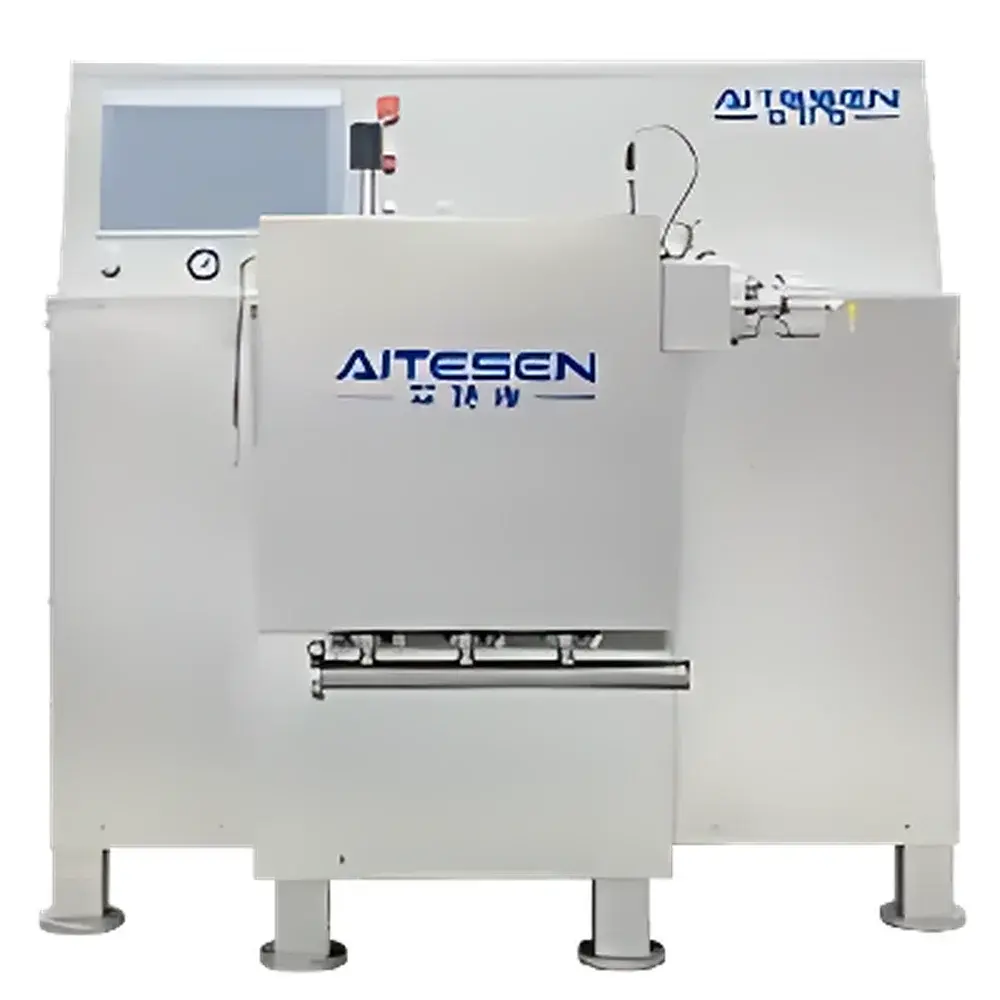
Aitesen HPH-P1 High-Pressure Homogenizer
| Brand | Aitesen |
|---|---|
| Origin | Jiangsu, China |
| Model | HPH-P1 |
| Construction | Modular pump head |
| Wetted materials | SAF2507 super duplex stainless steel |
| Homogenization valve | High-efficiency, safety-engineered |
| Pressure regulation | Manual handwheel + optional pneumatic actuation |
| Drive system | Stable, continuous-duty motor |
| Control interface | Touchscreen panel with real-time pressure monitoring, data logging, export capability (CSV), and programmable safety pressure limits |
| Optional modules | Variable-frequency flow control, automated pressurization, PLC-based automation, jacketed temperature control, multi-stage homogenization, closed-loop recirculation, and integrated sample preconditioning |
| Flow rate range | 80–2000 L/h |
| Maximum operating pressure | 1500 bar (standard configurations) |
| Application scope | Cell disruption (E. coli, yeast, mammalian cells), liposome & LNP formulation, fat emulsion processing, nanostructured material dispersion (CNTs, graphene, nanocellulose), sterile pharmaceutical final fill support |
Overview
The Aitesen HPH-P1 is a high-pressure homogenizer engineered for reproducible, scalable mechanical cell disruption and nano-scale particle size reduction in regulated life science and pharmaceutical manufacturing environments. It operates on the principle of controlled fluid shear, cavitation, and impact—generated by forcing suspension through a precisely engineered homogenization valve at pressures up to 1500 bar. This enables consistent lysis of robust microbial cells (e.g., Escherichia coli, Saccharomyces cerevisiae) and efficient formation of sub-100 nm lipid nanoparticles (LNPs), liposomes, and stable oil-in-water emulsions. Designed with modular architecture and full wet-path compatibility with SAF2507 super duplex stainless steel, the HPH-P1 meets stringent requirements for cleanability, corrosion resistance, and long-term operational stability under repeated sterilization cycles (CIP/SIP). Its pressure delivery system maintains ±1.5% linearity across the full operating range, supporting process validation per ICH Q5A and Q5B guidelines.
Key Features
- Modular pump head assembly for rapid maintenance and validated cleaning protocols
- SAF2507 wetted surfaces—resistant to chloride-induced stress corrosion cracking and compatible with aggressive buffers, organic solvents, and alkaline CIP agents
- Patented dual-stage homogenization valve with adjustable geometry for tunable shear intensity and minimal heat generation
- Touchscreen HMI with real-time pressure waveform visualization, event logging, and timestamped audit trail (21 CFR Part 11–ready when paired with optional PLC module)
- Manual pressure handwheel with calibrated scale + optional pneumatic or servo-driven pressure actuation for GMP-compliant recipe execution
- Integrated thermal management interface supporting external chiller integration (−5°C to 40°C operating range)
- Flow rate scalability from 80 L/h (pilot) to 2000 L/h (production), with pressure retention stability verified per ISO 5199
Sample Compatibility & Compliance
The HPH-P1 accommodates aqueous, viscous, and low-surface-tension formulations—including bacterial lysates, lipid dispersions, polymer suspensions, and nanoparticle precursors—with inlet viscosity tolerance up to 5000 cP. It supports both single-pass and closed-loop recirculation modes, enabling precise control over cumulative energy input (kWh/L). All contact parts comply with USP Class VI biocompatibility testing; surface finish Ra ≤ 0.4 µm (electropolished). The system conforms to CE Machinery Directive 2006/42/EC, PED 2014/68/EU for pressure equipment, and ISO 13485:2016 when deployed in medical device manufacturing. Documentation packages include DQ/IQ/OQ templates, FAT/SAT reports, and material traceability dossiers.
Software & Data Management
The embedded control firmware records pressure, flow, temperature, and runtime parameters at 10 Hz resolution, storing >10,000 batch records locally. Data export is supported via USB and Ethernet (Modbus TCP), with CSV output structured for direct import into LIMS or MES platforms. Optional PLC integration enables full recipe management, electronic signature capture, and ALCOA+ compliant audit trails—including user action logs, parameter change history, and alarm acknowledgment timestamps. Firmware updates are digitally signed and validated prior to installation, satisfying FDA expectations for software lifecycle control.
Applications
- Biopharmaceutical upstream processing: Gram-negative and gram-positive bacterial lysis, inclusion body recovery, yeast spheroplast disruption
- mRNA-LNP development: Scalable formulation of ionizable lipid nanoparticles meeting EMA/FDA quality attributes (PDI < 0.12, encapsulation efficiency > 90%)
- Parenteral nutrition & drug delivery: Sterile-grade fat emulsions (e.g., Intralipid® analogues), sustained-release microsphere suspensions
- Nanomaterial synthesis: Exfoliation of graphene oxide, dispersion of carbon nanotubes, stabilization of nanocellulose gels
- Cosmeceutical R&D: Submicron emulsions for transdermal delivery, phospholipid vesicle systems for active ingredient encapsulation
FAQ
What is the maximum allowable inlet particle size for reliable operation?
Particles exceeding 200 µm diameter require pre-filtration via 200 µm mesh or inline degassing to prevent valve clogging.
Can the HPH-P1 be validated for sterile manufacturing under cGMP?
Yes—when equipped with SIP-capable valves, electropolished tubing, and validated cleaning cycle parameters, it supports Annex 1 and PIC/S TR 79 compliance.
Is remote monitoring supported out-of-the-box?
Standard Ethernet connectivity enables SCADA integration; remote diagnostics require optional secure VPN gateway configuration.
How is temperature rise during homogenization managed?
Jacketed homogenizer blocks and external chillers maintain sample temperature within ±2°C of setpoint during continuous operation.
Does the system support multi-step pressure ramping for sensitive formulations?
Yes—the touchscreen interface allows up to 5 programmable pressure segments per cycle, with dwell time and ramp rate control.