
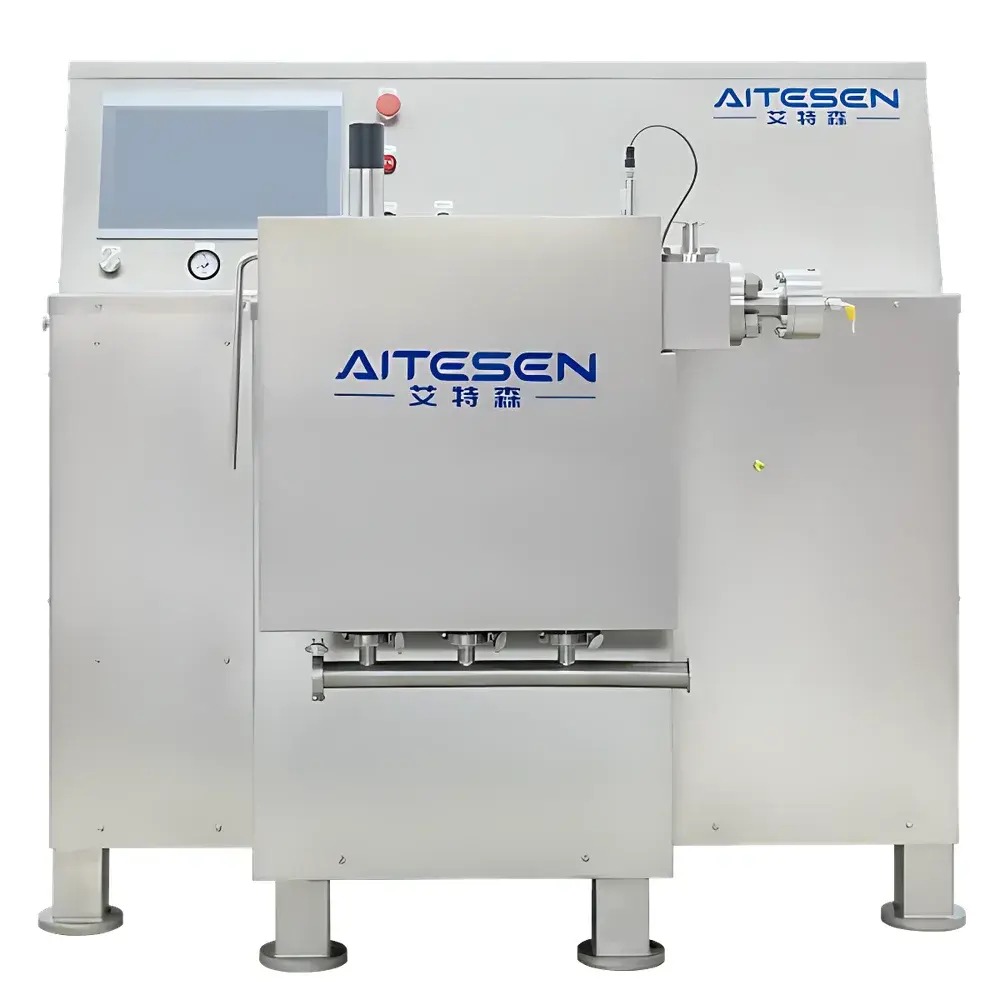
Aitesen HPH-P Series Production-Scale High-Pressure Homogenizer
| Brand | Aitesen |
|---|---|
| Origin | Jiangsu, China |
| Instrument Type | High-Pressure Homogenizer |
| Structural Design | Modular Pump Head |
| Valve Material | SAF2507 Super Duplex Stainless Steel |
| Pressure Regulation | Manual & Pneumatic |
| Control Interface | Touchscreen Panel |
| Data Logging | Real-Time Pressure Monitoring & Exportable Records |
| Safety Features | Adjustable Pressure Limit with Audible/Visual Alarm |
| Optional Modules | Variable-Frequency Flow Control, Automated Pressurization, PLC Integration, Temperature Control, Multi-Stage Homogenization, Closed-Loop Circulation, Pre-Processing Unit |
| Flow Rate Range | 80–2000 L/h |
| Maximum Operating Pressure | 1500 bar (standard), 1000 bar (high-flow configurations) |
| Compliance | Designed for GMP-aligned process development and scale-up per ISO 22411, ASTM E2456, and USP <1119> guidelines |
Overview
The Aitesen HPH-P Series Production-Scale High-Pressure Homogenizer is an engineered solution for continuous, scalable microfluidization under precisely controlled high-pressure conditions. Based on the principle of turbulent shear, cavitation, and impact forces generated by forcing suspensions or emulsions through a narrow, geometrically optimized homogenization valve at pressures up to 1500 bar, the system achieves consistent particle size reduction, cell lysis, and nanoemulsion formation across batch and continuous operation modes. Unlike laboratory-scale counterparts, the HPH-P series integrates industrial-grade mechanical architecture—including a modular pump head assembly fabricated from SAF2507 super duplex stainless steel—to ensure corrosion resistance, pressure integrity, and long-term operational stability in demanding biopharmaceutical and advanced material manufacturing environments.
Key Features
- Modular pump head design enables rapid maintenance, valve replacement, and configuration flexibility for varying process demands.
- SAF2507 valve and fluid path components provide exceptional resistance to chloride-induced stress corrosion cracking—critical for saline-based formulations and aggressive solvents used in LNP and liposome processing.
- Real-time pressure monitoring with touchscreen interface supports dynamic adjustment via manual or pneumatic regulation; all pressure events are timestamped and exportable in CSV format for audit trails.
- Configurable safety envelope includes user-defined maximum pressure limits with dual-stage audible and visual alarms to prevent over-pressurization during start-up or transient flow conditions.
- Robust drive system delivers stable torque output across full flow range (80–2000 L/h), minimizing pulsation and ensuring uniform energy input per unit volume.
- Factory-integrated mounting points and standardized flange interfaces simplify integration into existing cleanroom utilities (CIP/SIP lines, buffer distribution, temperature-controlled jackets).
Sample Compatibility & Compliance
The HPH-P series accommodates aqueous, organic, and mixed-phase systems including viscous drug suspensions (e.g., nanocrystal dispersions), lipid-based formulations (LNP, liposomes, fat emulsions), microbial lysates (E. coli, yeast), and nanomaterial dispersions (graphene oxide, cellulose nanocrystals). All wetted surfaces comply with USP Class VI biocompatibility requirements. The system supports validation protocols aligned with FDA 21 CFR Part 11 for electronic records and signatures when paired with optional PLC control and audit-trail-enabled software. Design adheres to ISO 22411 (particle size analysis instrumentation) and ASTM E2456 (homogenizer performance characterization), facilitating regulatory submission readiness for Phase II–III clinical manufacturing and commercial production.
Software & Data Management
Standard firmware provides local data logging of pressure, runtime, and cycle count with USB export capability. Optional PLC-integrated control adds Ethernet/IP or Modbus TCP connectivity for SCADA-level supervision, recipe management, and automated batch reporting. All pressure and operational logs include mandatory metadata (operator ID, timestamp, system state), satisfying GLP/GMP documentation requirements. When configured with validated software modules, the system supports electronic signature workflows and secure user access levels (admin/operator/auditor) compliant with Annex 11 and ALCOA+ data integrity principles.
Applications
- Biopharmaceutical: Gram-scale bacterial/yeast cell disruption for recombinant protein recovery; preparation of mRNA-LNP complexes with narrow PDI (90%.
- Drug Product Development: Terminal sterilization-compatible fat emulsions (e.g., propofol analogs); nanostructured lipid carriers (NLCs); sustained-release microsphere suspensions.
- Food & Nutraceuticals: Cold-processed fruit juice stabilization; nanoemulsified vitamins; allergen-reduced dairy matrices via controlled casein fragmentation.
- Advanced Materials: Exfoliation of 2D materials (graphene, MoS₂); dispersion of carbon nanotubes without surfactant overload; fabrication of ceramic nanoparticle inks for additive manufacturing.
- Integrated Platforms: Coupled with tangential flow filtration (TFF), extrusion, or lyophilization modules for end-to-end nanomedicine process lines.
FAQ
What is the maximum allowable operating temperature for continuous processing?
The standard configuration supports inlet temperatures up to 60 °C; optional jacketed homogenization cells extend this to 120 °C for thermally activated formulations.
Can the HPH-P series be qualified for sterile manufacturing?
Yes—when equipped with SIP-capable valves, electropolished fluid paths, and integrated steam tracing, it meets ASME BPE-2023 surface finish and drainability criteria for aseptic processing.
Is third-party IQ/OQ/PQ documentation available?
Aitesen provides vendor-supported qualification templates aligned with ISO 13485 and ICH Q5C, including test protocols for pressure accuracy (±1.5% FS), flow repeatability (RSD <2%), and valve wear assessment.
How does multi-stage homogenization improve formulation consistency?
Sequential pressure zones allow staged energy input—first stage for coarse disruption, second for fine-size narrowing—reducing thermal load and improving batch-to-batch reproducibility in sensitive biologics.
What certifications apply to the electrical and mechanical safety design?
The system complies with CE marking per Machinery Directive 2006/42/EC and Low Voltage Directive 2014/35/EU; IP55-rated enclosures meet NEMA 12 requirements for pharmaceutical utility corridors.



