
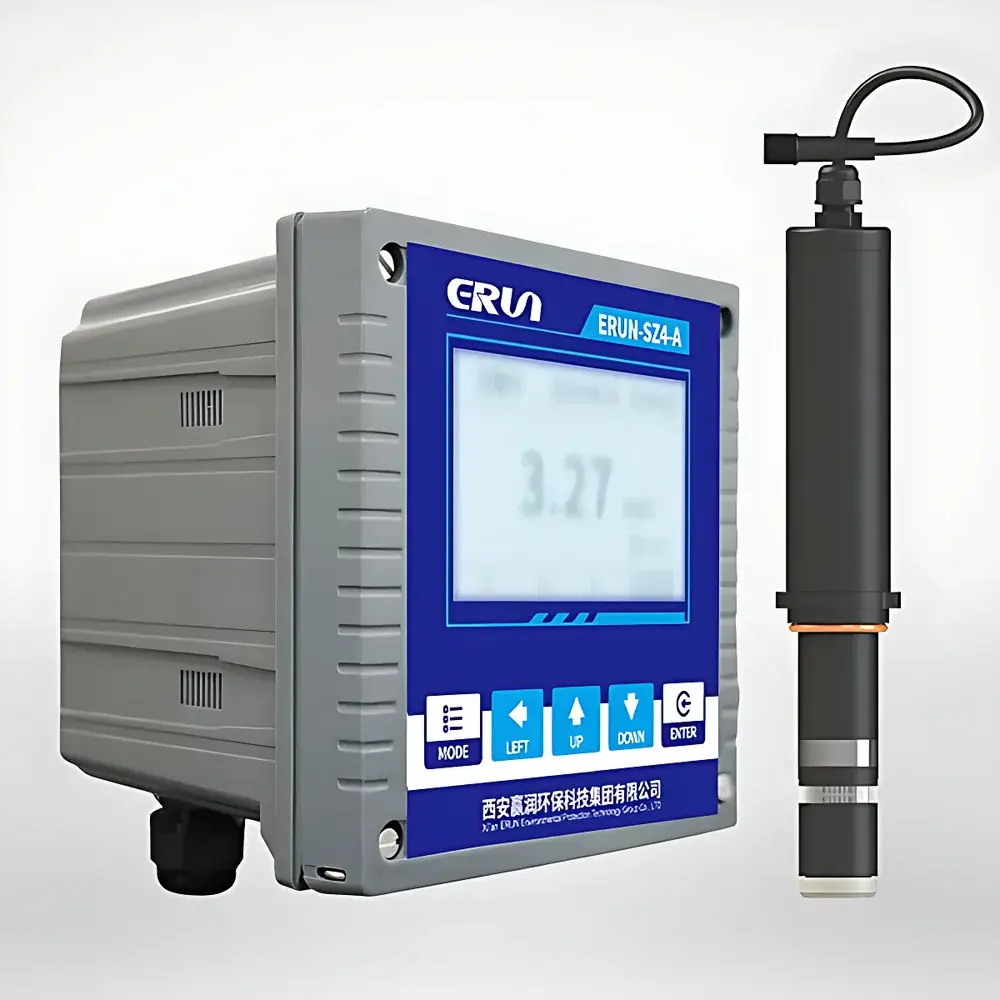
ERUN-SZ4-K4 Online Chlorine Dioxide Analyzer
| Brand | ERUN |
|---|---|
| Origin | Shaanxi, China |
| Model | ERUN-SZ4-K4 |
| Instrument Type | Online Analyzer |
| Measured Parameter | Chlorine Dioxide (ClO₂) |
| Measurement Range | 0–5 mg/L and 0–20 mg/L (dual-range) |
| Accuracy | ±3% of reading |
| Repeatability | ±3% |
| Resolution | 0.001 mg/L |
| Limit of Detection | 0.030 mg/L |
| Response Time (T90) | ≤90 s |
| Measurement Principle | Amperometric Electrochemical Detection (Three-Electrode System with Membrane-Covered Gold Working Electrode) |
| Temperature Range | −5 to 60 °C |
| Temp. Accuracy | ±0.4 °C |
| Temp. Resolution | 0.1 °C |
| Operating Voltage | DC 9–28 V |
| Power Consumption | ≤0.5 W (peak) |
| Output Options | RS485 (Modbus RTU), 4–20 mA (optional) |
| Enclosure Rating | IP68 |
| Pressure Rating | <0.1 MPa |
Overview
The ERUN-SZ4-K4 Online Chlorine Dioxide Analyzer is a dedicated electrochemical monitoring instrument engineered for continuous, real-time quantification of aqueous chlorine dioxide (ClO₂) in potable water distribution systems, wastewater disinfection processes, and industrial process streams. It employs a membrane-covered, amperometric three-electrode sensor architecture—featuring a high-purity gold working electrode, silver/silver chloride reference electrode, and platinum counter electrode—operating under controlled potentiostatic conditions. The sensor applies a fixed bias potential to drive the selective electrochemical oxidation of ClO₂ at the working electrode surface; the resulting Faradaic current is linearly proportional to analyte concentration per Faraday’s law. This principle ensures reagent-free, low-maintenance operation with minimal drift and high specificity in complex matrices containing residual chlorine, chloramines, or ozone—provided interferences are mitigated via selective membrane permeability and optimized operating potential.
Key Features
- Reagent-free amperometric detection eliminates chemical consumption, waste generation, and associated handling hazards—supporting sustainable operational compliance.
- Membrane-covered gold working electrode provides robust fouling resistance and extended service life in turbid or particulate-laden water samples.
- Integrated potentiostat maintains precise electrode potential stability, ensuring consistent sensitivity and minimizing zero-point drift over time.
- Dual-range measurement capability (0–5 mg/L and 0–20 mg/L) enables flexible deployment across low-dose municipal applications and high-concentration industrial dosing control points.
- High-resolution analog-to-digital conversion delivers 0.001 mg/L resolution and supports trace-level process monitoring with documented reproducibility (±3% RSD).
- IP68-rated housing and flow-through cell design allow direct insertion into pressurized pipelines (<0.1 MPa) or open-channel bypass manifolds without external enclosures.
Sample Compatibility & Compliance
The ERUN-SZ4-K4 is validated for use in clarified drinking water, filtered wastewater effluent, cooling tower make-up, and food-grade process water. Its electrochemical selectivity—enhanced by hydrophobic membrane diffusion barriers and optimized electrode polarization—minimizes cross-sensitivity to free chlorine (HOCl/OCl⁻), monochloramine, and dissolved oxygen when operated within specified pH (6.0–8.5) and temperature ranges. While not certified to ISO 9001 or ISO/IEC 17025 by default, the analyzer’s performance metrics align with method validation expectations outlined in ASTM D6503 (Standard Guide for On-Line Monitoring of Disinfectants in Water) and EPA Method 334.0 (for chlorine-based oxidants). Data integrity is supported through timestamped digital output (Modbus RTU over RS485), enabling integration with SCADA or LIMS platforms compliant with 21 CFR Part 11 audit-trail requirements when deployed with appropriate system-level controls.
Software & Data Management
The analyzer operates autonomously without embedded firmware-based configuration software. All calibration, range selection, and output scaling are performed via Modbus register access using industry-standard SCADA HMI tools or custom Python/Node-RED scripts. Single-point and two-point calibration routines accommodate field verification against NIST-traceable ClO₂ standards (e.g., iodometric titration or spectrophotometric DPD methods). Raw current signals are digitally compensated for temperature (−5 to 60 °C, ±0.4 °C accuracy) prior to concentration calculation. Optional 4–20 mA analog output supports legacy PLC integration with galvanic isolation. Configuration changes and calibration events are logged internally with timestamps—enabling retrospective QA/QC review when interfaced with historian systems supporting Modbus TCP bridging.
Applications
- Real-time feedback control of ClO₂ generators in municipal water treatment plants.
- Verification of disinfectant residual maintenance in hospital hot-water loops and pharmaceutical purified water (PW) distribution systems.
- Monitoring ClO₂ decay kinetics during storage and transport in bottled water production lines.
- Compliance tracking for regulatory reporting under local ordinances requiring continuous oxidant residual surveillance.
- Performance validation of UV-ClO₂ advanced oxidation processes in tertiary wastewater reuse facilities.
FAQ
Does the ERUN-SZ4-K4 require daily reagent addition or chemical maintenance?
No—this is a reagent-free amperometric sensor. No liquid reagents, buffers, or catalysts are consumed during operation.
Can it distinguish between chlorine dioxide and free chlorine in mixed-dose scenarios?
It exhibits moderate selectivity for ClO₂ over HOCl/OCl⁻ due to membrane permeability and applied potential optimization; however, significant free chlorine interference (>1 mg/L) may occur. For mixed-oxidant applications, parallel measurement with a free chlorine-specific sensor and mathematical compensation is recommended.
What is the recommended calibration frequency under continuous operation?
Field validation every 7–14 days is advised for critical applications; longer intervals (up to 30 days) may be justified with historical stability data and routine DPD spot-check correlation.
Is the sensor compatible with MODBUS TCP networks?
The native interface is MODBUS RTU over RS485. MODBUS TCP connectivity requires an external protocol converter or gateway device.
How does temperature variation affect measurement accuracy?
Internal Pt1000-based temperature compensation corrects for thermal effects on diffusion rate and electrode kinetics; the stated ±0.4 °C sensor accuracy contributes less than ±0.8% additional uncertainty across the full operating range.
Related Products







