
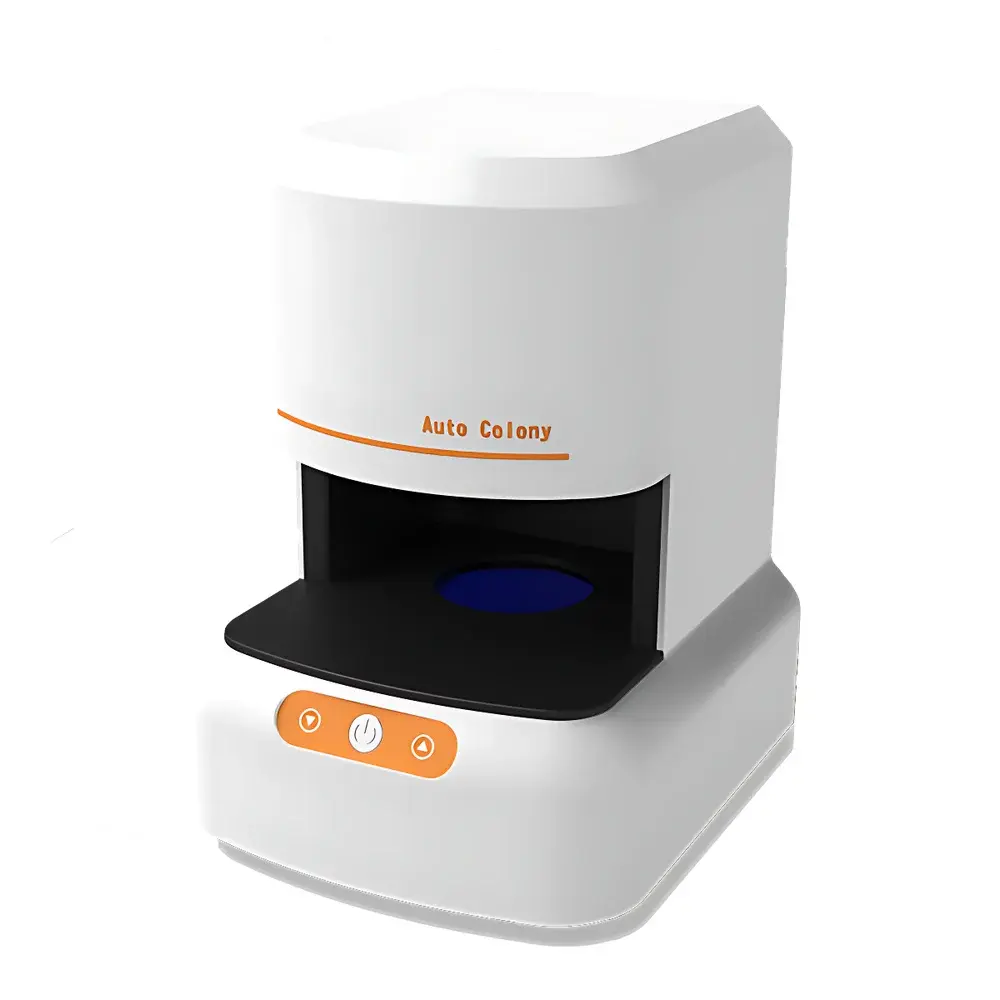
HengAo HCC-90A Fully Automated Colony Counter
| Brand | Tianjin HengAo |
|---|---|
| Origin | Tianjin, China |
| Manufacturer Type | Direct Manufacturer |
| Instrument Type | Fully Automated Colony Counter |
| Counting Speed | < 0.5 s per image |
| Data Export Format | Excel (.xlsx) |
| User Interface | Touchscreen-Controlled Software Platform |
| Compliance | Designed for ISO 4833-1:2013, ISO 7218, FDA Bacteriological Analytical Manual (BAM), and USP <61>/<62> microbiological testing workflows |
Overview
The HengAo HCC-90A Fully Automated Colony Counter is an optical imaging-based microbiological enumeration system engineered for precision, repeatability, and regulatory alignment in routine and high-throughput microbial colony quantification. It operates on digital image analysis principles: high-resolution monochrome or RGB top-down illumination captures Petri dish images, followed by algorithmic segmentation using adaptive thresholding, edge detection, and morphological filtering. The system distinguishes viable colonies from debris, condensation droplets, scratches, or agar imperfections through multi-parameter pixel intensity and spatial feature analysis — eliminating manual subjectivity while maintaining traceability per GLP and GMP documentation requirements.
Key Features
- Sub-0.5-second image acquisition and analysis cycle per standard 90 mm Petri dish — enabling throughput of up to 120 plates per hour in batch mode
- Integrated touchscreen interface with intuitive navigation; no physical control buttons on the instrument chassis — minimizing mechanical wear and enhancing long-term operational reliability
- Multi-color colony annotation: users assign distinct color tags (e.g., red for Escherichia coli, green for Staphylococcus aureus) to differentiate morphotypes or selective media outcomes
- Intelligent colony separation algorithms for touching or confluent colonies, leveraging watershed segmentation and convex hull reconstruction
- Background subtraction engine that dynamically corrects for uneven illumination, agar opacity gradients, and plate edge artifacts
- Region-of-interest (ROI) zoom function supporting real-time 2× to 8× digital magnification for morphological verification without re-imaging
- One-click export of count results, coordinates, size distribution histograms, and annotated images directly to Microsoft Excel (.xlsx) with timestamped metadata
Sample Compatibility & Compliance
The HCC-90A accommodates standard 90 mm and 100 mm Petri dishes (including polystyrene, polypropylene, and glass-bottom variants), as well as membrane filter assemblies on sterile pads. It supports both pour-plate and spread-plate methodologies across common microbiological media — nutrient agar, TSA, VRBA, PCA, MRS, Sabouraud dextrose agar, and chromogenic formulations. Validation protocols align with ISO/IEC 17025 laboratory accreditation criteria. The software architecture supports audit trail generation (user ID, timestamp, parameter changes, result edits) compliant with FDA 21 CFR Part 11 when deployed with network authentication and electronic signature modules. Routine use meets ISO 4833-1:2013 (horizontal method for microbiology — enumeration of microorganisms — colony count at 30 °C) and ISO 7218 (microbiology of food and animal feeding stuffs — general requirements and guidance for microbiological examinations).
Software & Data Management
The proprietary HCC-Soft v3.2 platform runs on embedded Windows IoT OS, ensuring deterministic response times and immunity to third-party application interference. All image processing parameters — contrast enhancement, noise reduction kernel size, minimum/maximum colony area thresholds, circularity filters, and color channel weighting — are user-configurable and savable as method templates. Each saved assay includes full DICOM-like header metadata: plate ID, operator, date/time, incubation conditions (if manually entered), medium type, dilution factor, and pass/fail flags per ISO-defined acceptance criteria. Raw images and processed overlays are stored in lossless PNG format with embedded EXIF tags. Local database logging enables trend analysis across batches, shifts, or analysts — supporting internal QC review and external inspection readiness.
Applications
The HCC-90A serves as a core enumeration tool in quality control laboratories across regulated industries. In food and beverage manufacturing, it supports shelf-life studies, raw material screening, and environmental monitoring per HACCP and FSMA requirements. For water utilities and wastewater treatment facilities, it streamlines compliance reporting under EPA Method 9215 (heterotrophic plate count) and ISO 9308-1. Clinical microbiology labs utilize it for rapid colony enumeration in urine culture workflows (e.g., ≥10⁵ CFU/mL thresholds), wound swab analysis, and antimicrobial susceptibility test plate reading. Pharmaceutical QA/QC teams apply it during sterility test filtration validation, bioburden assessment of non-sterile products (USP ), and environmental monitoring of Grade A/B cleanrooms (ISO 14644-1). Its flexibility also extends to academic research involving mutant strain isolation, biofilm dispersal assays, and antibiotic gradient plate analysis.
FAQ
Does the HCC-90A support dual-channel fluorescence imaging?
No — the HCC-90A is optimized for visible-light reflectance imaging only. Fluorescent colony detection requires dedicated UV/blue excitation hardware and emission-filtered sensors, which are not integrated into this model.
Can counting methods be validated according to ISO 17994?
Yes — the system provides full traceability of image acquisition settings, algorithm parameters, and operator actions, enabling formal method validation against reference plate counts per ISO 17994 (microbiology — validation of alternative methods for enumeration of microorganisms).
Is remote software update capability available?
Firmware and software updates are delivered via encrypted USB drive or secure HTTPS download through authorized HengAo support portals — no unsecured OTA functionality is implemented to preserve data integrity and regulatory compliance.




